


















Lesson 30 of 45 · Fungi and Parasites
Chapter 6 review: Fungi and parasites
Review fungi, protozoa and helminths in one comparison picture and table, practice drug targets and life cycle order, and take a ten-question quiz.
The three groups in this chapter are very different organisms, but they pose the same basic problems. They are eukaryotes, so they are close relatives of their hosts. They often need an elaborate route between hosts, such as spores in the air, cysts in water, or a mosquito. And they are treated with a small set of drugs that exploit the few differences that exist.
This review puts the groups side by side so that you can compare them. Learn the table, then practice putting the stages of the malaria life cycle in order, matching drugs to their targets and testing yourself with the quiz.
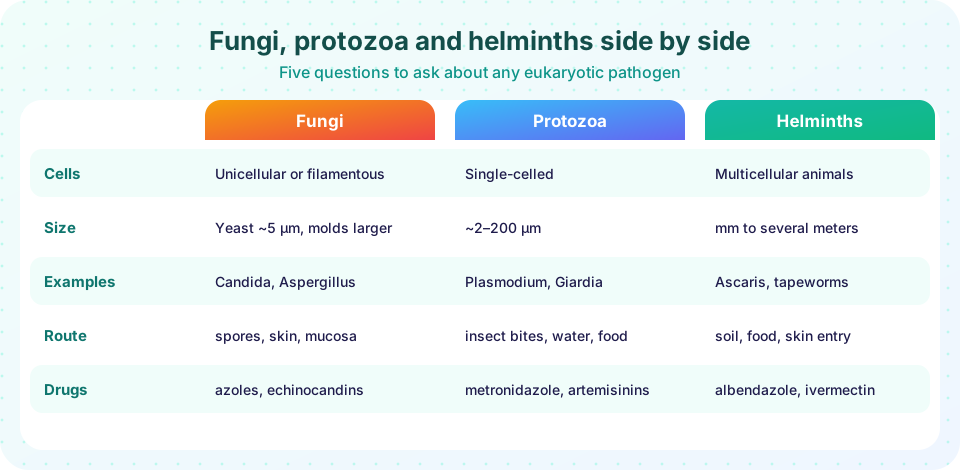
The chapter at a glance
| Question | Fungi | Protozoa | Helminths |
|---|---|---|---|
| What are they? | single cells (yeasts) or hyphae (molds) | single-celled eukaryotes | multicellular worms |
| Wall or covering | chitin and glucan wall | no wall (some form cysts) | cuticle or tegument |
| How do they feed? | absorb after external digestion | engulf or absorb | absorb or ingest host tissues and blood |
| Spread by | spores, direct contact | cysts in food and water, insect vectors | eggs, larvae, snails, undercooked meat |
| Typical diseases | thrush, ringworm, aspergillosis | malaria, giardiasis, sleeping sickness | roundworm, tapeworm, schistosomiasis |
| Drugs | polyenes, azoles, echinocandins | artemisinins, metronidazole | albendazole, ivermectin, praziquantel |
Remember three links with earlier chapters. First, the fungal sterol ergosterol and the glucan cell wall are the targets that make antifungal treatment possible. Second, the malaria life cycle involves two hosts and several forms, so a break at any step can reduce disease. Third, any parasite or fungus is easiest to control where sanitation and clean water are in place, which links to the chain of infection in the next chapter.
Putting it together: a case to reason through
Here is a teaching scenario, written for practice and not as a diagnostic guide. A traveler returns from a region where malaria is common and, some days later, develops fever and chills that return in waves. What does the biology of the last two lessons tell you?
The repeating waves match the synchronized bursting of infected red blood cells, so the first idea is a blood-stage Plasmodium infection. The time between waves would help a laboratory narrow down the species, and a stained blood smear or a rapid test would confirm it, because the parasite is visible inside red cells. The mosquito that infected the traveler was a female Anopheles, and the infection could not pass directly to a neighbor in ordinary contact. If the species were P. vivax, treatment would also need to consider the dormant liver hypnozoites that can cause relapse months later. Prevention for future travel follows the life cycle: avoid bites with nets and repellents, and ask a doctor about preventive drugs.
Now change the story to a different organism. A person on long-term immunosuppressive treatment develops pneumonia, and a fungus is found. The reasoning shifts to opportunistic infection, to inhaled spores as the portal of entry, and to drugs that hit ergosterol or glucan in the wall. A third story: a child in a village without clean water has chronic abdominal pain and eggs are found in stool. The reasoning shifts again, to a helminth, to the fecal–oral route or skin penetration by larvae, and to sanitation, shoes and anthelmintic drugs.
Linking structure to treatment
Every drug in this chapter makes sense once you recall the biology. Amphotericin B binds ergosterol, so it targets fungal membranes. Caspofungin blocks glucan synthesis, so it targets the fungal wall. Albendazole binds tubulin of the worm, ivermectin hits nerve and muscle channels, and artemisinin works inside the red cell. When you meet a new drug, ask what cellular feature it is aimed at, and whether the human host has the same feature. The answer predicts both the activity and the side effects.
Try it
The first demonstration is a drug-target flashcard in the console. It shuffles a set of drugs, prints a question and then the answer. Extend the list yourself.
Press Run (or Ctrl + Enter) to see the console output here.
No output.
The second demonstration checks the order of the malaria life cycle. Run it, then change the student_order list to practice.
Press Run (or Ctrl + Enter) to see the result here.
Program input · what you'd type while the program runs
Type the answers before you press Run, one per line. Each time the program reads a line (with input()), it gets the next line from this box.
Check your understanding
Quick check · 10 questions
of 10 answered You scored / 10 · perfect!
-
1. Which pair correctly matches a drug with its target?
Amphotericin B binds ergosterol; fluconazole blocks ergosterol synthesis; albendazole binds worm tubulin. -
2. Which type of pathogen has no cell wall and often moves with flagella, cilia or pseudopods?
Protozoa are wall-less single-celled eukaryotes. -
3. Which statement about yeast is correct?
Budding is the usual way yeasts divide. -
4. Which of these is a trematode?
Schistosomes are blood flukes, and flukes are trematodes. -
5. Why does P. vivax infection sometimes relapse months after treatment of the blood stage?
Hypnozoites are dormant liver forms that wake later. -
6. What is the main reason an AIDS patient may get Pneumocystis pneumonia?
Opportunistic fungi mainly cause disease when the immune system is impaired. -
7. What is the difference between a definitive host and an intermediate host?
Definitive hosts support maturity or sexual reproduction; intermediate hosts support developing stages. -
8. Mold hyphae together are called a:
A mycelium is a mass of hyphae that forms the feeding body. -
9. What fungal structure is targeted by the echinocandin drugs?
Echinocandins block glucan synthase, which humans lack because we have no cell wall. -
10. Which control measure targets the vector in malaria?
Nets prevent bites and kill mosquitoes.
Summary
- Fungi, protozoa and helminths are eukaryotes, so treatment must use small differences from human cells.
- Fungal drugs hit ergosterol and the glucan wall; antiparasitic drugs hit parasite-specific enzymes and channels.
- Spread depends on spores, cysts, eggs and larvae, or vectors such as mosquitoes and snails.
- Life cycles show where control can work: nets, sanitation, cooking and drugs.
Track your progress
Create a free account to tick off lessons and pick up where you left off on any device.
of Microbiology lessons completed