


















Lesson 45 of 45 · Projects and Practice
Where to go next after microbiology
Plan your next steps after microbiology: related tracks in immunology, molecular biology, biochemistry, pathology, pharmacology and public health, plus careers and habits.
You have now met the microbial world from the smallest viruses to the largest parasitic worms, followed pathogens through infection and immunity, and seen how microbes feed us, heal us and keep the planet running. This final lesson is about what comes next: how microbiology connects to other subjects, which careers and projects it opens, and how to keep learning in a way that sticks.
Microbiology is rarely a destination on its own. It is a crossroads where genetics, chemistry, medicine, ecology and data science all meet. Wherever you want to go, you will find a path that starts here.
What you will learn
- Which subjects extend the ideas of this course, and how
- What kinds of careers and projects use microbiology
- How to keep the knowledge fresh with active study habits
- Where this course connects to other tracks on this site
Key terms
Interdisciplinary: combining methods and ideas from more than one field.
One Health: the approach that links human, animal and environmental health.
Spaced repetition: reviewing material at increasing intervals to remember it longer.
Active recall: testing yourself instead of re-reading.
Capstone project: a larger piece of work that applies many skills at once.
Neighboring subjects
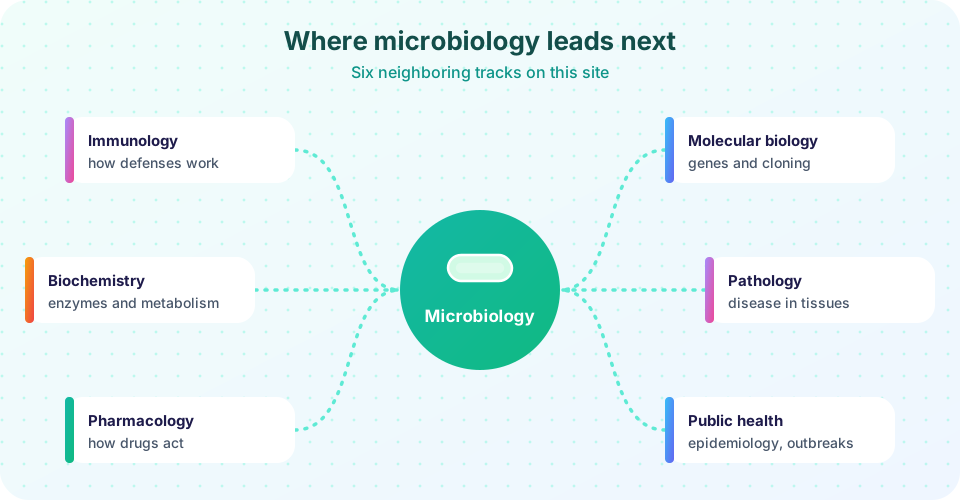
Immunology. This course covered the immune system in one lesson. The immunology track goes deeper: how antibody diversity is generated, how T cells are educated, how vaccines are designed and why the immune system sometimes attacks the body itself. If you were fascinated by memory and vaccines, start here.
Molecular biology. Phage cycles, plasmids, recombinant insulin and CRISPR all rest on DNA, RNA and protein. The molecular biology track explains replication, transcription, translation, gene regulation and the tools of genetic engineering that make modern microbiology possible.
Biochemistry. Fermentation, nitrogen fixation, antibiotic mechanisms and nitrification are all chemistry. The biochemistry track covers enzymes, metabolic pathways and energy, so you can see why a drug binds its target and how a cell controls its flux.
Pathology. When a pathogen invades, tissues change. The pathology track describes inflammation, tissue damage and healing, which complements the pathogenesis you studied in chapter 7.
Pharmacology. Antibiotics, antivirals and antifungals are drugs. The pharmacology track explains how a drug is absorbed, distributed and removed, how dose and effect are related and how side effects arise.
Public health and epidemiology. The chain of infection, R₀, herd immunity and the SIR model all belong to epidemiology. The public health and epidemiology track shows how outbreaks are investigated, how risk is measured and how interventions are evaluated.
Other tracks extend particular lessons. The bioinformatics track teaches how genomes of microbes and viruses are sequenced, assembled and compared. The food science track goes further into preservation, processing and safety. The climate science track covers the carbon and nitrogen cycles at planet scale, and the statistics and probability track provides the tools behind the dose-response curves, Poisson counts and sampling that appear throughout microbiology.
A good plan is to pick one neighboring subject, work through its first chapters, and keep a notebook of questions that cross between the two. Often a question that was unclear in one subject is answered in the other: how does a bacterial enzyme choose its substrate (biochemistry), how does the immune system recognize that enzyme (immunology), and how would you track a resistance gene across a hospital (bioinformatics and epidemiology)?
What you can do with microbiology
- Healthcare and diagnostics. Clinical microbiologists identify the cause of infections and test antibiotic susceptibility; infection control teams stop hospital outbreaks.
- Public health. Epidemiologists and laboratory scientists detect and investigate outbreaks, run vaccination programs and track resistance.
- Biotechnology and industry. Fermentation scientists and bioprocess engineers make medicines, enzymes and foods; synthetic biologists design new organisms.
- Food and agriculture. Food microbiologists keep products safe; soil microbiologists improve crops and soil health.
- Environment. Environmental microbiologists work on water quality, wastewater plants, pollution cleanup and climate research.
- Research. Microbes are model organisms for genetics, evolution and cell biology; new phages, antibiotics and vaccines are all still being discovered.
A related idea is One Health: many diseases pass between animals and people, and the same antibiotics are used in clinics and farms, so human, animal and environmental health are tied together. Microbiologists, doctors, veterinarians and ecologists increasingly work in teams.
Project ideas
Real hands-on work needs a laboratory and proper safety training, so the projects below are all safe, desk-based or kitchen-based ones. Always follow local rules and ask a teacher or supervisor before experimenting with microbes.
- Model an outbreak. Extend the SIR model from chapter 9 to an SEIR model, and compare it with published outbreak curves.
- Analyze a genome. Use the bioinformatics track to compare the sequences of two related viruses.
- Write a briefing. Explain antibiotic resistance for a non-scientist audience in one page, with one diagram.
- Design a fair test. Plan, on paper, an experiment to compare two hand-washing methods, listing the controls, the measurements and the statistics you would use.
- Safe kitchen fermentation. With an adult, make a simple yogurt or sourdough following a trusted recipe, and record temperature, time and taste.
Study habits that work
Understanding fades unless you use it. Three habits help most. Active recall: close the book and write down what you remember about a lesson, then check. Spaced repetition: review the glossary and the formula sheet after one day, one week and one month. Teaching: explain the chain of infection or the nitrogen cycle to somebody else, because gaps appear when you try to say it out loud. Combine these with the practice set, and rebuild one simulation from scratch without looking at the code.
Common misconceptions
"I have finished microbiology." This course is a foundation. Each chapter is a field of its own, and new discoveries arrive every year.
"Microbiology is only for people who want to be doctors." It is used in industry, agriculture, the environment, food, data science and policy, as well as in medicine.
"Reading is enough." Practice, calculation and teaching are what turn information into skill.
Try it
The first demonstration is a study-path picker. Choose an interest and it suggests the next tracks. Edit the lists to match your own plans.
Press Run (or Ctrl + Enter) to see the console output here.
No output.
The second demonstration is a simple spaced-repetition planner. It prints the review dates for a topic, using intervals that grow, so that you can plan your revision.
Press Run (or Ctrl + Enter) to see the result here.
Program input · what you'd type while the program runs
Type the answers before you press Run, one per line. Each time the program reads a line (with input()), it gets the next line from this box.
Check your understanding
Quick check · 4 questions
of 4 answered You scored / 4 · perfect!
-
1. Which neighboring subject would deepen your understanding of how drugs are absorbed and removed?
Pharmacology covers drug action, dose and effect, and the movement of drugs through the body. -
2. Which approach helps memory most?
Testing yourself at growing intervals strengthens recall more than passive review. -
3. What is the One Health idea?
Many diseases and resistance genes move between people, animals and the environment. -
4. Which track would help you understand the statistics behind dose-response and Poisson counts?
Probability distributions and estimation underlie many microbiology calculations.
Summary
- Microbiology connects to immunology, molecular biology, biochemistry, pathology, pharmacology and public health.
- Careers include diagnostics, public health, biotechnology, food, environment and research.
- Safe project ideas include modeling, genome comparison, writing, test design and kitchen fermentation with an adult.
- Active recall, spaced repetition and teaching keep knowledge fresh.
Track your progress
Create a free account to tick off lessons and pick up where you left off on any device.
of Microbiology lessons completed