


















Lesson 15 of 45 · Bacterial Structure and Growth
Growth Conditions and Control of Microbes
Learn how oxygen, pH, water activity and nutrients shape bacterial growth, and how heat, filtration, radiation, disinfectants and antibiotics control microbes.
Growth is not automatic. Even the fastest-growing bacterium multiplies only if its environment supplies the right food, the right temperature, the right acidity, the right amount of water and, depending on the species, the right amount of oxygen. Change any one and growth slows or stops. That single idea explains two huge areas of practical work. In the laboratory and in medicine we create the right conditions to grow microbes we want to study. In kitchens, hospitals and factories we do the opposite: we remove one of the conditions on purpose to stop the microbes we do not want.
This lesson first describes the main physical and chemical conditions for growth, then the toolbox for controlling microbes: heat, filters, radiation, chemicals and antibiotics. You will see how to calculate the effect of heat, a calculation that decides how long a can of food must be cooked.
What you will learn
- How oxygen, pH, temperature and water activity limit growth.
- The five oxygen classes and why oxygen can be toxic.
- The difference between sterilization, disinfection and antisepsis.
- How heat kills microbes and how to use D-values in calculations.
- The main classes of antibiotics and their targets.
Key terms
Obligate anaerobe: a microbe that cannot grow when oxygen is present.
Water activity (aw): a measure of available water, from 0 (dry) to 1 (pure water).
Sterilization: the destruction or removal of all life forms, including endospores.
Disinfection: reducing harmful microbes on objects, usually with chemicals; it does not necessarily kill spores.
Bactericidal / bacteriostatic: killing bacteria / only preventing their growth.
Oxygen
Oxygen is a double-edged molecule. It lets cells extract far more energy from food (see Fermentation and Respiration), but its by-products are dangerous: superoxide (O₂⁻) and hydrogen peroxide (H₂O₂) damage proteins, lipids and DNA. Organisms that live with oxygen carry enzymes that neutralize these products: superoxide dismutase converts superoxide to hydrogen peroxide, and catalase converts hydrogen peroxide to water and oxygen (2 H₂O₂ → 2 H₂O + O₂). Bubbles when you drip hydrogen peroxide onto a culture show that catalase is present (the catalase test).
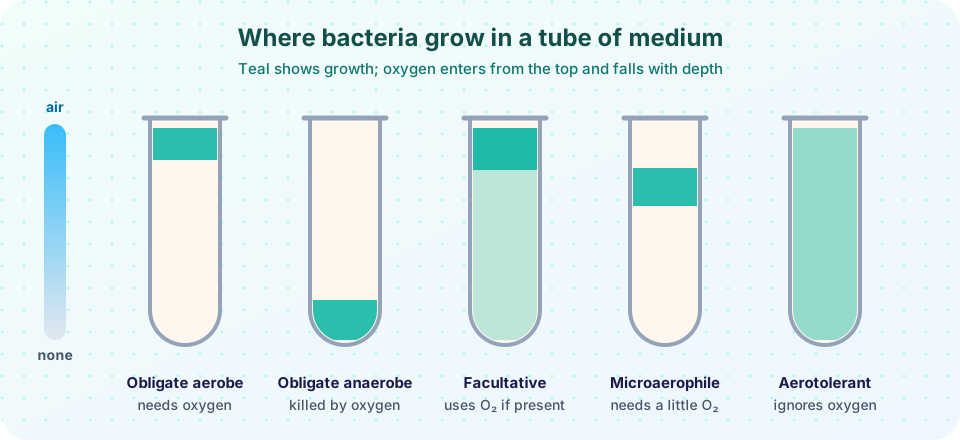
Microbes fall into five oxygen classes (see the tubes in the picture):
| Class | Oxygen relation | Typical enzymes | Example |
|---|---|---|---|
| Obligate aerobe | requires O₂ for respiration | SOD and catalase | Mycobacterium tuberculosis, Pseudomonas aeruginosa |
| Obligate anaerobe | killed by O₂ | little or no SOD or catalase | Clostridium species, Bacteroides |
| Facultative anaerobe | uses O₂ if present, otherwise ferments or respires without it | SOD and catalase | E. coli, Staphylococcus |
| Microaerophile | needs low O₂ (about 2 to 10%) | limited tolerance | Campylobacter, Helicobacter pylori |
| Aerotolerant anaerobe | does not use O₂ but is not harmed | SOD but no catalase | Streptococcus species, lactic acid bacteria |
Anaerobes matter in medicine because deep wounds, abscesses and the gut have little oxygen. Anaerobic cultures are done in sealed jars or chambers filled with nitrogen and hydrogen.
pH, water and nutrients
pH. Most bacteria are neutrophiles with an optimum between pH 6.5 and 7.5, and they pump protons in or out to keep the cytoplasm near neutral. Acidic foods (below pH 4.6) prevent Clostridium botulinum spores from germinating, which is why pickled and fruit foods can be canned in boiling water, while low-acid foods such as beans and meat need a pressure cooker. Fermentation itself lowers the pH, protecting yogurt and sauerkraut.
Water activity. Microbes need available water. Salt and sugar bind water; high concentrations draw it out of cells by osmosis. Most bacteria need aw above about 0.90, some such as Staphylococcus aureus tolerate about 0.86, and many molds and yeasts grow down to 0.6 to 0.8. That is why jams, honey and dried meats keep for months: drying and salting lower aw below the level at which common bacteria can grow, although molds may still appear.
Nutrients. Cells need carbon, nitrogen, phosphorus, sulfur and many trace elements (iron, zinc, magnesium), and some need extra growth factors, such as certain vitamins or amino acids, that they cannot make for themselves. Iron is so scarce in the human body that pathogens release iron-grabbing molecules (siderophores), and the body in turn hides its iron.
Controlling microbes: the vocabulary
| Term | Meaning |
|---|---|
| Sterilization | all life, including endospores, is destroyed or removed |
| Disinfection | harmful microbes on objects reduced (typically by chemicals) |
| Antisepsis | chemicals on living tissue to reduce microbes |
| Sanitization | reducing microbes to a safe level, for example on eating utensils |
| Bactericidal / bacteriostatic | kills / prevents growth, which may resume when the agent is removed |
Heat
Heat is the most reliable way to kill microbes. It denatures proteins and damages membranes, and moist heat works faster than dry heat because water carries heat into cells.
- Autoclave: saturated steam at 121 °C (about 15 psi above atmospheric pressure) for 15 to 20 minutes sterilizes most laboratory media and equipment, including endospores. Pressure is needed only because it raises the boiling point of water.
- Boiling: 100 °C kills most vegetative bacteria, viruses and fungi within minutes but not all spores.
- Dry heat: an oven at 160 to 170 °C for about 2 hours for glassware and metal instruments.
- Pasteurization: a controlled mild heat that kills pathogens and many spoilage organisms without spoiling taste. Milk is usually held at 72 °C for 15 seconds (high-temperature short-time) or at 63 °C for 30 minutes (batch); ultra-high-temperature milk is heated at 135 to 140 °C for a few seconds, giving a long shelf life. Pasteurization does not sterilize.
D-values: how fast does heat kill?
Microbes die at a constant fraction per unit time at a given temperature, so survivors decline exponentially. The decimal reduction time D is the time at a given temperature to kill 90% of the population, i.e. one log reduction. Then
N = N₀ × 10^(−t / D) or t = D × log₁₀(N₀ / N).
The food industry designs canning so that the spores of C. botulinum are reduced by 12 logs (the "botulinum cook" or 12D). If D at 121 °C is roughly 0.2 minutes for these spores, 12 D is about 2.4 minutes at 121 °C, and real processes add a safety margin. The values in the code below are illustrative, not safety data for real food.
Press Run (or Ctrl + Enter) to see the result here.
Program input · what you'd type while the program runs
Type the answers before you press Run, one per line. Each time the program reads a line (with input()), it gets the next line from this box.
Other physical methods
- Filtration: liquids that cannot be heated (vaccines, some drugs) pass through membrane filters with pores of 0.22 µm that trap bacteria, though not viruses. Air in laboratory safety cabinets passes through HEPA filters.
- Radiation: ultraviolet light near 260 nm is absorbed by DNA and causes thymine dimers that block replication; it disinfects surfaces and air but does not penetrate far. Ionizing radiation (gamma rays, electron beams) sterilizes packaged items such as syringes.
- Cold and drying: refrigeration at about 4 °C slows most growth but does not kill; some bacteria (Listeria) grow slowly even in the refrigerator. Freezing stops growth and kills some cells, but does not sterilize. Drying and freeze-drying preserve food and cultures.
Chemical agents
No chemical agent is best in every situation. Alcohols (60 to 90% ethanol or isopropanol) denature proteins and dissolve membrane lipids, and are fast but do not kill spores. Chlorine (bleach) and iodine are oxidizers that work well on a wide range of microbes, including many spores at high concentration. Phenolics and quaternary ammonium compounds are used on surfaces, hydrogen peroxide produces reactive oxygen, glutaraldehyde and ethylene oxide gas sterilize heat-sensitive medical devices. Effectiveness depends on concentration, contact time, temperature and the presence of organic matter such as blood, which can neutralize the chemical.
Antibiotics: selective toxicity
An antibiotic is a substance made by microbes (or made synthetically) that kills or inhibits bacteria. The aim is selective toxicity: harm the pathogen and not the patient. That works best when the target exists only in bacteria.
| Target | Examples | How they work |
|---|---|---|
| Cell wall synthesis | penicillins, cephalosporins, vancomycin | block cross-linking of peptidoglycan |
| Protein synthesis (30S) | tetracyclines, aminoglycosides | bind the small ribosomal subunit |
| Protein synthesis (50S) | macrolides, chloramphenicol | bind the large ribosomal subunit |
| Nucleic acid synthesis | fluoroquinolones, rifampin | block DNA gyrase / RNA polymerase |
| Folate metabolism | sulfonamides, trimethoprim | block steps in a vitamin pathway that bacteria must make themselves |
| Membrane | polymyxins | disrupt the Gram-negative outer membrane |
The lowest concentration that prevents visible growth is the minimum inhibitory concentration (MIC). Overuse of antibiotics selects resistant bacteria, a story told in Chapter 4 and Chapter 7.
Common misconceptions
"Boiling sterilizes." Boiling kills vegetative cells but spores can survive; sterilization needs 121 °C steam under pressure.
"Alcohol hand gel kills everything." It is effective against many bacteria and enveloped viruses, but not against spores such as C. difficile.
"Antibiotics work on viruses." They target bacterial structures (walls, ribosomes, enzymes) that viruses lack.
"Pasteurized means sterile." Pasteurization reduces pathogens, but spores and some spoilage microbes survive.
Check your understanding
Quick check · 5 questions
of 5 answered You scored / 5 · perfect!
-
1. An organism grows throughout a thioglycolate tube, but most densely at the top. It is...
Facultative anaerobes grow with or without oxygen but do best with it, so growth is densest at the top. -
2. Which enzyme converts hydrogen peroxide into water and oxygen?
Catalase breaks down H₂O₂. Bubbling when peroxide is added indicates catalase. -
3. If the D-value is 0.5 min, how long does a 6-log reduction take?
t = D × number of logs = 0.5 × 6 = 3 min. -
4. Which method sterilizes a heat-labile vaccine solution?
Filters physically remove bacteria without heat (viruses may pass, so other steps are also used). -
5. Why is a drug that blocks peptidoglycan synthesis relatively safe for humans?
This is selective toxicity: the drug targets a structure only bacteria have.
Summary
- Growth needs suitable oxygen, pH, temperature, water activity and nutrients. Oxygen classes: obligate aerobe, obligate anaerobe, facultative, microaerophile and aerotolerant.
- Superoxide dismutase and catalase protect cells from toxic oxygen products.
- Sterilization kills everything including spores; disinfection and antisepsis only reduce microbes.
- Heat kills exponentially:
t = D × log₁₀(N₀/N). Autoclaves use steam at 121 °C; pasteurization is milder. - Filters, UV light, ionizing radiation, drying and chemicals each have a place; antibiotics exploit targets present in bacteria but not in us.
Track your progress
Create a free account to tick off lessons and pick up where you left off on any device.
of Microbiology lessons completed