


















Lesson 7 of 45 · The Microbial World
Three Domains and Classification
How microbes are named and classified: binomial names, taxonomic ranks, the 16S rRNA tree, the three domains, and the endosymbiotic origin of mitochondria.
For two thousand years people sorted life into plants and animals. Microscopes broke that scheme: where does a swimming green single-celled organism belong, or a mold, or a bacterium that does not have a nucleus? Biologists tried more kingdoms, and in 1969 Robert Whittaker proposed five (animals, plants, fungi, protists and monerans, the last for all prokaryotes). Then in 1977 Carl Woese and George Fox found that the monerans were not one group at all.
This lesson explains how microbes are named, how they are ranked, and why the modern tree has three domains instead of two or five. It also tells the story of how our own cells came to contain captured bacteria.
What you will learn
- How to write a scientific name correctly and why binomial names exist.
- The taxonomic ranks, from domain to species.
- Why ribosomal RNA is used to build the tree of life.
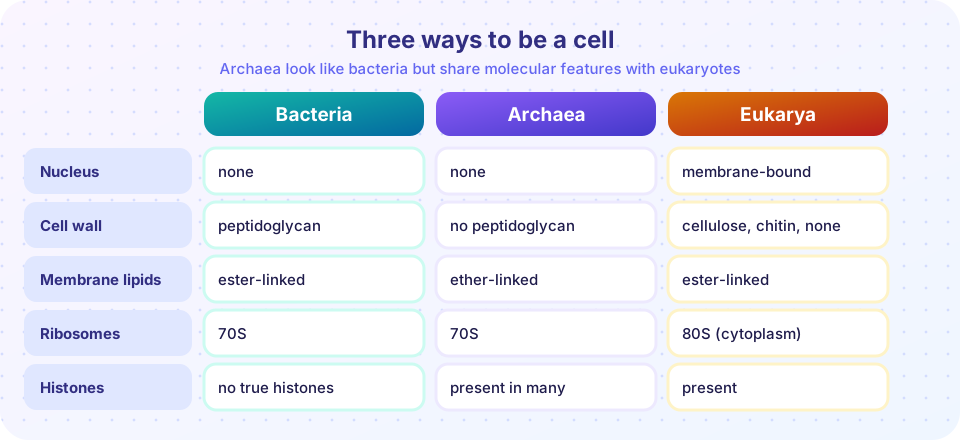
- The main differences between Bacteria, Archaea and Eukarya.
- The endosymbiotic theory and its evidence.
Key terms
Binomial nomenclature: a two-part Latin name, genus then species, such as Escherichia coli.
Taxon (plural taxa): any named group in classification, at any rank.
16S rRNA: the RNA component of the small ribosomal subunit in prokaryotes; its gene is used to compare species.
Strain: a population within a species derived from one isolate, often with a particular trait.
Endosymbiosis: one organism living inside another to the benefit of both.
Naming microbes
Carl Linnaeus introduced the two-part naming system in the 1700s. Every species gets a genus name (capitalized) and a species epithet (lowercase), both italicized or underlined. After the first full use, the genus is abbreviated to its first letter: Staphylococcus aureus becomes S. aureus. The pair is unique to one species, and unlike common names it means the same in every country. "Strep throat" may be called something else in another language, but Streptococcus pyogenes is understood by scientists everywhere.
Names often describe the organism: Staphylococcus (from Greek, "bunch of grapes" cocci), aureus (golden); Escherichia honors Theodor Escherich, who discovered the bacterium. Names of higher ranks (such as the family Enterobacteriaceae) are capitalized but not italicized.
Ranks
Linnaean classification nests groups inside groups, like folders inside folders. The main ranks, from the broadest to the narrowest, are:
Domain > Phylum > Class > Order > Family > Genus > Species
For example, Escherichia coli: Domain Bacteria, Phylum Pseudomonadota (formerly Proteobacteria), Class Gammaproteobacteria, Order Enterobacterales, Family Enterobacteriaceae, Genus Escherichia, species coli. Phylum names were updated in 2021, so older books say Proteobacteria. Names change as new data come in; taxonomy is a living field.
What counts as a "species" among bacteria is awkward, because they reproduce asexually and swap genes. In practice, two isolates are usually assigned the same species when their 16S rRNA genes are at least about 98.7% identical and, for genome comparisons, when their average nucleotide identity (ANI) is about 95% or more. These are conventions that guide decisions, not laws of nature.
Below the species: strains and serotypes
Names stop at the species, but medicine often needs finer detail. A strain is a population descended from a single isolate, and different strains of one species can behave very differently. Escherichia coli is a good example. Most strains live harmlessly in the gut, and the K-12 laboratory strain is a workhorse of genetics, but the strain labelled O157:H7 carries a phage-borne gene for Shiga toxin and can cause severe food-borne illness. The letters and numbers describe a serotype: which versions of the surface sugar (O antigen) and the flagellar protein (H antigen) the cell carries. When you see a name with extra letters after the species, you are looking at a strain or serotype, and you should not assume that it behaves like the rest of the species.
Why ribosomal RNA?
How do you build a family tree for organisms that share almost no visible features? Woese reasoned that you need a molecule found in every cell, with a function so essential that it changes slowly. The ribosome is such a machine, and the RNA in its small subunit (16S rRNA in prokaryotes, 18S in eukaryotes) has some regions that are nearly identical across life and others that vary. By aligning sequences and counting differences, you can estimate how long ago two lineages diverged.
The tree this produced had three main branches: Bacteria, Archaea and Eukarya. The surprise was that the archaea, which look like bacteria down the microscope, were as distinct from them as from us.
Many later analyses of other genes agree that archaea and eukaryotes are closer relatives than either is to bacteria. In fact, the eukaryotic machinery for copying DNA and making RNA looks like a more elaborate version of the archaeal one. Most researchers now think the first eukaryote arose from within the archaea, with the Asgard group a leading candidate relative, although details are still under debate.
Press Run (or Ctrl + Enter) to see the result here.
Program input · what you'd type while the program runs
Type the answers before you press Run, one per line. Each time the program reads a line (with input()), it gets the next line from this box.
Endosymbiosis: how eukaryotic cells got their organelles
Mitochondria and chloroplasts look like bacteria in miniature. In 1967 Lynn Margulis (then Lynn Sagan) championed an old idea and gave it strong support: the endosymbiotic theory. About two billion years ago, an ancestral host cell engulfed an aerobic bacterium related to today's alphaproteobacteria and kept it alive. The guest ended up as the mitochondrion, supplying energy. Later, one eukaryotic lineage took in a cyanobacterium, which became the chloroplast in algae and plants.
Evidence includes the following:
- Both organelles have a double membrane, consistent with engulfment.
- They have their own circular DNA, with genes closely related to bacterial ones.
- They have 70S ribosomes like bacteria, not the 80S ribosomes of the eukaryotic cytoplasm.
- They divide by binary fission, independently of the cell's own division cycle.
- Some antibiotics that target bacterial ribosomes also affect mitochondrial protein synthesis, which explains certain side effects.
Where do viruses fit?
Viruses have no ribosomes and no genes in common that all of them share, so there is no rRNA tree for them. They are classified separately, by the International Committee on Taxonomy of Viruses, using genome type, shape and other traits. Chapter 5 returns to them.
Common misconceptions
"Archaea are just strange bacteria." They are a separate domain with different membrane lipids, different cell wall chemistry and a transcription machinery similar to eukaryotes.
"The tree of life is settled." The three-domain view is widely accepted, but whether eukaryotes arose beside or within the archaea is still researched. Gene transfer between microbes also makes parts of the tree look more like a web.
"A species is a clear-cut natural unit." For bacteria, species boundaries are drawn by agreed thresholds of genetic similarity.
Check your understanding
Quick check · 4 questions
of 4 answered You scored / 4 · perfect!
-
1. Which is the correct way to write a scientific name?
The genus is capitalized, the species is lowercase, and both are italicized. -
2. Why is 16S rRNA useful for building the tree of life?
A universal, functionally constrained molecule lets you compare distant relatives. -
3. Which feature do archaea share with eukaryotes but not bacteria?
Many archaea have histones; bacteria do not have true histones. Archaea do not have a nucleus, and 70S ribosomes are shared with bacteria. -
4. Which is NOT evidence for the endosymbiotic origin of mitochondria?
Mitochondria have no cellulose wall. The other three features point to bacterial ancestry.
Summary
- Species are named with a binomial: genus capitalized, species lowercase, italicized.
- The ranks run Domain, Phylum, Class, Order, Family, Genus, Species.
- Ribosomal RNA comparison revealed three domains: Bacteria, Archaea, Eukarya, with archaea closer to eukaryotes.
- Mitochondria and chloroplasts descend from engulfed bacteria (endosymbiosis).
- Viruses are classified separately because they are not cells.
Track your progress
Create a free account to tick off lessons and pick up where you left off on any device.
of Microbiology lessons completed