


















Lesson 42 of 45 · Projects and Practice
Project: how antibiotic resistance evolves
Simulate how resistant bacteria take over under antibiotic treatment, test the cost of resistance, and repeat the Luria-Delbruck fluctuation test on a computer.
Resistance is often described as if bacteria "learn" to survive an antibiotic. The truth is different and more interesting: it is evolution by natural selection, observable in a few days. In this project you will model that process, first with a simple competition between a susceptible and a resistant strain, then with a computer version of one of the most elegant experiments in the history of biology, the 1943 fluctuation test of Salvador Luria and Max Delbrück.
Both models are deliberately simple. They show the logic of selection, not the details of any real drug or bacterium. As in all of this course, the simulations are demonstrations and not data from experiments.
What you will learn
- How selection turns a rare resistant mutant into the dominant strain
- Why resistance can have a fitness cost, and what that means for stopping a drug
- What the Luria–Delbrück experiment tested, and what its outcome showed
- How to use a stochastic simulation to compare two hypotheses
Key terms
Natural selection: differences in survival and reproduction that favor some variants over others.
Fitness cost: a reduction in growth rate that a resistance mutation can cause when the drug is absent.
Selective pressure: an environmental factor, such as an antibiotic, that favors some variants.
Fluctuation test: an experiment comparing the variance in mutant counts across parallel cultures with the mean.
Jackpot: a culture in which an early mutation yields a huge number of resistant descendants.
Part 1: selection under treatment
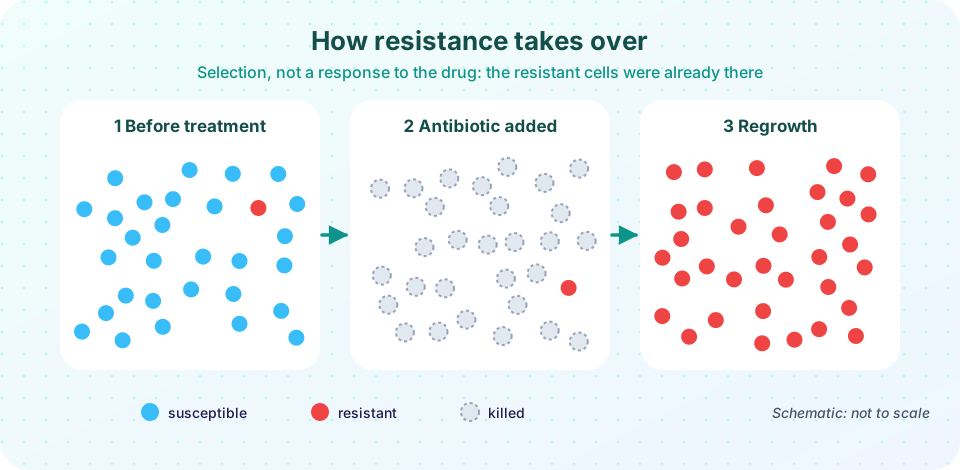
Imagine 10⁸ susceptible bacteria and, by chance mutation, only 100 resistant cells (one in a million). Both grow in a vessel with room for about 10⁹ cells. Resistance sometimes has a fitness cost: the altered target or the extra pumps slow growth a little. We assume the resistant strain grows 10 percent more slowly than the susceptible strain when no drug is present.
When a drug is added, it kills susceptible cells at a high rate but does not affect resistant cells. The resistant cells are now alone in a space that has just been cleared, so they grow without competition. After the drug stops, the culture is almost entirely resistant. Even though the resistant strain grows more slowly, it already has the whole population.
The first program simulates this with two equations that share a carrying capacity:
dS/dt = r_S × S × (1 − (S + R)/K) − kill(t) × S
dR/dt = r_R × R × (1 − (S + R)/K)
where kill(t) is positive only while the drug is present. The values are arbitrary, but the pattern would hold for many choices.
Part 2: the cost of resistance and stopping the drug
If a resistance mutation has a cost, stopping the drug lets the susceptible strain win back some space. How fast this happens depends on the size of the cost, and unfortunately costs are often small, or are later reduced by compensatory mutations. In the default run only a handful of susceptible cells survive the treatment, so by day 20 they are still a tiny minority, even though they grow faster. Try a cost of 0.3 and the survivors begin to recover, but the resistant strain still dominates. For this reason it is hard to make resistance "go away" simply by stopping a drug. The model lets you test this idea by changing the cost and by comparing a culture with no treatment.
Part 3: the Luria–Delbrück experiment
In the early 1940s a question divided biologists. When bacteria become resistant to a virus or a drug, is the resistance a response induced by the agent, so that any cell might adapt with some small probability on exposure, or a spontaneous mutation that occurs before exposure and is merely selected by the agent?
Luria, a microbiologist, and Delbrück, a physicist, devised a test based on statistics. Imagine growing many small, independent cultures from a few cells, and then spreading each entire culture on a plate containing phage and counting the surviving colonies.
- If resistance is induced after plating, every cell has the same small chance of becoming resistant, so the counts across cultures vary only by chance, following a Poisson distribution, whose variance is about equal to its mean.
- If resistance arises by spontaneous mutation during growth, then a mutation occurring early produces a large clone of resistant cells, while a late mutation produces few. Most cultures contain no mutants, and a few contain very many ("jackpots"). The variance is much larger than the mean.
The experiment gave counts with a huge variance, matching the spontaneous mutation hypothesis. Luria and Delbrück shared the 1969 Nobel Prize in Physiology or Medicine with Alfred Hershey for their work on the replication and genetics of viruses, and the fluctuation test is one of their best-known experiments. In 1952 Joshua and Esther Lederberg strengthened the conclusion with replica plating: they pressed a velvet pad onto a master plate of colonies grown without the drug and transferred copies to plates with the drug, and resistant colonies appeared at the same positions on each copy, showing that the resistant cells existed on the master plate before they ever met the drug.
The second program runs a version of the fluctuation test with a random number generator. It also explains why the antibiotic resistance problem is not caused by the antibiotic making mutations: they were already present.
Common misconceptions
"The antibiotic makes bacteria mutate into resistant forms." Resistance mutations arise spontaneously. The antibiotic selects the ones that exist. (Some antibiotics also raise the mutation rate a little by stressing cells, but the principle of selection still applies.)
"Stop the antibiotic and resistance will disappear." Sometimes it declines slowly, but the cost may be small or compensated, and resistance genes may be linked to others that are still useful, so resistant strains can persist for years.
"Resistance is a problem only in hospitals." Resistant bacteria spread through food, water, animals, travel and the community.
Try it
First, simulate competition between susceptible and resistant bacteria. The drug is on from day 2 to day 7. Change cost to 0 to see what happens when resistance is free.
Press Run (or Ctrl + Enter) to see the result here.
Program input · what you'd type while the program runs
Type the answers before you press Run, one per line. Each time the program reads a line (with input()), it gets the next line from this box.
Second, a computer version of the fluctuation test. Each culture starts from one sensitive cell and doubles 24 times. Resistant mutants arise with a small chance at each division. The program compares the spread of counts with what the induced-resistance hypothesis would predict.
Press Run (or Ctrl + Enter) to see the result here.
Program input · what you'd type while the program runs
Type the answers before you press Run, one per line. Each time the program reads a line (with input()), it gets the next line from this box.
Extensions
- Run the first model with
cost = 0and withcost = 0.3, and compare the share of resistant cells at day 20. - Add a second drug course from day 12 to day 15 and see what happens.
- In the fluctuation test, change
muand the number of generations and observe how the variance-to-mean ratio responds. - Write a few sentences explaining to a friend why a patient should finish the course prescribed by a doctor, using the idea of selection.
Check your understanding
Quick check · 5 questions
of 5 answered You scored / 5 · perfect!
-
1. In the model, why do resistant bacteria take over when the drug is present?
Selection removes the competition, so rare resistant cells expand into the free space. -
2. What does a 'fitness cost' of resistance mean?
A cost can let susceptible cells win back space when the drug is stopped, though it is often small. -
3. In the fluctuation test, what result supports spontaneous mutation?
Early mutations produce large clones, giving a skewed distribution. -
4. What did the Lederbergs' replica plating show?
Resistant colonies appeared at the same positions on each replica, so they pre-existed. -
5. Why is stopping an antibiotic not a guaranteed way to remove resistance?
If resistance is cheap, selection against it is weak.
Summary
- Resistant mutants exist at low frequency before treatment; the antibiotic selects them.
- A drug course clears competitors, so resistant cells can take over quickly, even with a small fitness cost.
- The Luria–Delbrück fluctuation test showed spontaneous mutation through large variance and jackpots; replica plating confirmed it.
- Stopping a drug does not guarantee that resistance will disappear.
- Stochastic simulations let you compare hypotheses by their statistical fingerprints.
Track your progress
Create a free account to tick off lessons and pick up where you left off on any device.
of Microbiology lessons completed