


















Lesson 35 of 45 · Microbes and Disease
Chapter 7 review: Microbes and disease
Review the chain of infection, virulence factors, immune defenses, vaccines and antibiotic resistance with a layered-defense picture and a ten-question quiz.
This chapter followed a pathogen through its whole career: it starts in a reservoir, passes through a chain of six links to a new host, uses virulence factors to establish an infection, meets layers of immune defenses, and may be pushed back by vaccines and antimicrobial drugs. Understanding the chain makes it easy to see why a handful of simple measures, such as clean water, hand washing and vaccination, have saved more lives than almost any other advance.
Use the picture and table below to see the whole chapter at a glance. Then try the two exercises, one that links R₀ to how fast an outbreak grows and one that puts Koch's postulates to work on case studies, and finish with the quiz.
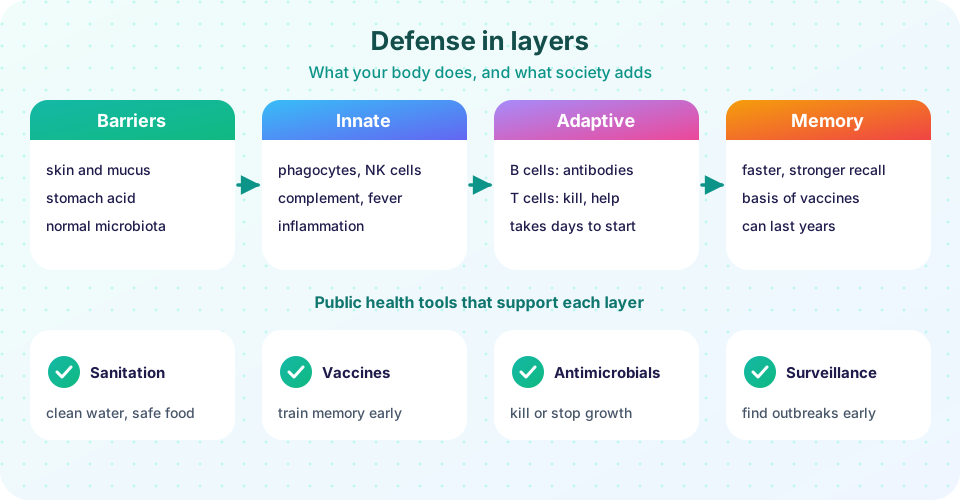
The chapter at a glance
| Topic | Key points | Lesson |
|---|---|---|
| Chain of infection | agent, reservoir, portal of exit, transmission, portal of entry, susceptible host | Overview |
| Virulence | adhesins, capsules, enzymes, exotoxins, endotoxin (lipid A), antigenic variation | Pathogenesis |
| Stages of disease | incubation, prodromal, illness, decline, convalescence | Pathogenesis |
| Proof of cause | Koch's postulates and their limits; molecular postulates | Pathogenesis |
| Innate immunity | barriers, phagocytes, complement, inflammation, fever, interferons | Immunity |
| Adaptive immunity | B cells and antibodies, helper and cytotoxic T cells, memory | Immunity |
| Vaccines | live, inactivated, subunit, toxoid, mRNA; herd threshold 1 − 1/R₀ | Immunity |
| Antibiotics | wall, ribosome, folate, DNA, RNA, membrane; MIC; resistance by selection | Antimicrobials |
Walking through an outbreak
A good way to test your understanding is to apply the chain of infection to a story. Imagine that thirty people who attended the same picnic develop vomiting and diarrhea within two days. Here is how an investigator might reason, using only ideas from this chapter.
The short incubation and the shared meal suggest a foodborne vehicle, so the investigator lists the foods and asks who ate what. A food eaten by almost all of the sick people and by few of the healthy ones becomes the main suspect. Laboratory tests of stool samples and leftover food look for the agent, perhaps Salmonella, Staphylococcus aureus toxin or norovirus. The reservoir may be raw poultry or eggs, or a food handler who was shedding a virus. The portal of exit and the portal of entry are the gut. The susceptible hosts include small children and older adults, who are more likely to become seriously ill.
Control measures follow the links. Remove the suspect food and clean the kitchen to deal with the vehicle and the reservoir. Teach hand washing and safe cooking and chilling to prevent transmission. Exclude sick food handlers from work. Report the cases to public health authorities, who can see whether other outbreaks are linked. Antibiotics may not even be needed: many such infections clear without them, and a doctor decides when drugs are appropriate.
The terms from the lesson on pathogenesis also apply. The count of sick people in a short time is an outbreak. The fraction who became ill among those who ate the food is the attack rate. A low ID50 would explain why a small contamination caused so many cases. Each of these ideas turns a confusing event into a series of testable questions.
Try it
The first demonstration shows how the reproduction number sets the growth of an outbreak. In the early phase of an epidemic, the number of cases grows roughly exponentially at a rate r = γ(R₀ − 1), where 1/γ is the infectious period. The doubling time is ln 2 / r. The numbers use an assumed infectious period of 5 days.
Press Run (or Ctrl + Enter) to see the result here.
Program input · what you'd type while the program runs
Type the answers before you press Run, one per line. Each time the program reads a line (with input()), it gets the next line from this box.
The second demonstration is a small Koch's postulates checker. For each case it reports which postulate cannot be satisfied. The scenarios are simplified, written for practice.
Press Run (or Ctrl + Enter) to see the console output here.
No output.
Check your understanding
Quick check · 10 questions
of 10 answered You scored / 10 · perfect!
-
1. Which pair of terms is matched correctly?
Virulence measures severity, and a vector is a carrier, usually an insect. -
2. Which toxin type is heat stable and part of the Gram-negative outer membrane?
Endotoxin is the lipid A of lipopolysaccharide. -
3. Place these stages in the correct order: illness, incubation, convalescence, prodromal, decline.
The five stages follow this order. -
4. Which cells make antibodies?
B cells differentiate into plasma cells, which secrete antibodies. -
5. Which vaccine type needs a repeat booster and often an adjuvant?
Non-replicating vaccines usually need adjuvants and repeat doses. -
6. R0 for a disease is 4. What fraction must be immune for herd immunity?
1 - 1/4 = 0.75. -
7. Which antibiotic class blocks peptidoglycan cross-linking?
Beta-lactams inhibit penicillin-binding proteins. -
8. What does a bacteriostatic drug do?
Bacteriostatic drugs inhibit growth and rely on the host defenses to clear the infection. -
9. How do resistance genes spread between bacteria?
Horizontal gene transfer moves resistance genes, often on plasmids. -
10. Why does soap and water hand washing reduce infections?
It removes microbes from hands, cutting contact transmission.
Summary
- Infection spreads along a chain of six links, and each link has an intervention.
- Pathogens use adhesins, capsules, enzymes and toxins; disease passes through five stages.
- The body defends in layers: barriers, innate responses and adaptive immunity with memory.
- Vaccines train memory; herd immunity protects a community when coverage is high enough.
- Antibiotics target features bacteria have and we lack; resistance is selected by use, so stewardship matters.
Next: Chapter 8 overview: Applied and environmental microbiology
Track your progress
Create a free account to tick off lessons and pick up where you left off on any device.
of Microbiology lessons completed