


















Lesson 2 of 46 · Getting Started
What is immunology? Self, nonself and a short history
Learn what the immune system does, how it separates self from nonself, the four hallmarks of immunity and the history from Jenner to modern checkpoint therapy.
Immunology begins with a puzzle that people noticed centuries before they knew about germs. Some people who survived a disease such as smallpox never caught it again, even when nursing the sick. Their bodies had somehow learned. The word immunity comes from the Latin immunitas, an exemption from public duties; in medicine it came to mean an exemption from disease.
Today we know that immunity is not one thing but a coordinated network of cells, tissues and molecules. This lesson gives you the map: what the immune system is for, the central trick of telling self from nonself, the four hallmarks that make it remarkable, and the history of how we found out.
What you will learn
- What the immune system does, beyond fighting infection.
- What "self" and "nonself" mean and why the distinction is hard.
- The four hallmarks of adaptive immunity.
- Who Jenner, Pasteur, Metchnikoff, Ehrlich, Behring, Burnet and others were, and what each contributed.
Key terms
- Immunity: the body's ability to resist or clear a harmful agent.
- Pathogen: a microorganism or virus that can cause disease.
- Antigen: any molecule that the immune system can recognize.
- Self / nonself: the body's own molecules versus foreign ones.
- Vaccine: a preparation that trains the immune system without causing the disease.
What the immune system is for
Fighting infection is the headline job, but it is not the only one. A modern definition lists four duties.
- Defense. Detect and eliminate pathogens such as bacteria, viruses, fungi and parasites.
- Surveillance. Spot and remove abnormal cells of your own, including some early cancer cells.
- Housekeeping. Clear dead and dying cells (billions are turned over every day) and help repair tissue after injury.
- Tolerance. Avoid attacking your own healthy tissues, harmless food proteins and the helpful microbes of the gut and skin.
Notice that the last duty is as important as the first. A defense that cannot hold its fire does more harm than the enemy: that is the story of allergy and autoimmune disease in Chapter 8.
The central problem: self versus nonself
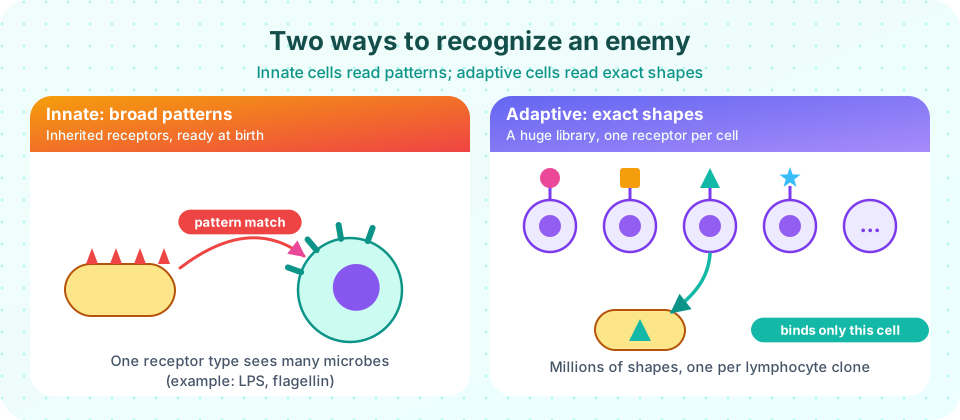
Imagine you must guard a city where every resident looks slightly different, and invaders can disguise themselves as residents. The immune system faces exactly this problem. It cannot carry a list of "bad" molecules, because pathogens evolve faster than we do. Instead it uses two complementary strategies.
- Innate recognition looks for patterns that are common to whole groups of microbes and absent from healthy human cells. Bacterial cell walls, double-stranded RNA from viruses, and flagellin from bacterial tails are examples. These receptors are inherited, ready from birth, and fast.
- Adaptive recognition builds a huge library of random receptors, throws out those that bind to self, and keeps those that bind to something foreign and dangerous. This takes days the first time but yields precise and long-lasting protection.
Four hallmarks of adaptive immunity
| Hallmark | Meaning | Everyday example |
|---|---|---|
| Specificity | Each lymphocyte recognizes one particular shape | Measles vaccine does not protect against flu |
| Diversity | Billions of different receptors exist before any infection | You can respond to a microbe never seen before |
| Memory | A second meeting causes a faster, larger response | Chickenpox rarely strikes twice |
| Self-tolerance | Cells that attack self are removed or silenced | You do not reject your own heart |
A short history
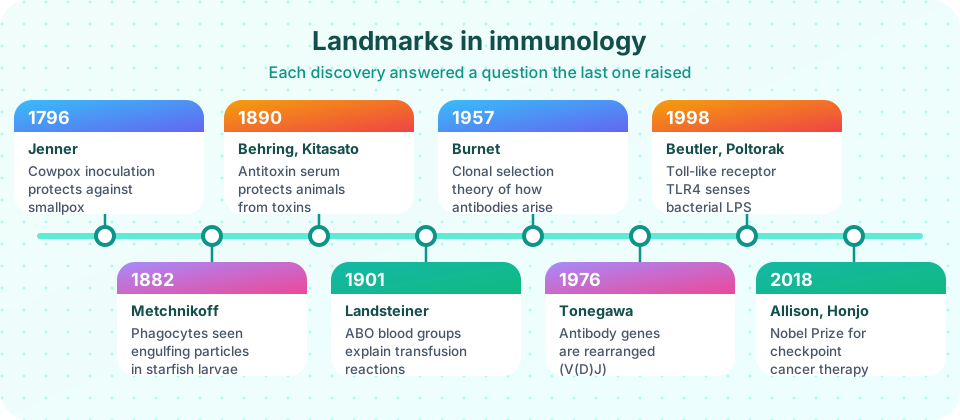
1796: Edward Jenner. The English physician noticed that milkmaids who had caught cowpox seemed protected from smallpox. In 1796 he inoculated a boy, James Phipps, with material from a cowpox sore and later showed that the boy resisted smallpox. The word vaccine comes from the Latin vacca, cow. Smallpox was declared eradicated worldwide by the World Health Organization in 1980, the first human disease to be wiped out.
1880s: Louis Pasteur. Pasteur showed that weakened (attenuated) microbes could protect: first chicken cholera, then anthrax, and in 1885 rabies. He founded the idea that we can design immunity.
1882: Élie Metchnikoff. He watched mobile cells in transparent starfish larvae surround a thorn he had inserted, and proposed that cells called phagocytes eat invaders. His cellular theory was at first strongly opposed.
1890: Emil von Behring and Shibasaburo Kitasato. They found that serum from animals exposed to diphtheria or tetanus toxin protected other animals: something in the blood, soon named antibody, neutralized the toxin. This is the humoral view (humor means fluid). Paul Ehrlich explained this with his side-chain theory and developed ways to standardize antitoxins. Metchnikoff and Ehrlich shared the 1908 Nobel Prize in Physiology or Medicine, a recognition that both cells and serum matter.
1901: Karl Landsteiner. He discovered the ABO blood groups, showing that antibodies to foreign red cells explain transfusion reactions.
1957: Macfarlane Burnet. His clonal selection theory said each lymphocyte carries one receptor type; an antigen selects the matching cell, which multiplies into a clone. Peter Medawar's work on tolerance in the 1950s showed that the system can learn what is self.
1959 to 1962. Rodney Porter and Gerald Edelman worked out the structure of antibodies (Nobel Prize 1972). 1976: Susumu Tonegawa showed that antibody genes are cut and rejoined in each B cell, which explained diversity (Nobel Prize 1987). 1989 onward: Charles Janeway proposed that innate cells use pattern recognition receptors; the discovery of Toll-like receptors (Beutler, Hoffmann; Nobel 2011) proved it. 2018: James Allison and Tasuku Honjo shared the Nobel Prize for the discovery of cancer therapy by inhibiting negative immune regulation.
Immunity in everyday life
You meet immunology far more often than you might think. A shallow cut on a finger turns red and tender within hours, which is innate immunity at work, and it heals without drama because barriers, phagocytes and clotting cooperate. A vaccination is a deliberate rehearsal: it shows your adaptive system a harmless version of a pathogen so that memory cells are ready. A blood transfusion must match the ABO group because your plasma already contains antibodies against the blood group sugars you lack. A transplanted kidney needs matching and drugs because your T cells recognize the donor's cells as foreign. Hay fever is a harmless pollen grain being treated as a threat. Each of these is a chapter later in the course, and each grows from the ideas in this lesson: recognition, response, memory and tolerance.
Common misconceptions
"A strong immune system is always better." Immunity must be balanced. Too weak means infections; too strong means allergy and autoimmune disease.
"Immunity means never getting sick." Immunity lowers the risk and severity of specific diseases. New pathogens and variants can still cause illness.
"You can boost your immune system with a single product." The system has many parts that need to be in balance. Sleep, nutrition, vaccination and not smoking matter, but no single supplement "boosts" it in a simple way.
Try it
Press Run (or Ctrl + Enter) to see the result here.
Program input · what you'd type while the program runs
Type the answers before you press Run, one per line. Each time the program reads a line (with input()), it gets the next line from this box.
Press Run (or Ctrl + Enter) to see the console output here.
No output.
Check your understanding
Quick check · 4 questions
of 4 answered You scored / 4 · perfect!
-
1. Which pair describes the two strategies the immune system uses to recognize threats?
Innate receptors recognize broad microbial patterns quickly; adaptive receptors recognize exact shapes and give memory. -
2. Who proposed the cellular theory that phagocytes engulf invaders?
Metchnikoff observed phagocytosis in starfish larvae. Ehrlich championed the humoral (antibody) side; they shared the 1908 Nobel Prize. -
3. Which is NOT a hallmark of adaptive immunity?
Adaptive immunity depends on diversity: billions of different receptors, each lymphocyte carrying one type. -
4. What did Burnet's clonal selection theory say?
Antigen does not instruct the cell; it selects a preexisting cell, which then expands as a clone.
Summary
- The immune system defends, surveils for abnormal cells, tidies up dead cells and, crucially, tolerates self.
- Innate immunity recognizes broad patterns quickly; adaptive immunity recognizes specific shapes and remembers.
- The four hallmarks of adaptive immunity are specificity, diversity, memory and self-tolerance.
- History: Jenner (vaccination), Pasteur (attenuation), Metchnikoff (phagocytes), Behring and Ehrlich (antibodies), Burnet (clonal selection), and later work on structure, genes and pattern recognition.
Next: Pathogens and infection
Track your progress
Create a free account to tick off lessons and pick up where you left off on any device.
of Immunology lessons completed