


















Lesson 15 of 46 · Innate Immunity
NK cells and interferons: catching infected and abnormal cells
Learn how natural killer cells spot cells with missing or stressed self markers, how they kill with perforin and granzymes, and how interferons warn neighbors and block viral replication.
Phagocytes and complement are brilliant against microbes outside our cells. A virus hiding inside a cell is a different problem: it can be seen only through what the cell reveals about itself. The innate immune system has two answers. One is a lymphocyte that kills sick cells on sight, the natural killer (NK) cell. The other is a family of messenger proteins, the interferons, which tell neighboring cells to prepare for a viral attack and which wake up the NK cells.
You will also learn the beautiful rule NK cells use to decide when to kill: check for the ID badge, and if it is missing, attack.
What you will learn
- What NK cells are and how they differ from T and B cells.
- The "missing self" and "induced self" rules for activation.
- How NK cells kill, including antibody-dependent cell-mediated cytotoxicity.
- What interferons are, how they signal and what they do to a cell.
Key terms
- NK cell: a cytotoxic innate lymphocyte that kills infected or tumor cells without prior sensitization.
- MHC class I (HLA class I in humans): molecules found on almost all nucleated cells that display fragments of internal proteins.
- Perforin / granzyme: proteins in NK and T-cell granules that make pores and trigger cell death.
- ADCC: antibody-dependent cell-mediated cytotoxicity, killing of an antibody-coated target.
- ISG: interferon-stimulated gene, one of hundreds of genes switched on by interferon.
Meet the NK cell
NK cells are large lymphocytes with visible granules, about 5 to 15 percent of lymphocytes in blood. Unlike B and T cells, they do not rearrange receptor genes and they do not need to be taught what to attack. Their name comes from the 1970s observation that some lymphocytes killed tumor cells in a dish without prior immunization. On cell labels, human NK cells are typically CD56-positive and CD3-negative (CD3 marks T cells).
The decision: balancing signals
Each NK cell wears a mixture of activating and inhibitory receptors. It adds them up.
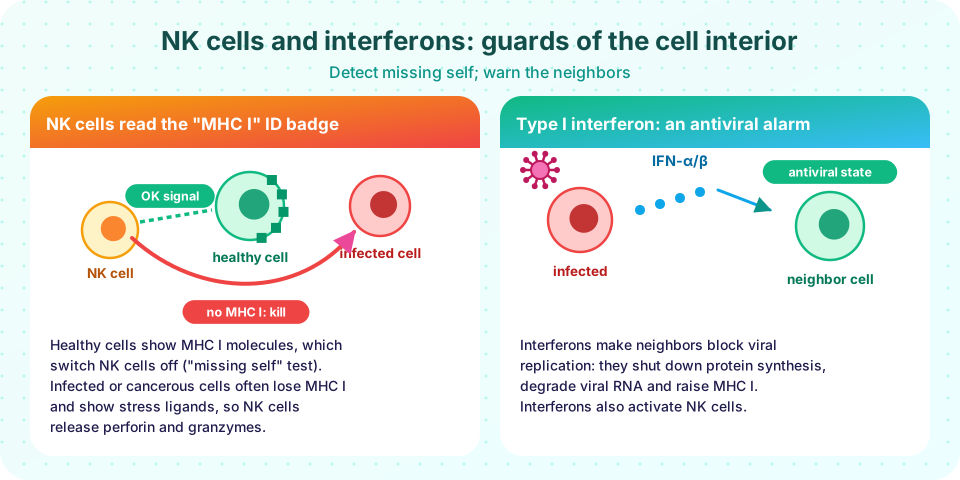
- Inhibitory receptors (for example KIRs, and NKG2A) bind MHC class I molecules on the target cell. When they are engaged, they tell the NK cell: "This is a normal cell; stand down."
- Activating receptors (for example NKG2D) bind stress-induced molecules that cells show when infected, damaged or transformed (MICA, MICB, ULBPs). They say: "This cell is in trouble."
Two rules follow:
- Missing self (proposed by Klas Kärre in the 1980s): a cell that has lost its MHC class I is not inhibited, so it is killed. Many viruses and tumors reduce MHC class I to hide from killer T cells (Chapter 5). NK cells catch exactly those cells, which makes a neat partnership: whichever strategy the virus uses, one of the two killers can see it.
- Induced self: a cell with stress ligands but normal MHC may still be killed if the activating signal is strong enough.
How NK cells kill
NK cells attach to the target and form a tight contact, then release the contents of their granules toward it.
- Perforin forms pores in the target membrane.
- Granzymes (proteases) enter through these pores and start apoptosis, programmed, tidy cell death, by activating caspases. Apoptosis is also useful because it destroys viral DNA inside the cell.
- Death receptor pathway: NK cells can also present FasL, which binds Fas on the target and triggers apoptosis from the outside.
Antibody help: ADCC
NK cells carry CD16 (FcγRIII), a receptor for the Fc part of IgG. If antibodies coat a target cell (a virus-infected cell with viral proteins on its surface, or a tumor cell), CD16 on the NK cell binds those antibodies and the NK cell kills the target. This is ADCC. Many therapeutic antibodies used against cancer (for example rituximab against B-cell lymphoma) work partly this way. It is another case of adaptive and innate branches working together.
Cytokines
Activated NK cells also release interferon-gamma (IFN-γ) and TNF, which activate macrophages and shape the later adaptive response. NK cells themselves are boosted by cytokines from dendritic cells and macrophages (IL-12, IL-15, IL-18) and by type I interferons.
Interferons: the antiviral alarm
In 1957 Alick Isaacs and Jean Lindenmann found that cells infected with one virus released a substance that made other cells resist a second virus: it "interfered" with infection, hence interferon. We now know three families.
| Type | Examples | Main producers | Main role |
|---|---|---|---|
| Type I | IFN-α (many forms), IFN-β | Almost any virus-infected cell; plasmacytoid dendritic cells make very large amounts | Antiviral state, activate NK cells, boost antigen presentation |
| Type II | IFN-γ | NK cells, T cells | Activates macrophages, regulates adaptive immunity |
| Type III | IFN-λ | Epithelial cells at barrier surfaces | Local antiviral defense at mucosae |
How it works
- Sensing. A virus-infected cell detects viral RNA or DNA with intracellular sensors (RIG-I and MDA5 for RNA; other sensors for DNA) or with endosomal TLRs.
- Production. The sensors switch on IRF3 and NF-κB, and the cell makes and secretes type I interferon.
- Signaling. Interferon binds the receptor IFNAR on the cell itself and its neighbors, activating the JAK-STAT pathway.
- Antiviral state. Hundreds of ISGs are turned on. Examples: PKR shuts down protein synthesis when it detects double-stranded RNA; OAS and RNase L chop up RNA; Mx proteins and IFITM proteins block virus assembly and entry. Neighboring cells therefore become hard places for the virus to multiply, before the virus reaches them.
- Immune boost. Interferon raises MHC class I and antigen processing (making infected cells easier for T cells to see) and activates NK cells.
Viruses fight back: many encode proteins that block interferon production or signaling, which is why the speed of interferon release often decides how severe an infection becomes. Some of the "flu-like" symptoms (fever, aches, fatigue) in viral illness are partly caused by interferons and other cytokines. Interferons have also been used as medicines, for example IFN-β in multiple sclerosis; this is educational information only.
Common misconceptions
"NK cells need to be activated by a previous infection." They act without prior sensitization, although cytokines can prime them. (Some evidence suggests NK cells can show a form of memory; this is an active research area.)
"NK cells kill anything that lacks MHC I." They weigh activating and inhibitory signals; losing inhibition is one input, not the only one.
"Interferons kill viruses." They do not kill directly; they cause cells to resist infection, and they recruit other immune cells.
Try it
Press Run (or Ctrl + Enter) to see the result here.
Program input · what you'd type while the program runs
Type the answers before you press Run, one per line. Each time the program reads a line (with input()), it gets the next line from this box.
Press Run (or Ctrl + Enter) to see the console output here.
No output.
Check your understanding
Quick check · 5 questions
of 5 answered You scored / 5 · perfect!
-
1. What does an NK cell do when its inhibitory receptors do NOT find MHC class I on a target?
This is the 'missing self' rule: loss of MHC I removes the inhibition. -
2. How do NK cells trigger apoptosis in a target?
Perforin and granzymes from granules, plus FasL on the surface, trigger programmed cell death. -
3. What is ADCC?
Antibody-dependent cell-mediated cytotoxicity uses Fc receptors to direct killing. -
4. Which describes the action of type I interferon on a neighboring cell?
Through IFNAR and JAK-STAT signaling, ISGs such as PKR, OAS and Mx are induced. -
5. Which is the main producer of IFN-gamma?
IFN-gamma (type II) comes from NK and T cells and activates macrophages.
Summary
- NK cells are innate lymphocytes that kill infected or abnormal cells by weighing activating and inhibitory signals; missing MHC class I removes inhibition ("missing self").
- They kill with perforin, granzymes and FasL, and can use antibodies through CD16 (ADCC).
- Type I interferons are released by infected cells, act through IFNAR and JAK-STAT, and induce ISGs such as PKR, OAS and Mx that create an antiviral state.
- IFN-γ comes from NK and T cells and activates macrophages; viruses often try to block interferon signaling.
Next: Chapter 3 review
Track your progress
Create a free account to tick off lessons and pick up where you left off on any device.
of Immunology lessons completed