


















Lesson 45 of 46 · Projects and Practice
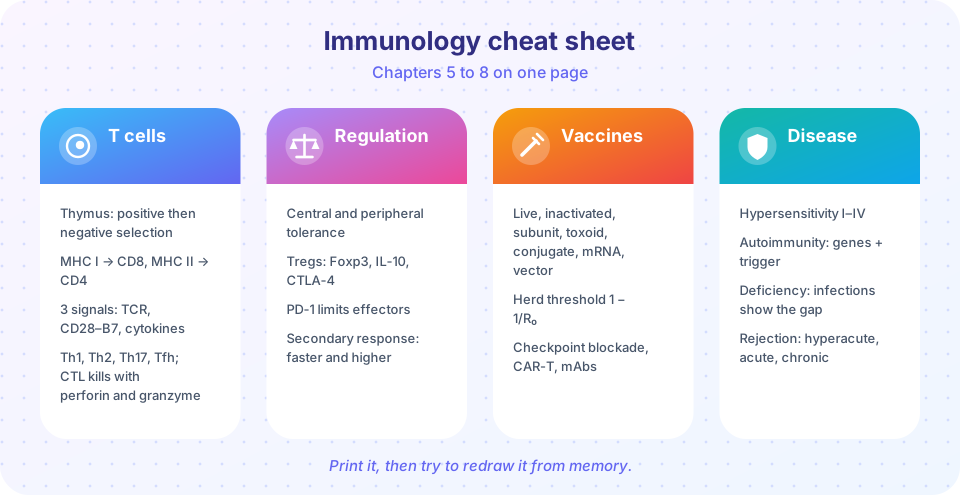
Cheat sheet: T cells, regulation, vaccines and immune disease
A one-page recap of the second half of the immunology course: T cells and MHC, tolerance and memory, vaccines and herd immunity, and immune disease, with formulas and a quick-recall quiz.
This page is meant to be read in five minutes, printed, or redrawn from memory. It repeats the central facts of Chapters 5 to 8 in the most compact form that is still accurate. If a line does not make sense, follow the lesson link beside it for the explanation. A summary is only useful when you understand what it summarizes.
What you will learn
- A quick way to recall the key facts and formulas of Chapters 5 to 8.
- Which relationships are most worth memorizing.
- How to test yourself with flash cards.
Key terms
Cheat sheet: a compact summary used for revision.
Active recall: testing yourself instead of rereading.
Spaced repetition: reviewing material at increasing intervals.
Chapter 5: T cells
- Receptor built by V(D)J recombination with RAG1 and RAG2. Thymus
- Positive selection in the cortex (binds self-MHC at all). Negative selection in the medulla (binds too strongly, helped by AIRE). Most thymocytes die.
- MHC I (HLA-A, B, C): all nucleated cells, endogenous peptides of 8-10 amino acids, CD8. MHC II (HLA-DR, DP, DQ): APCs, exogenous peptides of 13-25 amino acids, CD4. MHC and TCR
- Three signals: TCR plus peptide-MHC, CD28 with B7, cytokines. Signal 1 alone gives anergy.
- Helpers: Th1 (T-bet, IFN-gamma, intracellular microbes), Th2 (GATA3, IL-4/5/13, worms, allergy), Th17 (ROR-gamma-t, IL-17, fungi and surface bacteria), Tfh (Bcl-6, IL-21, CD40L, germinal centers). Helper and killer
- CTL: perforin, granzymes and Fas ligand cause apoptosis.
Chapter 6: regulation and memory
- Central tolerance (thymus and bone marrow) and peripheral tolerance (ignorance, anergy, deletion, Tregs, immune privilege). Tolerance
- Tregs: Foxp3, CD25, IL-10, TGF-beta, CTLA-4. FOXP3 mutation gives IPEX.
- Checkpoints: CTLA-4 acts early in lymph nodes. PD-1 acts on effectors in tissues.
- Primary response: lag of 5-10 days, IgM then IgG. Secondary: lag of 1-3 days, much higher, IgG, higher affinity. Memory
- Memory cells: memory B cells, long-lived plasma cells, TCM, TEM, TRM.
Chapter 7: vaccines and immunotherapy
- Platforms: live attenuated, inactivated, subunit, toxoid, conjugate, mRNA, viral vector. Adjuvants give danger signals. Types
- Herd immunity threshold = 1 − 1/R0. Coverage needed = threshold / VE. SIR: R0 = β/γ. Herd immunity
- Immunotherapy: checkpoint inhibitors (anti-PD-1, anti-PD-L1, anti-CTLA-4), CAR-T (anti-CD19), monoclonal antibodies (-omab, -ximab, -zumab, -umab). Immunotherapy
Chapter 8: immune disease
- Hypersensitivity: I (IgE, minutes), II (antibody on cells), III (immune complexes), IV (T cells, 1-3 days). Allergy
- Autoimmunity = susceptibility (HLA, genes) + triggers (mimicry, infection) + effectors. Autoantibodies are markers. Autoimmunity
- Immunodeficiency: antibodies (encapsulated bacteria), T cells (viruses, fungi), phagocytes (catalase-positive bacteria, molds), complement (Neisseria). Transplant: hyperacute, acute, chronic, GVHD. Immunodeficiency
Formulas to remember
Herd immunity threshold    = 1 - 1/R0
Coverage needed            = (1 - 1/R0) / VE
Effective reproduction no. Re = R0 x (fraction susceptible)
Half-life from slope       h = -1 / slope   (of log2 level vs time)
Sibling HLA match          = 25% for each sibling (full match)
Common misconceptions
"Memorizing the sheet is the same as understanding." The sheet is a retrieval aid. If you cannot explain a line in your own words, go back to the lesson.
"All the numbers here are exact." Timings and ranges, such as lags of days and R0 values, are typical ranges that vary in real life.
Try it
The first tool draws a random flash card from a deck built from this sheet. Run it several times.
Press Run (or Ctrl + Enter) to see the console output here.
No output.
The second tool turns the formulas into a plot: required coverage against R0 for three vaccine effectiveness values. Curves above 100 percent mean the threshold cannot be met by that vaccine alone.
Press Run (or Ctrl + Enter) to see the result here.
Program input · what you'd type while the program runs
Type the answers before you press Run, one per line. Each time the program reads a line (with input()), it gets the next line from this box.
Check your understanding
Quick check · 4 questions
of 4 answered You scored / 4 · perfect!
-
1. Which pair is correct?
CD4 binds MHC class II and CD8 binds MHC class I. -
2. A secondary response differs from a primary one mainly because it is:
Memory cells make the secondary response faster, larger and higher in affinity. -
3. For R0 = 4 and a vaccine with VE 100%, the threshold coverage is:
1 - 1/4 = 0.75. -
4. Which type of hypersensitivity involves immune complexes?
Immune complex deposition characterizes type III reactions.
Summary
- The second half of the course reduces to a few chains: T cell training and activation, tolerance and memory, vaccines and herd immunity, and four types of immune disease.
- Know the formulas: threshold, coverage, Re and half-life.
- Test yourself by recall, and redraw the poster from memory.
Next: Further study
Track your progress
Create a free account to tick off lessons and pick up where you left off on any device.
of Immunology lessons completed