


















Lesson 13 of 46 · Innate Immunity
Phagocytes and pattern recognition receptors
Meet neutrophils, macrophages and dendritic cells, learn how Toll-like and other pattern-recognition receptors sense microbes, and follow the steps of phagocytosis and killing.
Eating is the oldest defense strategy there is. Single-celled amoebae eat bacteria for dinner, and our own phagocytes still do something similar, only for protection instead of food. The word phagocyte comes from the Greek for "eating cell", the name Metchnikoff gave them in the 1880s. Today we also know how these cells know what to eat: they carry receptors that recognize molecules unique to microbes.
This lesson covers the three main phagocytes, the pattern-recognition receptors (PRRs) that sense invaders, the steps of phagocytosis, and the weapons a phagocyte uses to kill what it has swallowed.
What you will learn
- The roles of neutrophils, macrophages and dendritic cells.
- The idea of PAMPs and DAMPs, and the main families of PRRs.
- Which Toll-like receptor senses which microbial molecule.
- How phagocytes engulf and kill, and what opsonization adds.
Key terms
- PAMP: pathogen-associated molecular pattern, a molecule common to many microbes (LPS, flagellin, viral RNA).
- DAMP: damage-associated molecular pattern, a molecule released by stressed or dying host cells.
- PRR: pattern-recognition receptor, a germline-encoded receptor that senses PAMPs and DAMPs.
- Opsonin: a molecule such as an antibody or C3b that coats a microbe and makes it easier to engulf.
- Phagolysosome: the compartment formed when a phagosome fuses with lysosomes.
The three main professional phagocytes
Neutrophils are the most numerous white blood cells, with a multilobed nucleus and many granules full of enzymes and antimicrobial proteins. They circulate for only hours, arrive first at infections in huge numbers and die quickly. Besides phagocytosis, they can release neutrophil extracellular traps (NETs), webs of DNA studded with proteins that snare microbes.
Macrophages are larger, long-lived cells that live in tissues. They arise from blood monocytes or from embryonic precursors and take local names and tasks: Kupffer cells in the liver, alveolar macrophages in the lungs, microglia in the brain, and many more. They are expert scavengers (clearing millions of aged red cells every second across the body), sensors that release cytokines and, in some contexts, presenters of antigen to T cells. When they ingest a microbe they can be "classically activated" to kill, or shift toward repair of tissue.
Dendritic cells (DCs) are named for their treelike extensions. They are not mainly killers. Their job is to sample antigens in the tissue, mature after receiving danger signals, travel through lymph vessels to the lymph node and activate naive T cells. They are the main link between innate and adaptive immunity, and they are the most efficient antigen-presenting cells for starting a new T-cell response.
Sensing microbes: PAMPs, DAMPs and PRRs
A phagocyte cannot carry a receptor for every microbe. Instead, it targets molecules that microbes need and humans lack, which are hard for microbes to change. Charles Janeway proposed this logic in 1989. The receptors come in several families:
| Family | Location | Examples of what they sense |
|---|---|---|
| TLR Toll-like receptors | Cell surface and endosome membranes | Bacterial wall parts, flagellin, viral RNA, bacterial DNA |
| NLR NOD-like receptors | Cytoplasm | Bacterial peptidoglycan fragments; danger signals (forming inflammasomes) |
| RLR RIG-I-like receptors | Cytoplasm | Viral RNA inside the cell |
| CLR C-type lectin receptors | Cell surface | Fungal and bacterial sugars (mannose, beta-glucan) |
| Scavenger receptors | Cell surface | Modified lipids, bacterial walls, dead cells |
The TLRs are the best known. The name comes from Toll, a gene found in the fruit fly Drosophila by Christiane Nüsslein-Volhard's lab (as part of body-plan studies) and shown by Jules Hoffmann in 1996 to be needed for the fly's defense against fungi. Bruce Beutler and colleagues showed in 1998 that mouse TLR4 senses bacterial LPS. Humans have ten TLRs.
| TLR | Senses | Where |
|---|---|---|
| TLR2 (with TLR1 or TLR6) | Lipopeptides, lipoteichoic acid of bacteria, some fungal parts | Surface |
| TLR3 | Double-stranded RNA (many viruses) | Endosome |
| TLR4 (with MD-2 and CD14) | LPS of Gram-negative bacteria | Surface |
| TLR5 | Flagellin | Surface |
| TLR7 and TLR8 | Single-stranded RNA | Endosome |
| TLR9 | Unmethylated CpG DNA, common in bacteria | Endosome |
When a TLR binds its ligand, it recruits adaptor proteins (most often MyD88; TLR3 uses TRIF) and starts a signaling chain that activates transcription factors such as NF-κB and IRFs. The cell then turns on genes for cytokines (TNF-α, IL-1, IL-6, IL-12), chemokines and, for viral signals, type I interferons.
If the alarm is too strong, the damage can be severe: in sepsis, a flood of cytokines in response to bacterial products can cause low blood pressure and organ failure.
Phagocytosis step by step
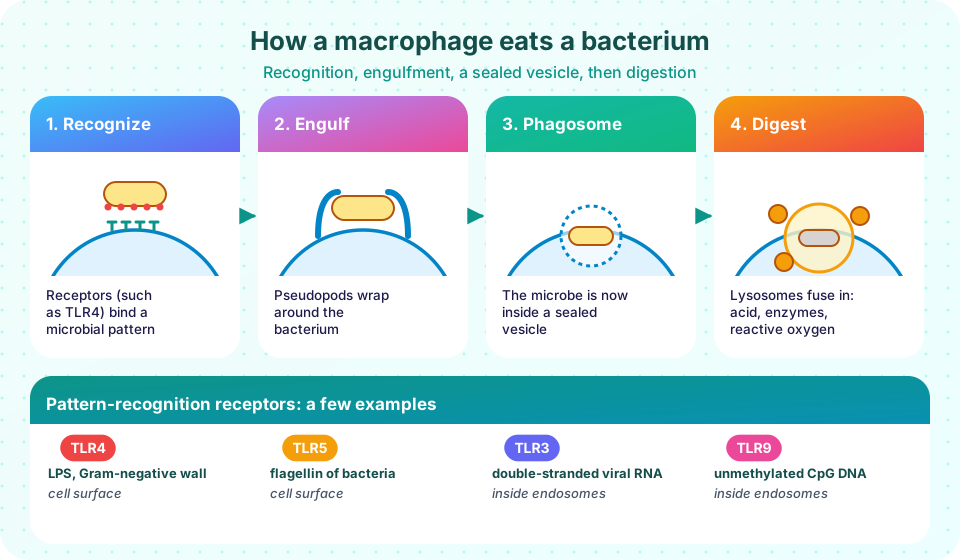
- Recognition and attachment. Receptors on the phagocyte bind the microbe's surface. Binding is far more efficient if the microbe is coated with opsonins: antibodies (recognized by Fc receptors) and complement C3b (recognized by complement receptors).
- Engulfment. The membrane extends pseudopods that wrap around the particle and fuse at their tips. The actin cytoskeleton powers this movement.
- Phagosome. The microbe is now trapped in a membrane-bound vesicle inside the cell.
- Maturation and killing. The phagosome fuses with lysosomes to form a phagolysosome. Its contents become acidic and are exposed to enzymes and to reactive molecules.
- Exit. Remains are expelled, and peptide fragments may be displayed to T cells (in antigen-presenting cells).
How a phagocyte kills
- Reactive oxygen species. The enzyme NADPH oxidase assembles at the phagosome and makes superoxide (the respiratory burst), which is converted to hydrogen peroxide and, in neutrophils, with the enzyme myeloperoxidase into hypochlorous acid, a bleach-like disinfectant that damages microbial proteins and membranes.
- Nitric oxide. Activated macrophages make NO using the enzyme iNOS.
- Enzymes, acid and peptides. Lysozyme, proteases, defensins, lactoferrin (which grabs iron) and low pH.
People with a defect in NADPH oxidase suffer chronic granulomatous disease: their phagocytes can engulf microbes but not kill some of them, leading to repeated serious bacterial and fungal infections.
Some bacteria fight back. Mycobacterium tuberculosis blocks phagosome maturation and survives inside macrophages; Staphylococcus aureus makes toxins that kill phagocytes; many bacteria hide in a slimy capsule that makes them hard to grab until opsonized.
Common misconceptions
"Phagocytes recognize specific bacteria." They recognize broad patterns shared by many microbes. Specificity for a particular species is a job of adaptive immunity.
"Macrophages and neutrophils do the same thing." Neutrophils are short-lived rapid killers; macrophages are long-lived organizers, scavengers and signalers.
"TLRs are only on immune cells." TLRs also appear on epithelial cells and others, which helps barrier tissues sense danger.
Try it
Press Run (or Ctrl + Enter) to see the result here.
Program input · what you'd type while the program runs
Type the answers before you press Run, one per line. Each time the program reads a line (with input()), it gets the next line from this box.
Press Run (or Ctrl + Enter) to see the console output here.
No output.
Check your understanding
Quick check · 5 questions
of 5 answered You scored / 5 · perfect!
-
1. Which TLR senses LPS of Gram-negative bacteria?
TLR4, with MD-2 and CD14, recognizes LPS. -
2. What is an opsonin?
Antibodies and complement C3b are opsonins; phagocytes have receptors for them. -
3. Which cell is the main link that activates naive T cells in the lymph node?
Dendritic cells carry antigen to nodes and provide the signals naive T cells need. -
4. Which statement about chronic granulomatous disease is correct?
Without the respiratory burst, some bacteria and fungi survive inside phagocytes. -
5. A PAMP is best described as:
PAMPs are the microbial patterns that PRRs detect.
Summary
- Neutrophils are rapid, short-lived killers; macrophages are long-lived scavengers and signalers; dendritic cells start adaptive responses.
- PRRs (TLRs, NLRs, RLRs, CLRs) sense PAMPs and DAMPs; TLR4 senses LPS, TLR5 flagellin, TLR3 dsRNA and TLR9 CpG DNA.
- Phagocytosis proceeds through recognition, engulfment, phagosome, phagolysosome and digestion; opsonins make it more efficient.
- Killing uses reactive oxygen, nitric oxide, enzymes, acid and antimicrobial peptides; defects cause serious disease.
Next: The complement system
Track your progress
Create a free account to tick off lessons and pick up where you left off on any device.
of Immunology lessons completed