


















Lesson 3 of 46 · Getting Started
Pathogens and infection: who the immune system faces
Meet the five main kinds of pathogen, learn how infections spread and progress, and see why where a microbe lives decides which immune defenses work against it.
An immune system makes sense only if you know what it is up against. The microbes that cause disease are astonishingly varied: some are a hundred times smaller than a bacterium, others are worms longer than your arm. They invade by different doors, live in different places inside you and use different tricks to hide. Because of that, the immune system carries a toolbox rather than a single weapon.
In this lesson you learn the five main groups of pathogen, how infections spread and unfold, and one idea that will keep returning: where a pathogen lives decides which immune response can reach it.
What you will learn
- The main pathogen groups and one typical disease for each.
- The difference between a pathogen, an opportunist and a harmless commensal.
- The stages of an infection and the main routes of transmission.
- Why extracellular and intracellular microbes need different immune responses.
Key terms
- Pathogenicity: the ability of a microbe to cause disease at all.
- Virulence: how severe the disease is that a particular strain causes.
- Opportunistic pathogen: a microbe that mostly harms people whose defenses are weakened.
- Microbiota: the community of microbes that normally live on and in the body.
- Toxin: a poisonous molecule made by a microbe; exotoxins are secreted proteins, endotoxin is the LPS in the outer membrane of Gram-negative bacteria.
The five groups
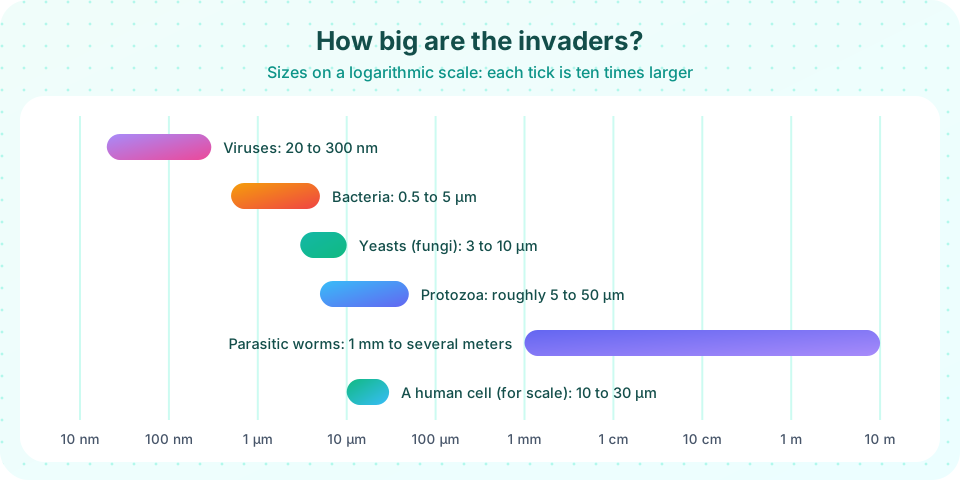
Viruses are packages of genetic material (DNA or RNA) in a protein coat, sometimes inside a lipid envelope. They are about 20 to 300 nm across and are not cells: they cannot grow or divide alone and must hijack a host cell's machinery. Examples: influenza, measles, HIV, SARS-CoV-2. Because viruses live and replicate inside cells, antibodies can only catch them while they travel between cells; killing infected cells requires T cells and NK cells.
Bacteria are single-celled prokaryotes, typically 0.5 to 5 micrometers long, with no nucleus. They reproduce by dividing and may live outside cells (Streptococcus pyogenes, which causes strep throat) or hide inside them (Mycobacterium tuberculosis, which survives inside macrophages). Gram-positive bacteria have a thick peptidoglycan wall; Gram-negative bacteria have a thin one plus an outer membrane containing lipopolysaccharide (LPS), a strong alarm signal for the immune system.
Fungi include yeasts (single-celled, such as Candida albicans) and molds (filamentous, such as Aspergillus). They are eukaryotes with chitin-rich walls. Most infections are superficial (athlete's foot) but deep infections occur mainly in people with weakened immunity.
Protozoa are single-celled eukaryotes such as Plasmodium (malaria), Giardia and Trypanosoma. Many have complex life cycles with changing surface proteins, which makes them difficult targets for antibodies.
Helminths are parasitic worms: roundworms (hookworm), flatworms (tapeworm, schistosomes). They are far too large to be eaten by a single cell, so the immune system uses a special set of weapons: eosinophils, IgE antibodies and mast cells. The same weapons cause allergy when aimed at harmless things.
A sixth, odd category deserves a mention: prions are misfolded proteins that can cause other proteins to misfold (mad cow disease, Creutzfeldt-Jakob disease). They provoke almost no immune response because they are made from a normal host protein.
Pathogens, opportunists and friends
Not every microbe is a pathogen. A healthy adult carries roughly as many bacterial cells as human cells (order of tens of trillions of each, by recent estimates). This microbiota trains the immune system, crowds out dangerous microbes and helps digestion. A commensal benefits without harming. An opportunist such as Candida or Pseudomonas causes trouble only when something fails: antibiotics that disturb the balance, burns, diabetes, or immunosuppression after a transplant.
Whether you get sick depends on three things at once: the microbe (its dose and virulence), the route (where it enters) and you (immune status, age, nutrition, genes, other illnesses). An exposure that is harmless for one person can be dangerous for another.
How infections spread
Transmission routes describe the path from a source to a new host.
| Route | How it works | Example |
|---|---|---|
| Respiratory droplets and aerosols | Particles from coughing, talking and breathing | Influenza, measles |
| Direct contact | Touching skin or fluids | Impetigo, herpes simplex |
| Indirect contact | Contaminated objects or hands | Norovirus on surfaces |
| Fecal-oral | Contaminated food or water | Cholera, hepatitis A |
| Vector-borne | Carried by an insect or other animal | Malaria (mosquito) |
| Bloodborne or sexual | Blood, body fluids | Hepatitis B, HIV |
| Mother to child | Across the placenta or at birth | Rubella, cytomegalovirus |
Public health interrupts these links: clean water, handwashing, masks, vector control and, most effectively, vaccination.
The course of an infection
Many acute infections follow four stages.
- Incubation: the microbe enters and multiplies; you feel nothing. Length ranges from hours to weeks.
- Prodrome: mild, vague symptoms such as tiredness or low fever.
- Acute phase: the microbe peaks, symptoms are clear, and the adaptive response is under way.
- Convalescence: the pathogen is cleared and tissues heal. Memory cells remain.
Some microbes do not end this way. They may become latent (herpes viruses hide in nerve cells for life), or become chronic (hepatitis B, TB), or be cleared only with help from drugs.
Where a microbe lives decides the response
| Location | Examples | Main immune weapons |
|---|---|---|
| Outside cells (blood, tissue fluid) | Streptococcus, many bacteria, free viruses | Antibodies, complement, phagocytes |
| Inside cell vesicles | Mycobacterium tuberculosis, Leishmania | Helper T cells that activate macrophages |
| Free in the cell cytoplasm | Most viruses, Listeria | Killer T cells, NK cells, interferons |
| Too big to engulf | Helminths | Eosinophils, IgE, mast cells |
This table is a compass for the rest of the course. Whenever you meet a new cell or molecule, ask: which kind of microbe is this for?
Koch's postulates
In the 1880s Robert Koch proposed four conditions to prove that a particular microbe causes a particular disease: (1) the microbe is found in every case of the disease and not in healthy hosts; (2) it can be isolated and grown in pure culture; (3) the cultured microbe causes the disease when put into a healthy host; (4) the same microbe can be recovered from that host. They were a landmark, but they have limits: viruses cannot be grown on plain media, some carriers stay healthy, and some microbes cannot be cultured. Modern methods use genetic evidence as well.
Common misconceptions
"Antibiotics treat all infections." Antibiotics act on bacteria. They do nothing against viruses, and fungi and parasites need their own drugs.
"All bacteria are harmful." Most bacteria are harmless or helpful. Only a small fraction cause disease.
"Being exposed means you will get infected." Exposure becomes infection only if the microbe reaches a suitable site in sufficient dose and gets past your defenses; infection does not always become disease.
Try it
Press Run (or Ctrl + Enter) to see the console output here.
No output.
Check your understanding
Quick check · 4 questions
of 4 answered You scored / 4 · perfect!
-
1. Which immune weapons are most important against a virus hiding inside a cell?
Antibodies cannot reach inside cells. Infected cells must be recognized and killed or alerted by T cells, NK cells and interferons. -
2. What is the best description of an opportunistic pathogen?
Candida and Pseudomonas are typical: usually harmless, dangerous when defenses fail. -
3. Why are helminths handled by eosinophils and IgE rather than by phagocytosis?
A worm is far bigger than a phagocyte, so the body uses chemical and antibody-guided attack by eosinophils and mast cells. -
4. Which stage of infection comes first?
The microbe first multiplies silently (incubation), then mild prodromal symptoms and the acute phase follow.
Summary
- Pathogens fall into viruses, bacteria, fungi, protozoa and helminths, ranging from about 20 nm to meters.
- Most microbes are harmless; commensals help, opportunists strike when defenses fail.
- Infections spread by droplets, contact, food and water, vectors, blood and from mother to child.
- Acute infections pass through incubation, prodrome, acute illness and convalescence; some become latent or chronic.
- The microbe's location (outside cells, in vesicles, in the cytoplasm, or too big) determines the effective immune response.
Track your progress
Create a free account to tick off lessons and pick up where you left off on any device.
of Immunology lessons completed