


















Lesson 36 of 46 · Vaccines and Immunotherapy
Chapter 7 review: vaccines and immunotherapy
Review vaccine platforms, adjuvants, herd immunity thresholds and cancer immunotherapy with a recap table and a ten-question mixed quiz.
This chapter turned immunology into medicine. You saw how memory is trained by vaccines, how a population can be protected collectively, and how brakes, engineered cells and antibodies can be used against cancer. The review below organizes these ideas and tests whether you can use them.
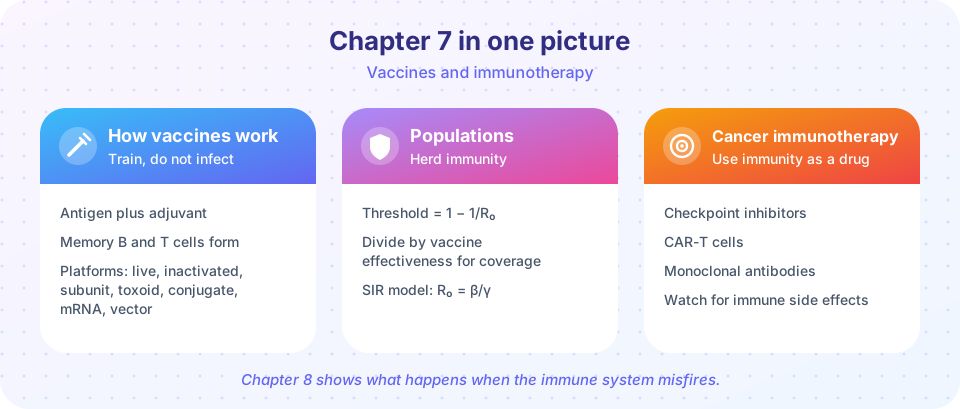
The chapter at a glance
| Topic | Key idea | Lesson |
|---|---|---|
| Live attenuated | Weakened pathogen. Strong and lasting. Avoided in severe immunodeficiency. | Types |
| Inactivated, subunit, toxoid | Safe. Need adjuvants and boosters. | Types |
| Conjugate | Sugar plus carrier protein recruits T cell help. | Types |
| mRNA and vector | Cells make the antigen from instructions. | Types |
| Adjuvants | Supply danger signals and co-stimulation. | Types |
| Herd immunity | Threshold 1 − 1/R0. Coverage needed = threshold / VE. | Herd immunity |
| SIR model | S, I and R compartments, R0 = β/γ. | Herd immunity |
| Checkpoint inhibitors | Block PD-1, PD-L1 or CTLA-4 to release T cells. | Immunotherapy |
| CAR-T | Engineered T cells with an antibody-based receptor. | Immunotherapy |
| Monoclonal antibodies | ADCC, complement, signal blocking. Names show origin. | Immunotherapy |
How the ideas connect
Everything depends on memory. A vaccine works because of the secondary response you studied in Chapter 6. Boosters, adjuvants and conjugate designs are all ways of improving the quality of the memory that forms.
Population effects add to individual effects. A vaccine protects the person who receives it, and when enough people are protected it also protects others. The threshold formula links the biology of the pathogen to the policy target.
Cancer immunotherapy re-uses the same biology. Checkpoint inhibitors are the other side of tolerance. CAR-T cells use the signals 1 and 2 you learned about. Monoclonal antibodies use the Fc-dependent killing mechanisms you saw with antibodies in the previous chapters.
Worked example: planning a measles vaccination programme
Suppose you are asked to think through a programme for a country in which measles has become common again. The chapter gives you the tools.
The pathogen. Measles is among the most contagious human infections, with an R0 of 12 to 18. The herd immunity threshold is therefore about 92 to 94 percent. Because no vaccine is perfect, the coverage needed is higher: with an effectiveness of 97 percent for two doses, you need around 95 to 97 percent coverage. One dose is not enough, since a single dose protects fewer people than two.
The vaccine type. The usual measles vaccine is live attenuated, which means it gives strong, long-lasting immunity after one or two doses because the weakened virus replicates a little and stimulates B and T cells. It is not suitable for people with severe immunodeficiency, who are instead protected indirectly by high coverage in everyone around them. That is herd immunity doing the work it was meant to do.
The memory. Two doses produce a secondary response with memory B and T cells. The second dose is not a repeat for the sake of repeating. It catches the few people who did not respond to the first dose and raises the response in the others.
The gaps. National averages hide local pockets. A single school or neighbourhood with 85 percent coverage can sustain an outbreak even when the national figure is 95 percent. A good programme therefore looks at coverage by district and by age group, and aims first at the places where it is lowest.
The numbers. The SIR model tells you that if coverage is below the threshold, an outbreak can still take off, and that raising coverage even a few percentage points can change the picture a great deal when you are close to the threshold.
This kind of reasoning joins molecular biology, immunology and statistics in a single plan. It is also the reasoning behind decisions about boosters, new vaccines and travel advice.
Questions to ask yourself
- Why does a more contagious infection need a higher coverage?
- Which vaccine properties make a vaccine suited to infants, and which to older adults?
- How would you explain the difference between individual and population protection to a friend?
Try it
This exercise calculates required coverage for a range of vaccine effectiveness values.
Press Run (or Ctrl + Enter) to see the result here.
Program input · what you'd type while the program runs
Type the answers before you press Run, one per line. Each time the program reads a line (with input()), it gets the next line from this box.
The second exercise is a platform matcher: it suggests which vaccine type fits each statement. It is an exercise and not a guide for choosing a vaccine.
Press Run (or Ctrl + Enter) to see the console output here.
No output.
Check your understanding
Quick check · 10 questions
of 10 answered You scored / 10 · perfect!
-
1. Which vaccine type is usually avoided in people with severe immunodeficiency?
Live vaccines replicate and could cause disease when immunity is severely impaired. -
2. Why do conjugate vaccines work in infants?
T cell help drives class switching and memory against the sugar. -
3. For R0 = 10, what is the herd immunity threshold?
1 - 1/10 = 0.9. -
4. A vaccine has 80% effectiveness and the threshold is 60% immune. What coverage is needed?
Coverage = 0.60 / 0.80 = 0.75. -
5. In the SIR model, R0 equals:
R0 = β/γ, the contact rate times the infectious period. -
6. What is the role of an adjuvant?
Adjuvants stimulate innate sensors, increasing co-stimulation and cytokines. -
7. Which cells does an anti-CD19 CAR-T product target?
CD19 is a B cell marker, present on many B cell cancers. -
8. What is ADCC?
In antibody-dependent cellular cytotoxicity, NK cells recognize bound antibody through Fc receptors and kill the target. -
9. Which ending marks a humanized antibody?
-zumab = humanized. -ximab = chimeric. -omab = mouse. -umab = fully human. -
10. Which is a typical side effect of checkpoint inhibitors?
Removing the brakes can allow inflammation in healthy tissues.
Summary
- Vaccine platforms trade off safety, strength and convenience. Adjuvants and boosters shape memory.
- Herd immunity depends on R0 and vaccine effectiveness.
- Cancer immunotherapy uses checkpoint blockade, CAR-T cells and monoclonal antibodies.
- Next you will see what happens when the immune system misfires.
Next: Chapter 8 overview: allergy, autoimmunity and immunodeficiency
Track your progress
Create a free account to tick off lessons and pick up where you left off on any device.
of Immunology lessons completed