


















Lesson 10 of 46 · Overview of the Immune System
Chapter 2 review: the immune system at a glance
Review chapter 2: primary and secondary lymphoid organs, the family of immune cells, innate versus adaptive immunity and lymph flow, with a recap table, tools and a ten-question quiz.
Chapter 2 gave you the map: where immune cells are born and trained, where they meet antigen, how the two branches differ and cooperate, and how lymph links everything together. This review condenses it into a picture, a table and a mixed quiz.
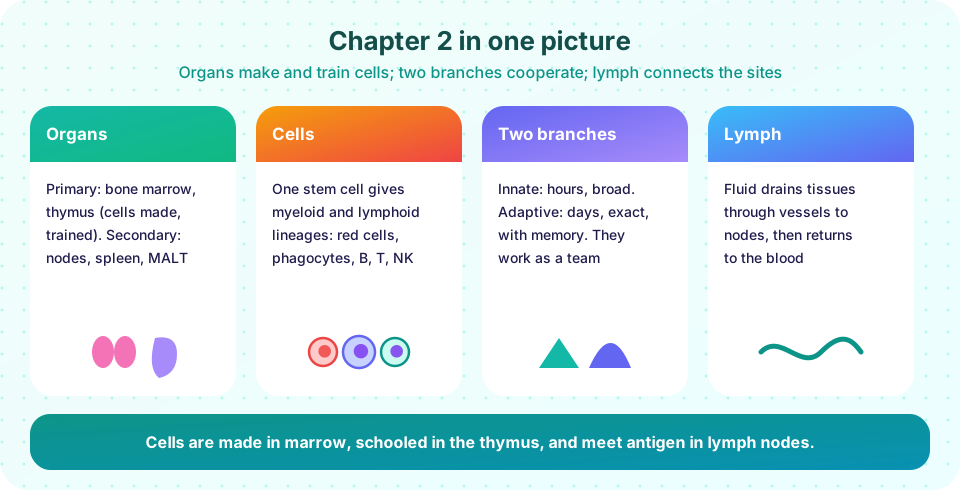
The chapter in one table
| Topic | Key facts |
|---|---|
| Primary organs | Bone marrow: all blood cells begin; B cells mature. Thymus: T cells tested by positive and negative selection |
| Secondary organs | Lymph nodes (filter lymph), spleen (filters blood), MALT (guards mucosae) |
| Cell lineages | Stem cell, then myeloid (red cells, platelets, neutrophils, eosinophils, basophils, monocytes) or lymphoid (B, T, NK, ILC) |
| Innate vs adaptive | Hours vs days; fixed vs rearranged receptors; little vs strong memory |
| Lymph | About 3 L/day returns to blood; one-way flow; node zones: sinus, follicle, paracortex, medulla |
Study checklist
- Draw a lymph node from memory and label six parts.
- Draw the blood-cell family tree and mark where the thymus enters.
- Explain in two sentences why a second infection is handled faster than the first.
- Name two ways innate and adaptive cells help each other.
A worked scenario
A young adult has their spleen removed after a car accident. Months later they develop a serious blood infection with an encapsulated bacterium. Why was the spleen so important, and what could have helped?
- The spleen filters blood. Its red pulp macrophages remove bacteria that are coated with antibody or complement, which is especially important for encapsulated bacteria that evade other defenses.
- Its white pulp is a secondary lymphoid organ in which B cells meet blood-borne antigen and make antibody quickly.
- Without a spleen, other organs (liver, lymph nodes) partly compensate, but the response to this kind of bacterium is weaker.
- Doctors therefore recommend vaccines against encapsulated bacteria and sometimes preventive antibiotics for people without a working spleen.
Common exam pitfalls
- Confusing primary and secondary organs: primary organs are where lymphocytes are made and educated (marrow, thymus); secondary organs are where they meet antigen.
- Saying B cells mature in the thymus (the thymus is for T cells).
- Believing lymph is made inside nodes or that lymph has a pump.
- Forgetting that dendritic cells reach the node through lymph, while naive lymphocytes arrive from the blood.
- Describing the swelling of a node as a failure instead of a normal sign of a response in progress.
Explain it in your own words
Teach these to an imaginary friend. Where is a T cell made, and where is it educated? What is the path of a drop of lymph from a finger to the blood? Why does the body need both a fast general response and a slow specific one? How does a rare lymphocyte find its antigen? If any answer feels vague, return to the matching lesson and look at its picture again. Drawing the lymph node and the blood-cell tree from memory is one of the best ways to check yourself before moving on.
What comes next
Chapter 3 takes the innate branch apart: the barriers that stop most microbes, the inflammation that follows a breach, the phagocytes and receptors that sense danger, the complement cascade and the NK cells that patrol for infected cells. Keep the lymph node picture handy, because dendritic cells from the innate side will carry their antigen there to start the adaptive response.
Try it
Press Run (or Ctrl + Enter) to see the console output here.
No output.
Check your understanding
Quick check · 10 questions
of 10 answered You scored / 10 · perfect!
-
1. In which organ do T cells undergo positive and negative selection?
Selection of developing T cells happens in the thymus. -
2. Which lineage gives rise to B cells, T cells and NK cells?
They all arise from the common lymphoid progenitor. -
3. The spleen's main role among these is to:
The spleen filters blood and its white pulp hosts T and B cells. -
4. Which is the correct direction of lymph flow?
Lymph begins as tissue fluid and ends in the subclavian veins. -
5. A naive lymphocyte that finds no antigen in a node will:
Naive cells recirculate until they meet their antigen. -
6. Which statement about innate immunity is correct?
Innate defenses are immediate and use germline-encoded receptors. -
7. Where in the node are plasma cells mostly found?
Plasma cells settle in the medulla and release antibodies into efferent lymph. -
8. What does a germinal center do?
Germinal centers sit inside follicles and support B-cell proliferation and selection. -
9. Which pair correctly matches a cell to its main job?
Eosinophils target parasites; antibodies are made by plasma cells; NK cells kill abnormal cells. -
10. Why does a second infection get cleared faster?
Memory cells are numerous and primed, so the adaptive response is faster and larger.
Summary
- Primary organs create and train lymphocytes; secondary organs host their meeting with antigen.
- Blood cells form a family tree from one stem cell with myeloid and lymphoid branches.
- Innate and adaptive immunity differ in speed, receptors and memory, but they cooperate through dendritic cells, cytokines and antibodies.
- Lymph carries antigen from tissues through nodes to the blood, and node zones sort the cells for an efficient start to the response.
Track your progress
Create a free account to tick off lessons and pick up where you left off on any device.
of Immunology lessons completed