


















Lesson 32 of 46 · Vaccines and Immunotherapy
Chapter 7 overview: vaccines and immunotherapy
A map of the chapter on how vaccines build immune memory, how herd immunity protects populations, and how immunotherapy turns immunity into a treatment for cancer.
Everything you have learned so far, receptors, signals, memory and brakes, becomes useful medicine in this chapter. A vaccine trains the adaptive immune system on a harmless version of a pathogen, so that real infection meets a prepared defence. Immunotherapy goes a step further: it uses antibodies, engineered cells or released brakes to treat disease, above all cancer.
Both fields are young by the standards of medicine, and both rest on the ideas of Chapters 5 and 6. A vaccine works because of memory. Checkpoint therapy works because of the brakes. CAR-T therapy works because T cells can be redirected by a new receptor.
What you will learn
- How vaccines work and what the main vaccine platforms are.
- The role of adjuvants and boosters.
- How herd immunity is calculated and why it matters.
- How cancer immunotherapy uses checkpoint inhibitors, CAR-T cells and antibodies.
Key terms
Vaccine: a preparation that stimulates adaptive immunity to a pathogen without causing the disease it prevents.
Adjuvant: a substance added to a vaccine to strengthen the immune response.
Herd immunity: indirect protection of unvaccinated people when enough of a population is immune.
Immunotherapy: treatment that works by modifying immune activity.
Monoclonal antibody: an antibody made by one clone of B cells, produced in quantity as a drug.
A short history
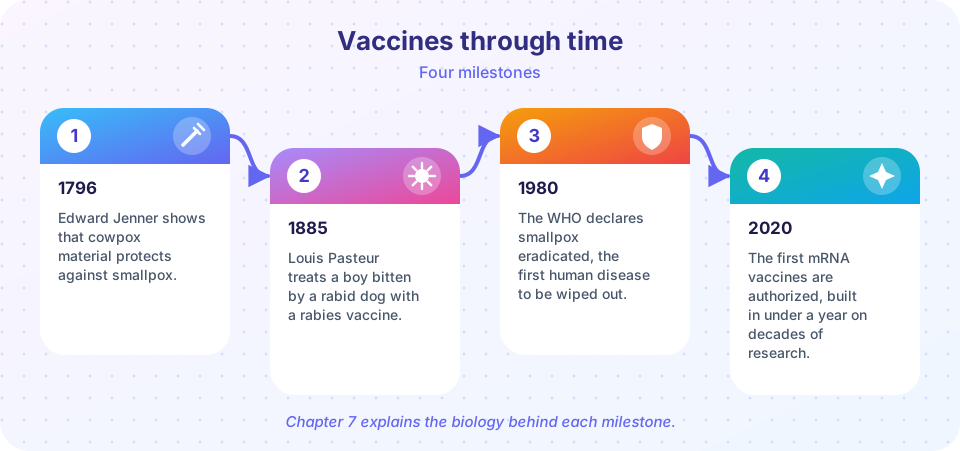
The first vaccine was an experiment. In 1796 the English physician Edward Jenner took material from a cowpox sore on a milkmaid and inoculated a boy with it. When the boy was later exposed to smallpox, he did not become ill. The word vaccine comes from the Latin vacca, cow. In the 1880s Louis Pasteur and colleagues developed vaccines for chicken cholera, anthrax and, in 1885, rabies, by weakening the microbes.
The 20th century added vaccines against diphtheria, tetanus, polio, measles and many more, and a global campaign led by the World Health Organization eliminated smallpox, declared eradicated in 1980. The 21st century added vaccines made by genetic engineering and, in 2020, the first mRNA vaccines to be authorized for use in people. In the same decades, immunology produced the first drugs that treat cancer by releasing T cells from their brakes.
Educational information. This course explains biology. It does not tell any person what medical decisions to make. Questions about vaccination, allergy or treatment belong with a doctor or public health service.
Chapter 7 in four ideas
Protecting populations
Immunity as a drug
Two ways of looking at a vaccine
A vaccine can be understood at two scales. At the scale of one person, it is an instruction to the adaptive immune system: here is an antigen, with a danger signal, so please build memory. The lessons on vaccine types and adjuvants describe how different designs deliver that instruction. At the scale of a population, a vaccine is a way of lowering the number of susceptible people, which changes how fast an infection can spread. The lesson on herd immunity describes this scale with simple mathematics.
Immunotherapy has a similar double nature. A checkpoint inhibitor acts on single T cells, but its value is measured in patients who survive longer. Keeping both scales in mind, the molecule and the person, is a good habit throughout the chapter.
A map of the chapter
- Vaccine types and adjuvants compares platforms from live attenuated to mRNA.
- Herd immunity shows the threshold formula and a simple epidemic model.
- Cancer immunotherapy covers checkpoint inhibitors, CAR-T cells and monoclonal antibodies.
- Chapter review summarizes with a ten-question quiz.
Common misconceptions
"Vaccines weaken the immune system." They exercise it. A vaccine trains specific memory and does not use up the capacity of the system.
"Natural infection is always better than vaccination." Infection can produce strong immunity, but it carries the risk of the disease itself, such as measles complications or paralysis from polio.
Try it
This short script counts how many years separate the milestones on the timeline. It is a small exercise in reading history as data.
Press Run (or Ctrl + Enter) to see the console output here.
No output.
Check your understanding
Quick check · 3 questions
of 3 answered You scored / 3 · perfect!
-
1. What is the main goal of a vaccine?
A vaccine primes adaptive immunity so that a real infection meets memory cells. -
2. Which disease was declared eradicated in 1980?
Smallpox is the only human disease so far to have been eradicated by vaccination. -
3. What do checkpoint inhibitors do?
They block inhibitory receptors such as PD-1 or CTLA-4.
Summary
- Vaccines use immune memory to prevent disease, and adjuvants strengthen them.
- Herd immunity protects a population when enough people are immune.
- Immunotherapy uses the immune system as a treatment: checkpoint blockade, CAR-T cells and monoclonal antibodies.
Track your progress
Create a free account to tick off lessons and pick up where you left off on any device.
of Immunology lessons completed