


















Lesson 14 of 46 · Innate Immunity
The complement system: a protein cascade that tags and bursts microbes
Understand the complement cascade: the classical, lectin and alternative pathways, the central C3 convertase, opsonization, inflammation, the membrane attack complex and how host cells are protected.
Your blood plasma contains a set of about thirty proteins that, once switched on, work together like a row of falling dominoes with amplifiers between them. They are called complement, because in the 1890s Jules Bordet and Paul Ehrlich found that they "complement" antibodies in killing bacteria. Complement coats microbes so phagocytes can grab them, calls in more defenders, and, in some cases, drills holes in the microbe's membrane.
It is a beautiful example of a cascade: each step is an enzyme activating the next, so a small trigger leads to a huge response. The challenge is control, since a system that powerful must be kept off healthy cells. This lesson shows how it is switched on, what it does and how it is kept in check.
What you will learn
- The three activation pathways and what triggers each.
- What the C3 convertase does and why C3 is the hub.
- The three main outcomes: opsonization, inflammation and lysis.
- How host cells are protected and what happens when complement is deficient.
Key terms
- Cascade: a series of reactions in which each product activates the next step.
- Convertase: an enzyme complex that cleaves a complement protein (C3 convertase cleaves C3).
- Anaphylatoxin: a small fragment (C3a, C5a) that triggers inflammation.
- MAC: membrane attack complex, the pore formed by C5b, C6, C7, C8 and many C9.
- Opsonization: coating a particle to make it easier for phagocytes to engulf.
Three ways to start
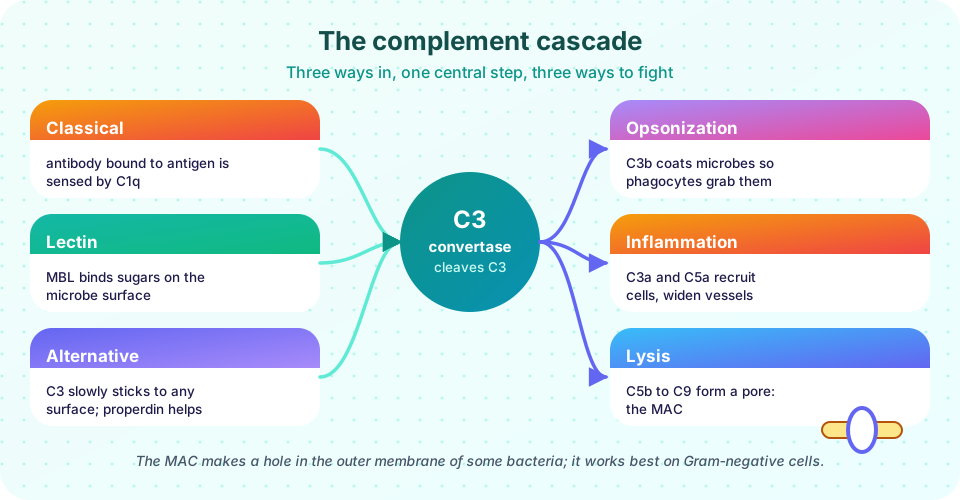
All three routes lead to the same enzyme, the C3 convertase, but they begin with different triggers.
| Pathway | Trigger | Key early proteins | C3 convertase |
|---|---|---|---|
| Classical | Antibody (IgM or IgG) bound to an antigen, or some danger molecules such as CRP | C1q, C1r, C1s, C4, C2 | C4b2b |
| Lectin | Mannose-binding lectin (MBL) or ficolins attaching to sugars on microbe surfaces | MBL, ficolins, MASPs, C4, C2 | C4b2b |
| Alternative | Spontaneous, constant low-level activation of C3 on any surface; amplified on microbes | C3, factor B, factor D, properdin | C3bBb |
- In the classical pathway, C1q is a flower-like molecule with six heads that binds the Fc regions of antibodies clustered on a microbe. This is a point where adaptive immunity (antibodies) recruits innate weapons.
- In the lectin pathway, the receptor binds mannose-rich sugars that are common on microbes but rare on our own cell surfaces. It works without antibody.
- In the alternative pathway, C3 in the plasma is constantly and slowly broken down ("tick-over"). On a normal human cell, regulatory proteins quickly shut that down. On a microbe, the active fragment C3b can stick and set up a positive feedback loop: each C3b on the surface helps make more convertase, which makes more C3b. Properdin stabilizes the convertase, which is why this pathway is also called the properdin pathway.
The hub: C3
The most abundant complement protein is C3. The convertase cuts it into two pieces:
- C3a, a small fragment released into the surroundings. It acts as an anaphylatoxin: it makes mast cells release histamine, raises vessel permeability and attracts cells.
- C3b, a larger fragment with a hidden reactive bond (a thioester) that, once exposed, links covalently to nearby surfaces. This is how microbes get tagged.
Because C3b binds the microbe that produced it, complement has a built-in "local" action: the tags land on the target and not far away.
Three outcomes
- Opsonization. Microbes coated with C3b are bound by complement receptors (CR1, CR3) on phagocytes, which greatly increases phagocytosis. For many encapsulated bacteria, such as pneumococci, this is a vital defense.
- Inflammation. C3a, and especially C5a, are anaphylatoxins; C5a is also one of the strongest chemoattractants for neutrophils, and it activates phagocytes and mast cells.
- Lysis. More C3b joins the convertase to form a C5 convertase, which cuts C5 into C5a and C5b. C5b attracts C6, C7, C8 and then 10 to 16 molecules of C9, which together form the membrane attack complex (MAC), a ring-shaped pore about 10 nm wide in the membrane. The cell loses its contents and dies. MAC is mainly effective against Gram-negative bacteria and some enveloped viruses; Gram-positive bacteria have thick walls that block it, so for them opsonization matters most. People who lack C5 to C9 are not generally ill; their main weakness is repeated infection with Neisseria (meningococcus), which shows how important the MAC is against that genus.
Complement also helps clear immune complexes (antibody-antigen clumps) and dying cells, which is why deficiencies in early components (C1q, C2, C4) are linked to lupus-like autoimmune disease.
Keeping complement in check
Without control, complement would attack the body. Host cells carry regulators:
- Factor H and DAF (CD55) speed the decay of C3 convertases on host surfaces.
- Factor I with cofactors cuts C3b into inactive pieces.
- CD59 blocks the assembly of C9 into the MAC.
- C1 inhibitor restrains C1 and the lectin proteases. A shortage of it causes hereditary angioedema, with attacks of swelling driven by bradykinin.
Microbes that survive in blood often recruit our own regulators to their surfaces, for example by binding factor H, to disguise themselves. Medicines that block complement (for example anti-C5 antibodies) are used in certain rare blood and kidney disorders.
Complement in medicine
Because complement is so powerful, doctors keep an eye on it. Blood tests for the levels of C3 and C4, or for total complement activity (the CH50 test), help assess diseases such as lupus, where immune complexes consume complement and the levels fall. In a mismatched blood transfusion, anti-A or anti-B antibodies (mostly IgM) bind the donor's red cells and trigger the classical pathway, so the cells burst inside the bloodstream, which is why the reaction is so dangerous. People treated with drugs that block C5 lose the MAC and are at much higher risk of meningococcal infection, so they are vaccinated against it and watched carefully. These examples show the two sides of the system: protection when it works, and damage when it is deficient, overactive or aimed at the wrong target.
Common misconceptions
"Complement is part of adaptive immunity because it works with antibodies." It is an innate system; antibodies are only one of its triggers.
"The MAC is the main job of complement." In most infections, opsonization and inflammation matter more than lysis.
"Complement only fights bacteria." It also clears dead cells and immune complexes, and shapes brain development and inflammation.
Try it
Press Run (or Ctrl + Enter) to see the result here.
Program input · what you'd type while the program runs
Type the answers before you press Run, one per line. Each time the program reads a line (with input()), it gets the next line from this box.
Check your understanding
Quick check · 5 questions
of 5 answered You scored / 5 · perfect!
-
1. Which pathway is triggered by antibody bound to antigen?
C1q binds the Fc regions of IgM or IgG on a microbe and starts the classical pathway. -
2. What does the C3 convertase do?
C3 is the hub. C3b opsonizes and C3a is an anaphylatoxin. -
3. Which fragment is a strong neutrophil chemoattractant?
C5a recruits and activates neutrophils, and acts on mast cells. -
4. Why does complement not usually attack healthy host cells?
Regulators speed convertase decay or block the MAC on host surfaces. -
5. Deficiency in the late components C5 to C9 is typically linked to repeated infections with:
The MAC is especially important against Neisseria species.
Summary
- Complement is a plasma cascade that tags, recruits and lyses; classical, lectin and alternative pathways converge on the C3 convertase.
- C3b opsonizes microbes, C3a and C5a drive inflammation, and C5b with C6 to C9 forms the MAC pore.
- The alternative pathway has a positive feedback loop that runs away on microbes but is damped on host cells by regulators.
- Deficiencies cause characteristic problems: early components with lupus-like disease, late components with Neisseria infections, C1 inhibitor with angioedema.
Next: NK cells and interferons
Track your progress
Create a free account to tick off lessons and pick up where you left off on any device.
of Immunology lessons completed