


















Lesson 11 of 46 · Innate Immunity
Chapter 3 overview: innate immunity
A map of chapter 3: the four layers of innate defense, what each lesson covers and why layered defenses make the body so hard to invade.
Most of the microbes that touch you never get anywhere. They land on skin that is dry, slightly acidic and constantly shedding. They are trapped in mucus and swept out by cilia. They meet enzymes, acid and antimicrobial peptides. Those that get past are met by cells that eat them and proteins that punch holes in them. All of this happens without any prior exposure and mostly without you noticing. This is innate immunity, and it stops the vast majority of threats in the first minutes and hours.
This chapter explores the innate system layer by layer. The overview below gives you the plan.
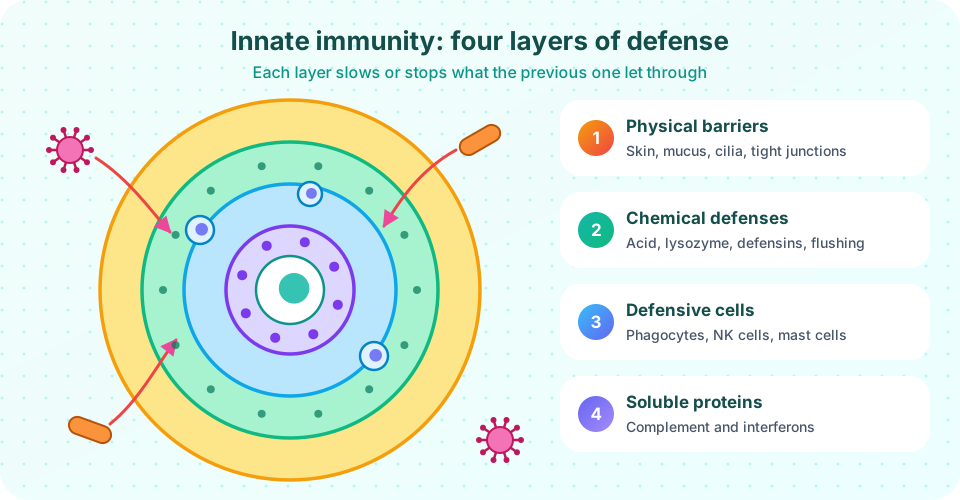
Layered defense
Layer 1: Barriers
Layer 2: Chemistry
Layer 3: Cells
Layer 4: Proteins
Layers work together, not alone.
What each lesson covers
- Barriers and inflammation. Skin, mucous membranes, chemical defenses and the microbiota; then what happens when a barrier is broken: mast cells, histamine, widened vessels, neutrophil recruitment and the five signs of inflammation.
- Phagocytes and pattern recognition. Neutrophils, macrophages and dendritic cells; Toll-like receptors; the steps of phagocytosis and how phagocytes kill.
- The complement system. A cascade of blood proteins that tags microbes, recruits cells and makes pores.
- NK cells and interferons. How the body catches virus-infected and cancerous cells.
- Chapter 3 review. One picture, one table, ten questions.
Why layers?
Each layer has a failure rate. A microbe might evade the skin, slip past mucus or resist lysozyme. If every layer lets through, say, one in ten, four layers let through only one in ten thousand. Evolution did not need a perfect wall; it needed several imperfect ones in series. The widget below lets you try this arithmetic.
Questions this chapter answers
- How are most microbes stopped before any immune cell is involved?
- What turns a splinter into redness, heat, swelling and pain?
- How can a cell recognize a bacterium it has never met before?
- Which proteins in blood plasma can tag a microbe or even burst it?
- How does the body catch viruses that hide inside cells?
Terms you will meet
PAMP and PRR (a microbial pattern and the receptor that senses it), cytokine and chemokine (signals, the latter attracting cells), opsonin (a coat that helps phagocytes grab a target), MAC (the pore made by complement) and ISG (a gene switched on by interferon). Each one is explained when it appears.
How this chapter connects to the rest
The innate system does not work in isolation. In the next chapters you will see antibodies recruiting complement and phagocytes, T cells depending on signals from dendritic cells, and NK cells and T cells sharing the job of finding infected cells. Remember the location rule from Chapter 1: where the microbe lives decides which innate weapon is used. Surfaces meet barriers, tissues meet inflammation and phagocytes, blood meets complement, and the inside of a cell meets NK cells and interferons.
A study tip for this chapter
Many students find the innate system hard because it has many parts with similar-sounding names. Make a table with four columns (barrier, cell, protein, receptor) and add each new term as you meet it. After every lesson, check that you can say where the thing acts and what it senses or does. A good test is to tell the story of a thorn pricking a finger, naming one defense for each minute and hour as the story unfolds.
Try it
Press Run (or Ctrl + Enter) to see the console output here.
No output.
Check your understanding
Quick check · 3 questions
of 3 answered You scored / 3 · perfect!
-
1. Why is it an advantage to have several imperfect layers of defense?
Pass rates multiply, so even moderately effective layers in series let very few microbes through. -
2. Which is a chemical defense?
Lysozyme is an enzyme that cuts bacterial cell walls; the other two are physical defenses. -
3. Which innate component helps warn neighboring cells about a virus?
Type I interferons signal neighbors to enter an antiviral state.
Summary
- Innate immunity is immediate and inherited, and it stops most threats.
- It has four layers: barriers, chemistry, cells and proteins.
- Layers in series multiply down the number of invaders.
- The chapter covers barriers and inflammation, phagocytes, complement, NK cells and interferons.
Track your progress
Create a free account to tick off lessons and pick up where you left off on any device.
of Immunology lessons completed