


















Lesson 39 of 46 · Allergy, Autoimmunity and Immunodeficiency
Autoimmunity: when tolerance fails
Learn how tolerance fails to cause autoimmune disease, how genes, infections and the environment combine, and how autoantibodies and self-reactive T cells cause damage.
In Chapter 6 you saw that tolerance is a stack of safeguards: deletion in the thymus, anergy, regulatory T cells, checkpoints. Autoimmune disease is what happens when those safeguards are overwhelmed and the immune system attacks the body's own tissues in a way that causes lasting damage. Taken together, autoimmune diseases affect several percent of people, with each individual disease being much rarer. More than eighty conditions are classed as autoimmune, from type 1 diabetes to multiple sclerosis to rheumatoid arthritis.
Paul Ehrlich foresaw the problem in 1901 with his phrase horror autotoxicus, the idea that the body would never allow immunity to turn against itself. It took until the 1950s to show that it sometimes does. Ernest Witebsky and Noel Rose showed that immunizing animals with thyroid tissue could cause a disease like Hashimoto's thyroiditis, and from there the field grew. This lesson explains the shared logic of autoimmunity and gives representative examples.
What you will learn
- The risk factors that combine to produce autoimmune disease.
- How molecular mimicry, epitope spreading and bystander activation are thought to work.
- The difference between organ-specific and systemic autoimmunity, with examples.
- What autoantibodies are and what they are and are not used for.
Key terms
Autoantibody: an antibody directed at a self molecule.
Molecular mimicry: similarity between a microbe's antigen and a self antigen, leading to cross-reaction.
Epitope spreading: the widening of an immune response to new self epitopes after tissue damage.
HLA association: a statistical link between a particular HLA allele and a disease.
Systemic disease: one that affects many organs, as opposed to one organ.
Why tolerance fails
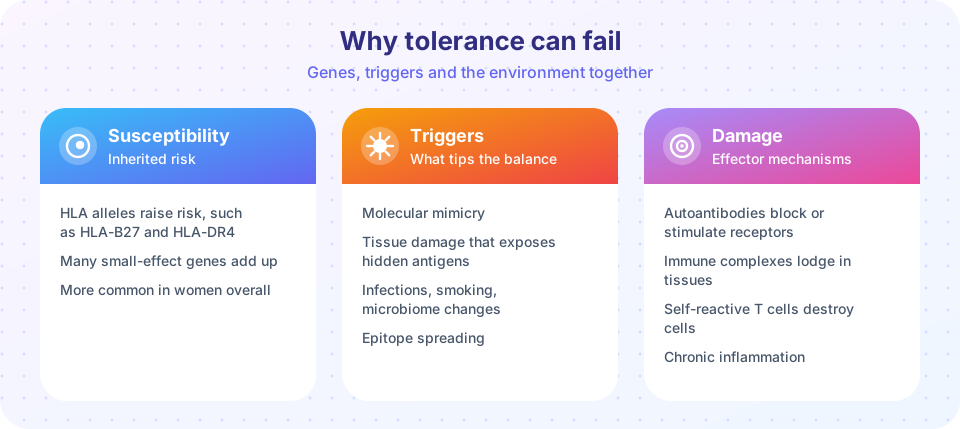
Autoimmune disease is rarely due to one cause. A useful working picture has three parts.
1. Susceptibility. Genes matter: the risk for an identical twin of an affected person is far higher than for the general population, though far from 100 percent, which shows that other factors count. The strongest genetic links are with HLA alleles, because they influence which self peptides T cells see. Examples include HLA-B27 with ankylosing spondylitis, HLA-DR3 and HLA-DR4 with type 1 diabetes, HLA-DQ2 and DQ8 with celiac disease, and HLA-DR4 with rheumatoid arthritis. Having such an allele raises risk but does not mean disease, since many carriers stay healthy. Other genes, including PTPN22 and many involved in cytokine signaling or regulatory T cells, add small effects. Many autoimmune diseases are more common in women, and a ratio of about four women to one man is often quoted for the group as a whole, with large differences between diseases.
2. Triggers. The environment supplies the push. Several mechanisms have been proposed:
- Molecular mimicry. In rheumatic fever, antibodies and T cells raised against Streptococcus pyogenes proteins cross-react with proteins in heart tissue. Guillain-Barré syndrome sometimes follows an infection with Campylobacter jejuni, whose surface resembles a nerve molecule.
- Release of hidden antigens. Injury to an organ can expose antigens that were never seen by developing T cells.
- Bystander activation. Intense inflammation can activate T cells that happen to be present, including self-reactive ones.
- Epitope spreading. As tissue is damaged, the response broadens from one epitope to others, so the attack grows and becomes self-sustaining.
Epstein-Barr virus infection is a well-studied example: a large study of military personnel found that people infected with the virus had a much higher risk of later developing multiple sclerosis, which supports a causal contribution, but the great majority of people infected with the virus never develop MS. Smoking, vitamin D status and the gut microbiome have also been studied as environmental factors.
3. Effector mechanisms. Once tolerance fails, tissue damage is carried out by the same mechanisms as in hypersensitivity: antibodies that block or stimulate receptors or tag cells (type II), immune complexes (type III) and self-reactive T cells (type IV).
Organ-specific diseases
| Disease | Target | Main mechanism |
|---|---|---|
| Type 1 diabetes | insulin-producing beta cells in the pancreas | T cell-mediated destruction |
| Hashimoto's thyroiditis | thyroid | T cells and antibodies against thyroid proteins |
| Graves disease | TSH receptor on the thyroid | stimulating autoantibodies cause overactivity |
| Myasthenia gravis | acetylcholine receptors at the neuromuscular junction | blocking autoantibodies |
| Multiple sclerosis | myelin in the central nervous system | T cell and antibody attack on myelin |
| Celiac disease | small intestine lining | T cell response to gluten peptides, with antibodies to tissue transglutaminase |
Systemic diseases
Systemic lupus erythematosus (SLE) involves autoantibodies against nuclear components, such as DNA. Antibody-DNA immune complexes lodge in kidneys, skin and joints, which is a type III mechanism, and symptoms vary widely. Rheumatoid arthritis involves chronic inflammation of the joint lining. It is associated with rheumatoid factor and with antibodies to citrullinated proteins (anti-CCP), and cytokines such as TNF drive the damage. Sjögren's syndrome affects tear and salivary glands.
Autoantibodies as markers
Autoantibodies can be markers, causes, or both. For some diseases, a specific antibody pattern supports diagnosis, always together with symptoms and other tests:
- anti-CCP antibodies in rheumatoid arthritis,
- anti-dsDNA and anti-Sm antibodies in lupus,
- anti-tissue transglutaminase antibodies in celiac disease,
- antibodies to the acetylcholine receptor in myasthenia gravis,
- antibodies to the TSH receptor in Graves disease,
- antibodies to GAD65 in type 1 diabetes.
An antibody may appear years before symptoms. Low levels of autoantibodies can also be found in healthy people, so the test result alone does not make a diagnosis.
Treatment principles
Most autoimmune diseases are chronic, and treatment aims to control rather than cure. Approaches include replacing what is lost (insulin in type 1 diabetes, thyroid hormone in Hashimoto's thyroiditis), reducing inflammation with corticosteroids, and using immunosuppressive or targeted drugs: antibodies against TNF (infliximab, adalimumab), against IL-6 receptors, drugs that deplete B cells (rituximab), or inhibitors of intracellular signaling. All broad immunosuppression carries a risk of infection, so specialist monitoring is needed. Restoring tolerance itself, for example by expanding regulatory T cells, is an active research goal.
Common misconceptions
"Autoimmune disease means a weak immune system." The immune system is misdirected. Many patients have both overactivity against self and treatment-related infection risks.
"Having an autoantibody means having the disease." Some healthy people have low levels, and the clinical picture matters.
"It is caused by one gene or one infection." Most autoimmune diseases are multifactorial.
Try it
This example is a liability-threshold model, a standard way to think about diseases with many risk factors. Each person has a "liability" score made of genes and environment. Disease appears when the liability crosses a threshold. Shifting the average liability, for example by carrying a risk allele, raises the share above the threshold. Numbers here are illustrative.
Press Run (or Ctrl + Enter) to see the result here.
Program input · what you'd type while the program runs
Type the answers before you press Run, one per line. Each time the program reads a line (with input()), it gets the next line from this box.
The second tool is a lookup of autoantibodies and the diseases they are associated with. It is for study only.
Press Run (or Ctrl + Enter) to see the console output here.
No output.
Check your understanding
Quick check · 5 questions
of 5 answered You scored / 5 · perfect!
-
1. What is molecular mimicry?
An immune response to a microbe can attack self tissue with a similar structure, as in rheumatic fever. -
2. Which condition involves stimulating autoantibodies against the TSH receptor?
In Graves disease the antibodies activate the receptor and cause an overactive thyroid. -
3. What is epitope spreading?
As cells are damaged, more self antigens are exposed and the response broadens. -
4. Which statement about HLA associations is correct?
HLA alleles are risk factors, not determinants. -
5. Which of these is an organ-specific autoimmune disease?
Type 1 diabetes targets the insulin-producing beta cells of the pancreas.
Summary
- Autoimmune disease results from failure of tolerance and usually needs genetic susceptibility, an environmental trigger and effector mechanisms.
- Molecular mimicry, hidden antigens, bystander activation and epitope spreading help explain how it starts and grows.
- Organ-specific diseases target one tissue. Systemic ones such as lupus and rheumatoid arthritis affect many.
- Autoantibodies are useful markers, but they are interpreted with clinical findings.
- Treatment replaces lost function and suppresses or redirects the immune response.
Track your progress
Create a free account to tick off lessons and pick up where you left off on any device.
of Immunology lessons completed