


















Lesson 46 of 46 · Projects and Practice
Further study: where to go after this immunology course
Plan your next steps after the immunology course: deeper biology, medicine and disease, and quantitative work, with links to related tracks on this site.
You have now covered the main ideas of immunology: how the immune system recognizes threats, how it is trained and regulated, how it remembers, how it can be directed by vaccines and drugs, and how it fails. That is a solid foundation, and what you do next depends on what you want from it. A future doctor, a laboratory scientist, a public health analyst and a curious reader will each want a different route.
This lesson suggests three directions, with links to related courses on this site, and some guidance on how to keep learning once you have finished the lessons.
What you will learn
- Three study directions that build on immunology.
- Which related tracks on this site support each one.
- How to practice and keep up with a fast-moving field.
Key terms
Primary literature: original research papers, as opposed to textbooks or news.
Review article: a paper that summarizes many studies on one topic.
Preprint: a research paper shared before formal peer review.
Bioinformatics: computational analysis of biological data.
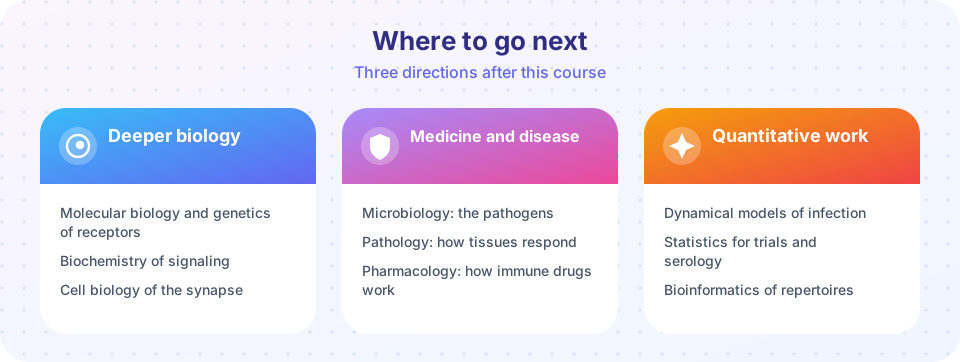
Direction 1: deeper biology
Immunology rests on cell and molecular biology. If you want to understand why receptors rearrange as they do, how signals pass from the T cell receptor to the nucleus, or how antibody genes are switched, strengthen the foundations.
- Molecular Biology covers DNA, RNA, gene expression and the techniques used in laboratories.
- Biochemistry covers proteins, enzymes and signaling pathways, the language of receptors and cytokines.
- Cells and Genetics revisits cell structure, inheritance and the basics of genetics.
Direction 2: medicine and disease
If your interest is health, the next steps connect immune responses to the organisms that provoke them, to the damage they cause and to the drugs that modify them.
- Microbiology studies bacteria, viruses, fungi and parasites, the opponents of the immune system.
- Pathology explains how tissues respond to injury and disease, including inflammation.
- Pharmacology explains how drugs act, including antihistamines, corticosteroids and biologic drugs.
- Anatomy and Physiology places the lymphatic system and organs in the context of the whole body.
Direction 3: quantitative and computational work
Modern immunology produces large datasets: receptor sequences from millions of cells, antibody levels from thousands of people, outbreak counts. Models of infection, like the SIR model in this course, are a gateway to mathematical biology.
- Probability and Statistics provides the tools for analyzing trials, serological surveys and experiments, including confidence intervals and the resampling used in the project.
- Bioinformatics covers the analysis of sequences and other biological data.
How to keep learning
Read primary literature slowly. Start with review articles in journals such as Nature Reviews Immunology or Annual Review of Immunology, then follow their references to the original papers. Read the abstract, then the figures, then the methods. Ask what was measured, in which species, and how large the effect was.
Follow how evidence changes. Immunology moves fast. Some ideas in current textbooks, such as the subset names of helper T cells or the details of memory cell types, are refined every few years. Treat textbook categories as useful maps and not as fixed borders.
Practice with data. The project in this chapter used synthetic data. Public datasets, for example vaccine trial summaries or surveillance reports from national health agencies, let you apply the same methods to real numbers. Always ask what a number means before making conclusions from it.
Be careful with health information. Reliable sources include national health agencies, the World Health Organization, and peer-reviewed journals. For personal health questions, a clinician is the right source.
Open questions in the field
A few questions that researchers are actively working on, and that your new vocabulary lets you follow:
- Can tolerance be restored in autoimmune disease without suppressing the whole immune system?
- How can vaccines be designed to induce broad, long-lasting responses to rapidly mutating viruses?
- Why do some patients respond to checkpoint inhibitors and others not, and how can responses be extended to more cancers?
- How does the microbiome shape immune development and allergy?
- How do immune responses change with aging, and can they be rejuvenated?
Common misconceptions
"A course is the end of learning." It is the foundation. Fields change, and the ability to read new evidence critically is worth more than any list of facts.
"Basic and clinical immunology are separate." The big advances, vaccines, monoclonal antibodies, checkpoint therapy, came from basic discoveries about how the system works.
Try it
The first tool is a small advisor that suggests a direction from your interests. It is a playful aid and has no authority.
Press Run (or Ctrl + Enter) to see the console output here.
No output.
The second example is a tiny simulation of why surveillance needs statistics: the share of positive tests in a sample varies by chance, and larger samples vary less.
Press Run (or Ctrl + Enter) to see the result here.
Program input · what you'd type while the program runs
Type the answers before you press Run, one per line. Each time the program reads a line (with input()), it gets the next line from this box.
Check your understanding
Quick check · 3 questions
of 3 answered You scored / 3 · perfect!
-
1. Which type of article is a good starting point for a new research topic?
Reviews summarize many studies and point to the original papers. -
2. Why does a larger survey sample give a narrower range of estimates?
Random variation in the proportion falls roughly with the square root of the sample size. -
3. Which track on this site would best prepare you to read about the microbes that the immune system fights?
Microbiology covers bacteria, viruses, fungi and parasites.
Summary
- After immunology you can go deeper into molecular and cell biology, into medicine and disease, or into quantitative and computational work.
- Related tracks on this site cover each direction.
- Learn to read primary literature, follow changing evidence and practice with data.
- You now have the vocabulary to follow current research. Congratulations on finishing the course.
Return to the Immunology course page.
Track your progress
Create a free account to tick off lessons and pick up where you left off on any device.
of Immunology lessons completed