


















Lesson 41 of 46 · Allergy, Autoimmunity and Immunodeficiency
Chapter 8 review: allergy, autoimmunity and immunodeficiency
Review hypersensitivity types, autoimmune mechanisms, immunodeficiency patterns and transplant rejection with a recap table and a ten-question mixed quiz.
This chapter examined the ways the immune system can go wrong. The same set of cells and molecules produced three different families of disease, depending on whether the response was too strong, aimed at self or too weak. The review below pulls the mechanisms together. As before, it is educational and does not replace medical care.
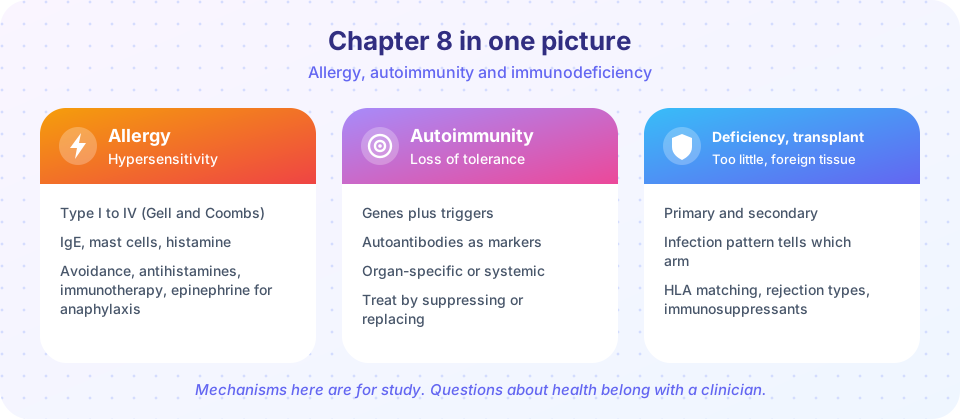
The chapter at a glance
| Topic | Key idea | Lesson |
|---|---|---|
| Type I | IgE, mast cells, histamine. Minutes. Hay fever, food allergy, anaphylaxis. | Allergy |
| Type II | IgG or IgM against cell-surface antigens. Transfusion reaction, Graves disease. | Allergy |
| Type III | Immune complexes. Serum sickness, lupus nephritis. | Allergy |
| Type IV | T cells. Delayed, 1-3 days. Contact dermatitis, tuberculin test. | Allergy |
| Autoimmunity | Genes plus triggers plus effector mechanisms. Mimicry, epitope spreading. | Autoimmunity |
| Autoantibodies | Markers such as anti-CCP, anti-dsDNA, anti-tTG. Interpreted with symptoms. | Autoimmunity |
| Primary deficiency | Inherited. SCID, agammaglobulinemia, CGD, complement defects. | Immunodeficiency |
| Secondary deficiency | Acquired. HIV, drugs, malnutrition, aging. | Immunodeficiency |
| Transplant | HLA matching, hyperacute, acute and chronic rejection, GVHD. | Immunodeficiency |
How the ideas connect
Earlier chapters predict the diseases. Tolerance failure (Chapter 6) leads to autoimmunity. Th2 and IgE (Chapters 4 and 5) lead to allergy. The thymus and complement (Chapters 3 and 5) explain specific deficiencies.
Mechanisms recur. The four hypersensitivity types are also the mechanisms of autoimmune tissue damage. Graves disease and myasthenia gravis are type II, lupus nephritis is type III, type 1 diabetes is type IV.
Treatment is a balancing act. Allergy and autoimmunity are treated by dampening the response. Immunodeficiency is treated by replacing the missing part or preventing infection. Transplant medicine adds suppression on purpose. Every step has a trade-off.
Worked example: three patients, three failures
These are teaching sketches, not real patients, and they show how to use the chapter's ideas to reason about a problem.
Patient A develops hives, wheezing and light-headedness minutes after eating a certain food. The time scale of minutes points to an IgE-mediated type I reaction. A previous mild reaction may have been the sensitization. This is a case of the immune system doing too much, and because the airway and circulation are involved, it is an emergency.
Patient B has fatigue, joint pain and a rash that is worse after sun exposure, and tests show antibodies against nuclear components such as DNA. The picture suggests an autoimmune disease with immune complexes, a type III mechanism, in which tolerance has failed. Genes, hormones and environmental triggers have probably all contributed. Here the immune system is aimed at the wrong target, and treatment tries to reduce the inflammation and control the autoimmune response.
Patient C is an infant with repeated severe infections by viruses and fungi, poor growth and very low T cells. This points to a primary defect in the T cell arm, such as a severe combined immunodeficiency. The immune system is doing too little. Early diagnosis, ideally from newborn screening, matters because transplantation or gene therapy works best before serious infections occur.
Each patient is a different failure, but you can reason about all three with the same four questions: what is the threat or trigger, which arm of the immune system is involved, is the response too strong, too weak or misdirected, and what evidence would confirm it. The mechanisms are all taken from earlier chapters: IgE and mast cells, tolerance, immune complexes, the thymus and T cell development.
Questions to ask yourself
- Which of these patients would you expect to have a normal T cell count, and why?
- How would the timing of symptoms change if Patient A had a delayed type IV reaction instead?
- Why is early recognition so valuable in Patient C and in Patient A?
Try it
This exercise matches diseases to the hypersensitivity types used for tissue damage.
Press Run (or Ctrl + Enter) to see the console output here.
No output.
A second exercise compares how fast different reaction types appear.
Press Run (or Ctrl + Enter) to see the result here.
Program input · what you'd type while the program runs
Type the answers before you press Run, one per line. Each time the program reads a line (with input()), it gets the next line from this box.
Check your understanding
Quick check · 10 questions
of 10 answered You scored / 10 · perfect!
-
1. Which mediator is central to type I hypersensitivity?
IgE on mast cells triggers histamine release when allergen cross-links it. -
2. Which mechanism causes lupus nephritis?
Antibody-DNA complexes deposit in the kidney and activate complement. -
3. What is molecular mimicry?
Rheumatic fever is the classic example. -
4. A newborn has no T cells and serious infections. Which diagnosis is most consistent?
SCID causes severe, early viral, fungal and other infections. -
5. Which finding defines AIDS?
AIDS is the late stage of HIV infection. -
6. Which type of rejection occurs within minutes because of pre-formed antibodies?
Pre-formed antibodies activate complement and quickly destroy the graft. -
7. Which pair is correctly matched?
In myasthenia gravis, antibodies block acetylcholine receptors at the neuromuscular junction. -
8. Why does a sibling have a 25% chance of being a full HLA match?
Two parents with two haplotypes each give four equally likely combinations. -
9. What is graft-versus-host disease?
It occurs mainly after bone marrow or stem cell transplantation. -
10. Which statement about autoantibodies is correct?
Some healthy people have low levels, so results must be interpreted in context.
Summary
- Allergy, autoimmunity and immunodeficiency are failures of the same machinery: too strong, wrongly aimed, and too weak.
- Hypersensitivity types I to IV classify the mechanisms by mediator and timing, and they apply to autoimmune tissue damage too.
- Immunodeficiency can be recognized by infection patterns, and transplant rejection depends on HLA differences.
- The final chapter gives you case studies, a project, a glossary and a cheat sheet.
Next: Practice: case studies
Track your progress
Create a free account to tick off lessons and pick up where you left off on any device.
of Immunology lessons completed