


















Lesson 5 of 46 · Getting Started
Chapter 1 review: getting started
Review the foundations of immunology: self and nonself, the history of the field, the five pathogen groups and the numbers (titers, counts, logs). Includes flashcards and a quiz.
You have finished the first chapter. It was short on molecules and long on ideas, and those ideas will carry the rest of the course. This lesson pulls them into one picture, gives you a table to scan before an exam, and tests you with ten mixed questions.
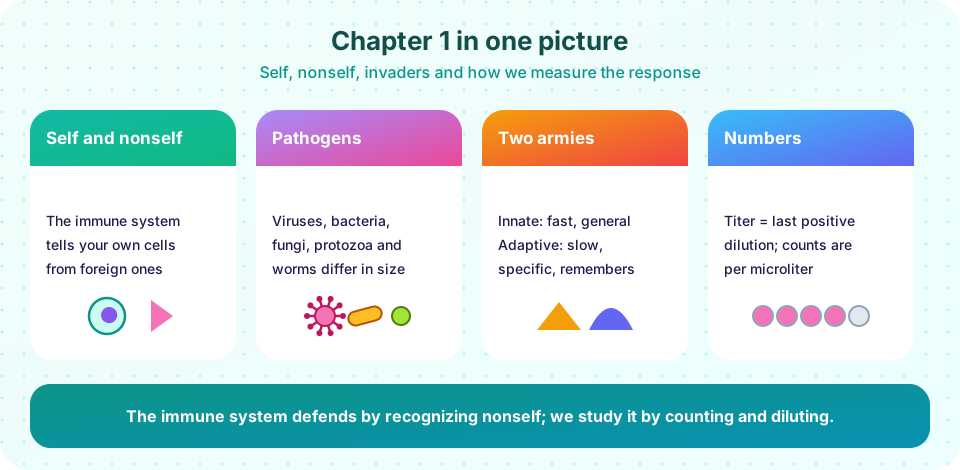
The chapter in one table
| Lesson | Big idea | Key facts to remember |
|---|---|---|
| What is immunology? | The system defends, surveils, tidies up and tolerates | Four hallmarks: specificity, diversity, memory, self-tolerance. Jenner 1796, Metchnikoff 1882, Behring 1890, Burnet 1957 |
| Pathogens and infection | Five groups of pathogen live in different places | Virus 20 to 300 nm; bacteria 0.5 to 5 µm; where it lives decides the response |
| Numbers in immunology | Immunity is measured with dilutions, counts and logs | Titer = reciprocal of last positive dilution; fourfold rise is meaningful; GMT is a geometric mean |
Three threads to carry forward
- Recognition is everything. Whether by innate patterns or by adaptive shapes, immunity begins when a receptor binds a molecule. Chapters 3 and 4 explore each type.
- Location matters. Extracellular microbes meet antibodies, complement and phagocytes. Intracellular microbes meet T cells and NK cells. Parasites too big to swallow meet eosinophils and IgE.
- Balance matters. Too little immunity leaves us open to infection; too much produces allergy and autoimmunity.
A worked scenario
During a flu season, a clinic takes a blood sample from a patient with a fever. Two weeks later, a second sample is taken. The laboratory tests both samples against the virus in a twofold dilution series. The first sample reacts down to 1:16; the second reacts down to 1:128. What do the numbers say?
- The titers are 16 and 128. The fold rise is 128 divided by 16, which equals 8.
- Eightfold is larger than the fourfold rule of thumb, so the data are consistent with a recent infection with this virus.
- Because this is a rise within one person, the absolute values matter less than the change. Two different laboratories could report different absolute titers for the same samples.
- The result supports a diagnosis but is only one input: symptoms and other tests count too.
Common exam pitfalls
- Mixing up pathogenicity (can it cause disease at all?) and virulence (how severe is the disease it causes?).
- Reading a titer as a count: 1:64 is a dilution, not 64 molecules.
- Forgetting that arithmetic means of titers are misleading and geometric means are used instead.
- Saying that all bacteria are harmful, or that antibiotics help against viruses.
- Treating innate and adaptive immunity as competitors rather than partners.
Explain it in your own words
Close the page and try to answer these aloud, as if teaching a friend. Why must the immune system be able to tell self from nonself? Why can a doctor not simply look up a list of bad molecules? What is the difference between a titer and a cell count? Why does the location of a pathogen decide which defenses work? If you stumble on one, reread that lesson's key-terms box and try again tomorrow; recalling after a pause is the strongest memory trick known to learning research.
Try it
Press Run (or Ctrl + Enter) to see the console output here.
No output.
Check your understanding
Quick check · 10 questions
of 10 answered You scored / 10 · perfect!
-
1. Which duty of the immune system is described by 'removing abnormal cells of your own'?
Surveillance means spotting and eliminating abnormal self cells, such as some early cancer cells. -
2. Which statement about innate and adaptive recognition is correct?
Innate receptors are inherited and recognize shared patterns; adaptive receptors are generated in each lymphocyte and give memory. -
3. Which finding supported the humoral theory?
Serum from immunized animals protected others, showing that molecules (antibodies) in the fluid part of blood act. -
4. A virus replicating in the cytoplasm is best controlled by which?
Because it sits inside cells, antibodies cannot reach it; infected cells must be recognized and killed or alerted. -
5. Which pathogen group ranges in size from about 0.5 to 5 micrometers?
Bacteria are typically a few micrometers; viruses are tens to hundreds of nanometers, and helminths are millimeters to meters. -
6. Which is the correct order of the stages of an acute infection?
The microbe first multiplies silently (incubation), then mild symptoms (prodrome), then clear illness, then recovery. -
7. Wells 1:2 through 1:32 are positive and 1:64 is negative. What is the titer?
The titer is the reciprocal of the last positive dilution, 32. -
8. Why use a geometric mean for titers?
Averaging the logs keeps one extreme value from dominating the result. -
9. A patient's blood has 8,000 white cells per microliter. Roughly how many white cells are in 1 milliliter?
1 mL is 1,000 µL, so 8,000 × 1,000 = 8,000,000. -
10. Which is the best description of 'self-tolerance'?
Tolerance mechanisms stop lymphocytes from attacking healthy self tissue; failures lead to autoimmune disease.
Summary
- Chapter 1 gave you the questions the rest of the course answers: what is self, who are the enemies, which defenses fit which enemy, and how do we measure the response.
- Four hallmarks of adaptive immunity, the history from Jenner to modern therapies, five pathogen groups, and the number tools (titer, fold rise, GMT, per-microliter counts, logs) are the core facts.
Track your progress
Create a free account to tick off lessons and pick up where you left off on any device.
of Immunology lessons completed