


















Lesson 8 of 46 · Overview of the Immune System
Innate versus adaptive immunity: two armies, one team
Compare innate and adaptive immunity by speed, receptors, specificity and memory, follow an infection through its first two weeks and see how the two branches cooperate.
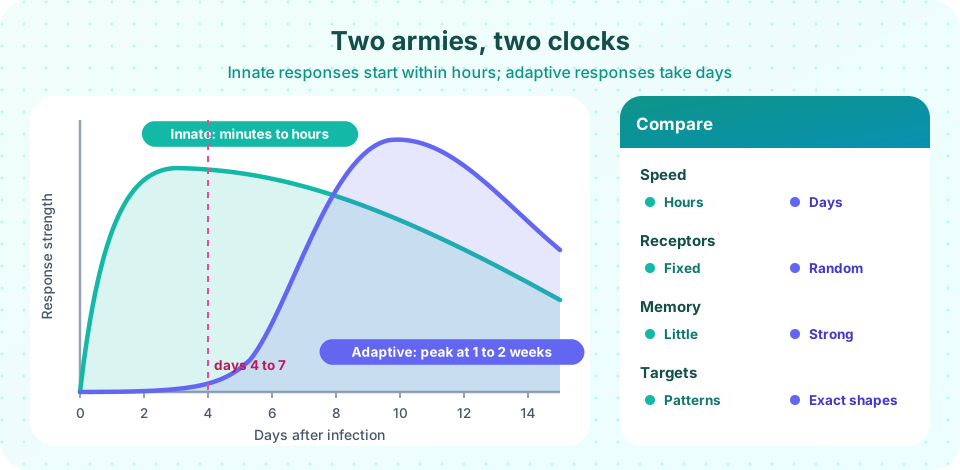
Textbooks divide the immune system into two branches, and every student has to learn the table: innate is fast and general, adaptive is slow and specific. That table is useful, but it hides the real story, which is cooperation. The innate branch buys time and sends the signals that wake up the adaptive branch. The adaptive branch then gives the innate branch better targeting and stronger weapons. Neither would work well alone.
This lesson compares the two on several axes, follows an imaginary infection through its first fortnight, and shows how memory changes the second encounter.
What you will learn
- The main differences between innate and adaptive immunity.
- How an infection unfolds in three phases over days.
- How the two branches cooperate.
- Why a second exposure to the same pathogen gives a faster and stronger response.
Key terms
- Innate immunity: defenses present from birth that recognize broad microbial patterns and respond within hours.
- Adaptive immunity: lymphocyte-based defenses that recognize specific antigens and develop memory.
- Humoral immunity: immunity carried by antibodies in body fluids.
- Cell-mediated immunity: immunity carried out by T cells acting directly on other cells.
- Cytokine: a small signaling protein that cells use to talk to each other.
The comparison
| Feature | Innate | Adaptive |
|---|---|---|
| Speed | Minutes to hours | Days (first exposure) |
| Receptors | Germline-encoded, fixed, a limited number of types | Generated by gene rearrangement in each lymphocyte; billions of possible |
| What is recognized | Shared patterns (e.g., bacterial cell wall parts) and signs of damage | Specific antigens down to a small shape |
| Main cells | Neutrophils, macrophages, dendritic cells, NK cells, mast cells, eosinophils | B cells and T cells |
| Main molecules | Complement, interferons, defensins, pattern-recognition receptors | Antibodies, T-cell receptors, cytokines |
| Memory | Mostly none (some "trained immunity" is being studied) | Yes: faster, larger, better on re-exposure |
| Self-tolerance | By design of its receptors | By selection and regulation of lymphocytes |
The adaptive branch is further split into humoral (B cells and antibodies, best against extracellular microbes and toxins) and cell-mediated (T cells, best against infected cells) arms. Remember the location rule from the pathogens lesson: where the enemy lives decides which arm is used.
An infection in three phases
Imagine a bacterium enters a cut on your finger.
- Immediate innate phase (0 to 4 hours). Barriers are breached, so resident macrophages and mast cells sense the microbe with pattern-recognition receptors, release cytokines and histamine, and the local blood vessels widen. Complement proteins in the fluid coat the bacterium. Neutrophils leave the blood and crowd in. Many infections are stopped here.
- Early induced response (4 to about 96 hours). If the infection persists, more cells are recruited, NK cells and interferons act against viruses, and dendritic cells pick up antigen and travel through lymph to the nearest node. In the node, they present the antigen to naive T cells. The rare T cell and B cell that happen to fit start to divide.
- Adaptive phase (about 4 days onward). Selected clones expand into thousands of effector cells. Plasma cells release antibodies; effector T cells leave the node and travel to the infected site. Over one to two weeks, the infection is cleared. Most effector cells then die, but a small group survives as memory cells.
The time lag in phase 3 is not laziness. Finding the single rare lymphocyte that recognizes this microbe (perhaps one cell in a hundred thousand or a million), letting it divide many times, and arming its offspring requires several rounds of cell division, each taking many hours.
How the branches cooperate
- Innate to adaptive: dendritic cells carry antigen to the lymph node and supply the signals (cytokines and co-stimulatory molecules) that naive T cells need. Without that "danger signal", a T cell that meets its antigen may be silenced instead of activated. That is a built-in safety catch against attacking harmless substances.
- Adaptive to innate: antibodies tag microbes so that phagocytes, NK cells and complement can find them (this is opsonization), and helper T cells release cytokines that make macrophages kill more effectively.
- Shared signals: cytokines such as interferons and interleukins circulate among all of them, like a group chat.
The second time is faster
On first exposure, the antibody response has a lag phase of about a week before antibodies appear, rises slowly, and the first antibodies are mostly the IgM class (Chapter 4). On re-exposure, memory B cells respond within a day or two; antibody levels rise higher and faster, and the antibody class is mainly IgG with a stronger fit to the antigen. This is the principle behind vaccination: a harmless first meeting creates memory so the "second" meeting is the real one. It is also why booster doses exist.
Evidence from people and animals
How do we know that both branches matter? Nature has run the experiment. Babies born with severe combined immunodeficiency (SCID) lack functional T cells, and often B cells as well. They are healthy at birth, partly protected by maternal antibodies, but then develop repeated, severe infections and need treatment such as a stem-cell transplant. The innate system alone cannot protect them for long. Conversely, people with inherited defects in particular innate pathways, for example in some Toll-like receptor signaling proteins or complement components, suffer from specific recurrent infections even though their lymphocytes are normal. Experiments in mice with genes switched off tell the same story. Neither branch can be removed without a price.
A third idea has emerged in recent years: trained immunity. After certain infections or vaccines (for example BCG, the tuberculosis vaccine), innate cells such as monocytes can undergo lasting changes in how their genes are switched on, so they respond more strongly to later, unrelated threats. This is not memory in the lymphocyte sense, because there is no antigen-specific receptor, and how much it matters in people is still an active research question. It shows that the old divide between "innate, no memory" and "adaptive, memory" is a useful simplification rather than an absolute law.
Common misconceptions
"Innate immunity is primitive and adaptive is advanced." Innate immunity exists in all animals and plants and is essential in humans; people with severe innate defects can die from infection even if their adaptive system is perfect.
"Adaptive immunity only starts after innate immunity has failed." Both begin together; the innate branch simply acts first because it needs no preparation.
"Antibodies kill microbes directly." Antibodies mostly label or neutralize; killing is carried out by complement and by phagocytes and other cells.
Try it
Press Run (or Ctrl + Enter) to see the result here.
Program input · what you'd type while the program runs
Type the answers before you press Run, one per line. Each time the program reads a line (with input()), it gets the next line from this box.
Check your understanding
Quick check · 4 questions
of 4 answered You scored / 4 · perfect!
-
1. Why does the adaptive response take several days on first exposure?
Only a tiny fraction of lymphocytes recognizes a given antigen; they must divide many times before the response is large. -
2. Which cell carries antigen from the tissue to the lymph node and activates naive T cells?
Dendritic cells bridge innate and adaptive immunity by presenting antigen with the necessary danger signals. -
3. What happens on the second exposure to the same antigen?
Memory B and T cells respond within a day or two, with higher antibody levels. -
4. Which is a feature of innate immunity?
Innate receptors are inherited; adaptive receptors are generated by gene rearrangement.
Summary
- Innate immunity is fast, broad and mostly memoryless; adaptive immunity is slower, specific and remembers.
- An infection passes through an immediate innate phase, an early induced phase and an adaptive phase from about day 4.
- Dendritic cells and cytokines wake adaptive cells; antibodies and helper T cells make innate cells stronger.
- A second exposure produces a faster, larger, higher-quality response, the basis of vaccines.
Track your progress
Create a free account to tick off lessons and pick up where you left off on any device.
of Immunology lessons completed