


















Lesson 16 of 46 · Innate Immunity
Chapter 3 review: innate immunity
Review chapter 3: barriers and inflammation, phagocytes and TLRs, the complement cascade and NK cells with interferons. A recap table, flashcards and a ten-question quiz.
The innate immune system is the part of your defense that you were born with and that never sleeps. In this chapter you followed an invader from the surface of the skin to the inside of a cell: barriers, inflammation, phagocytes and their pattern-recognition receptors, the complement cascade, and NK cells and interferons. This review ties them together.
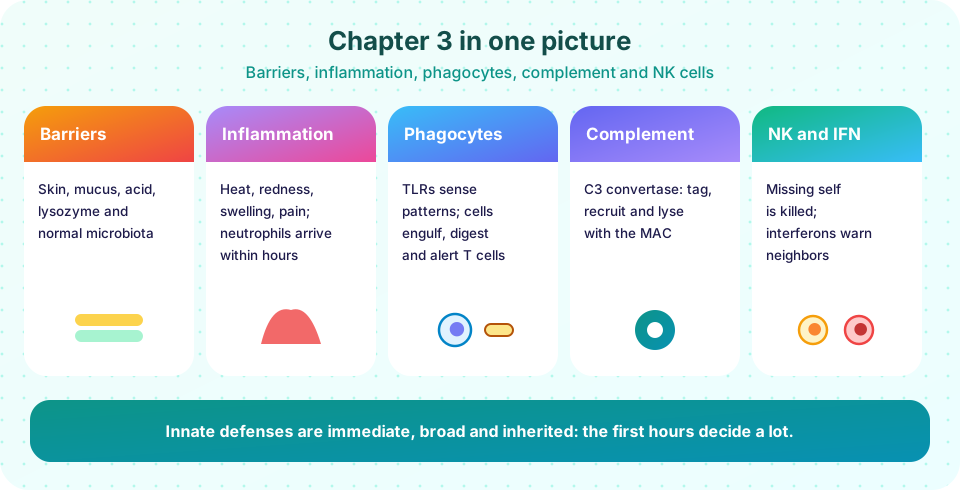
The chapter in one table
| Lesson | Problem it solves | Key players and facts |
|---|---|---|
| Barriers and inflammation | Stop entry; respond to a breach | Skin, mucus, lysozyme, defensins, microbiota; mast cells, histamine; rolling, adhesion, diapedesis, chemotaxis; five signs |
| Phagocytes and PRRs | Find and eat microbes | Neutrophils, macrophages, DCs; TLR4 (LPS), TLR5 (flagellin), TLR3 (dsRNA), TLR9 (CpG); phagolysosome; respiratory burst |
| Complement | Tag, recruit and lyse | Classical, lectin, alternative; C3 convertase; C3b, C3a, C5a, MAC; regulators |
| NK cells and interferons | Catch infected and abnormal cells | Missing self; perforin and granzymes; ADCC via CD16; IFN-α/β, ISGs |
Linking it to the location rule
| Where is the microbe? | Innate answer |
|---|---|
| On a surface | Barriers, mucus, flushing, microbiota |
| In tissue, outside cells | Inflammation, phagocytes, complement |
| Inside a cell | NK cells, interferons |
| Too big | Eosinophils and mast cells (Chapter 8) |
A worked scenario
A gardener pricks a finger on a rose thorn that carries soil bacteria. Trace the defense over three days.
- Minute 0: the thorn breaches the skin, the first barrier. Bacteria enter the tissue.
- Minutes to 1 hour: resident macrophages sense the bacteria with TLRs, and mast cells release histamine. The vessels widen and leak plasma containing complement proteins. Complement coats bacteria with C3b.
- Hours 1 to 6: neutrophils roll, stick, squeeze out and follow chemokines and C5a to the splinter site, where they phagocytose bacteria. The finger is red, warm, swollen and sore.
- Day 1 to 2: macrophages arrive in numbers and clear the debris. Dendritic cells carry antigen to the nearest lymph node, which enlarges as adaptive cells are activated.
- Day 3 onward: the swelling falls as the infection is cleared and repair begins; adaptive immunity takes over and builds memory.
Every step of this story appeared in the chapter. If you can tell it in your own words, you have learned the chapter.
Common exam pitfalls
- Mixing up the three recruitment steps (selectins for rolling, integrins for firm adhesion, chemokines for chemotaxis).
- Saying that complement is part of adaptive immunity because antibodies can activate it.
- Forgetting that NK cells are held back by MHC class I: they spare cells that display it normally and attack those that have lost it.
- Claiming that interferons kill viruses directly.
- Writing "TLR3 senses LPS" instead of TLR4.
Explain it in your own words
Say these out loud. How does a macrophage know that a bacterium is dangerous without having met it before? Why does a splinter cause redness and swelling, and why is that useful? What do the three pathways of complement have in common? Why can NK cells kill a cell that antibodies cannot reach? Try to include at least one named molecule in each answer (TLR4, C3b, perforin, interferon). If you can do that, you have the vocabulary and the logic together.
Try it
Press Run (or Ctrl + Enter) to see the console output here.
No output.
Check your understanding
Quick check · 10 questions
of 10 answered You scored / 10 · perfect!
-
1. Which cell is the first to arrive in large numbers at a bacterial wound?
Neutrophils are recruited within hours and are the first big wave. -
2. Which molecule coats microbes in complement and acts as an opsonin?
C3b binds covalently to surfaces and is recognized by complement receptors on phagocytes. -
3. Which sign of inflammation is caused by increased blood flow, and what is its Latin name?
Widened vessels bring more blood, causing redness (and heat). -
4. Which receptor senses double-stranded viral RNA in endosomes?
TLR3 is an endosomal receptor for double-stranded RNA. -
5. What triggers NK cell killing according to 'missing self'?
When inhibitory receptors find no MHC I, the NK cell is not held back and may kill. -
6. Which pathway of complement is triggered by antibody-antigen complexes?
C1q binds the Fc regions of antibodies on a microbe. -
7. What do ISGs such as PKR and OAS do?
PKR halts translation; OAS activates RNase L to degrade RNA. -
8. Which defect leads to chronic granulomatous disease?
Phagocytes can ingest but not kill some microbes without the respiratory burst. -
9. Why does mucus-cilia clearance protect the airways?
The mucociliary escalator is a physical barrier mechanism. -
10. Which immune event is the link between innate and adaptive immunity?
Dendritic cells mature on innate danger signals and then activate naive T cells.
Summary
- Innate immunity has layers: barriers, chemistry, cells and soluble proteins.
- Inflammation recruits neutrophils through rolling, adhesion, diapedesis and chemotaxis.
- Phagocytes use PRRs such as TLRs, then engulf and kill with oxygen radicals, enzymes and acid.
- Complement tags (C3b), recruits (C3a, C5a) and lyses (MAC) microbes under tight control.
- NK cells catch cells with missing self; interferons put neighbors in an antiviral state.
Track your progress
Create a free account to tick off lessons and pick up where you left off on any device.
of Immunology lessons completed