


















Lesson 31 of 46 · Immune Regulation and Memory
Chapter 6 review: immune regulation and memory
Review tolerance, regulatory T cells, checkpoints and immune memory with a one-page summary, a recap table and a ten-question mixed quiz.
This chapter was about control. You saw how the immune system avoids attacking the body, how it turns responses off, and how it keeps a record of past enemies. Use this page to check that the pieces fit together before moving on to vaccines, where memory and regulation are put to practical use.
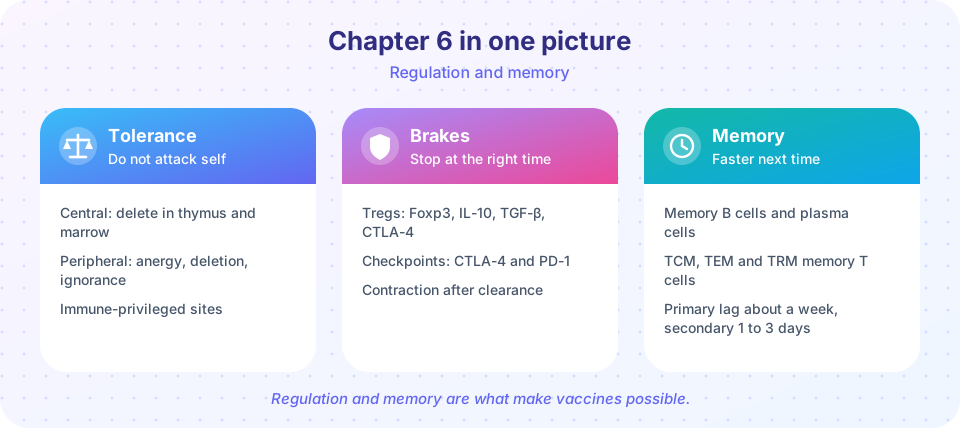
The chapter at a glance
| Topic | Key idea | Lesson |
|---|---|---|
| Central tolerance | Deletion or editing of self-reactive cells in thymus and bone marrow. | Tolerance |
| Peripheral tolerance | Ignorance, anergy, deletion, suppression and immune privilege. | Tolerance |
| Tregs | Foxp3 CD4 cells; IL-2 competition, CTLA-4, IL-10, TGF-beta. | Tolerance |
| Checkpoints | CTLA-4 limits priming. PD-1 limits effectors in tissues. | Tolerance |
| Primary response | Lag of about 5-10 days. IgM first, then modest IgG. | Memory |
| Secondary response | Lag of 1-3 days. Higher, IgG-dominated, higher affinity. | Memory |
| Memory cells | Memory B cells, long-lived plasma cells, TCM, TEM and TRM. | Memory |
How the ideas connect
Regulation makes powerful immunity affordable. Because there are brakes, the system can afford to build very strong weapons. Without tolerance mechanisms, the randomness that gives the immune system its diversity would also make autoimmune disease almost inevitable.
Memory depends on regulation too. After an infection, contraction removes most effector cells. The cells that survive and become memory cells are the product of a controlled process, not an accident.
Both are targets for medicine. Vaccines manufacture memory without disease. Checkpoint blockers remove brakes to attack tumors. Drugs for autoimmune disease try to restore or reinforce the brakes.
Worked example: the same virus twice
Imagine a person who is infected with a respiratory virus for the first time, and then meets the same virus a few years later. The chapter explains the difference between the two encounters.
During the first infection, only a few naive B and T cells recognize the virus. They must be found by antigen-presenting cells, activated and expanded, which takes about a week. In that week the virus multiplies and the person feels ill. IgM appears first, then IgG as germinal centers produce class-switched, mutated B cells. The T cell response peaks, kills infected cells, and then contracts. Regulatory T cells and checkpoint receptors such as CTLA-4 and PD-1 limit the response so that the inflammation does not damage the airways more than needed. When the virus is cleared, long-lived plasma cells move to the bone marrow, and memory B cells and memory T cells, including tissue-resident cells in the airway, are left behind.
During the second infection, the memory cells are far more numerous than the original naive clones were. Tissue-resident memory T cells in the airway see infected cells almost immediately. Memory B cells divide and become plasma cells within days, and the antibody that was already circulating blocks some virus at the start. The lag is 1 to 3 days instead of 5 to 10, the antibody level is much higher, and the virus often never gets far enough to cause symptoms.
Two cautions complete the picture. First, memory is not perfect. Antibody levels fall with time, and a virus that changes its surface proteins, as influenza viruses do, can escape memory that was built against an older version. Second, regulation never stops: even in the second infection, Tregs and checkpoints are working to stop a strong response from doing unnecessary harm.
Questions to ask yourself
- Which part of the second response is already in place before the virus arrives?
- Why does a failure of tolerance look different from a failure of memory?
- What would happen to the second infection if regulation were absent?
Try it
Use this program as a quick self-test. It shows prompts, and you answer in your head first.
Press Run (or Ctrl + Enter) to see the console output here.
No output.
A second tool compares several half-lives. For each half-life it prints the fraction of antibody left after 1, 5 and 20 years. It is just arithmetic, and the half-lives are examples only.
Press Run (or Ctrl + Enter) to see the result here.
Program input · what you'd type while the program runs
Type the answers before you press Run, one per line. Each time the program reads a line (with input()), it gets the next line from this box.
Check your understanding
Quick check · 10 questions
of 10 answered You scored / 10 · perfect!
-
1. A mature T cell meets its self antigen without co-stimulation. What is the most likely outcome?
Antigen without a second signal makes T cells anergic. -
2. Which protein can strip B7 from antigen-presenting cells and so reduce co-stimulation?
CTLA-4 binds B7 with higher affinity than CD28 and can remove it. -
3. IPEX syndrome is caused by mutations in which gene?
FOXP3 mutations remove functional Tregs and cause severe autoimmunity. -
4. Which receptor and ligand pair is blocked by many cancer immunotherapies?
PD-1/PD-L1 blockade releases exhausted T cells. -
5. What is affinity maturation?
Somatic hypermutation plus selection in germinal centers improves antibody affinity. -
6. Which statement about the secondary response is correct?
Memory cells make the second response faster, bigger and of higher affinity. -
7. Which cells are the main source of antibody in blood years after an infection?
Long-lived plasma cells in niches such as bone marrow secrete antibody continuously. -
8. Why is the eye described as immune privileged?
Immune privilege reduces inflammation at sites where damage would be especially harmful. -
9. Which step happens during contraction?
Contraction removes most effector cells after the antigen is cleared. -
10. What does trained immunity refer to?
Trained immunity is a form of innate memory, described after BCG vaccination and some infections.
Summary
- Tolerance comes in layers: central, then peripheral mechanisms including Tregs.
- CTLA-4 and PD-1 are checkpoints that limit T cell activity.
- Memory gives a faster, bigger, higher-affinity second response through memory B cells, plasma cells and memory T cells.
- Vaccines and cancer immunotherapy both build on these ideas, which is the topic of the next chapter.
Track your progress
Create a free account to tick off lessons and pick up where you left off on any device.
of Immunology lessons completed