


















Lesson 35 of 46 · Vaccines and Immunotherapy
Cancer immunotherapy: checkpoint inhibitors, CAR-T cells and antibodies
Explore how the immune system sees cancer, how tumors escape, and how checkpoint inhibitors, CAR-T cells and monoclonal antibodies turn immunity into treatment.
For a long time, the idea that the immune system could fight cancer was controversial. Tumors come from the body's own cells, which seems to make them invisible to a system built to ignore self. Yet cancers carry mutations and abnormal proteins that T cells can read, and people with weakened immunity develop certain cancers more often. In the last two decades this insight has become a new pillar of cancer treatment, called immunotherapy.
This lesson covers how the immune system sees tumors, how tumors escape, and three families of treatment: checkpoint inhibitors, CAR-T cells and monoclonal antibodies. It is an educational overview, not medical advice, and real treatment decisions depend on the type of cancer, the stage and the patient.
What you will learn
- The idea of immune surveillance and the three Es: elimination, equilibrium and escape.
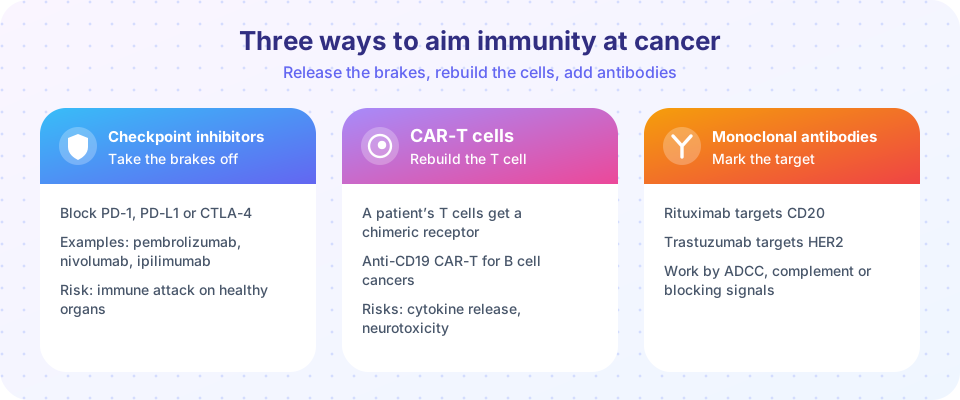
- How anti-PD-1, anti-PD-L1 and anti-CTLA-4 antibodies release T cells.
- How a CAR-T cell is built and what its risks are.
- How monoclonal antibodies work and how their names are formed.
Key terms
Neoantigen: a new peptide created by a tumor mutation and seen by T cells as foreign.
Immune checkpoint inhibitor: a drug, usually an antibody, that blocks an inhibitory receptor such as PD-1.
CAR (chimeric antigen receptor): an artificial receptor that joins an antibody-like binding domain to T cell signaling domains.
Cytokine release syndrome: a systemic inflammatory reaction caused by massive immune activation.
Monoclonal antibody (mAb): an antibody from a single B cell clone, made in large amounts.
Immune surveillance, editing and escape
In the 1950s, Macfarlane Burnet and Lewis Thomas proposed that the immune system routinely finds and removes early tumor cells. This is immune surveillance. Later work by Robert Schreiber and others refined the idea into cancer immunoediting, with three phases:
- Elimination. Innate and adaptive cells destroy emerging tumor cells.
- Equilibrium. The immune system holds surviving tumor cells in check, but also selects for variants that are harder to attack.
- Escape. A variant that has become resistant grows into a clinical tumor.
Tumors escape in several ways: they lose MHC class I or antigen genes, create an environment full of suppressive cells such as Tregs, secrete TGF-beta and, crucially, express checkpoint ligands such as PD-L1 that switch off T cells. A tumor with many mutations tends to have many neoantigens, and, on average, responds better to checkpoint inhibitors.
Checkpoint inhibitors
You met the checkpoint receptors CTLA-4 and PD-1 in Chapter 6. A checkpoint inhibitor is an antibody that blocks one of them, and therefore takes the brake off T cells that already recognize the tumor.
- Anti-CTLA-4: ipilimumab was approved in 2011 for advanced melanoma and was the first checkpoint inhibitor.
- Anti-PD-1: pembrolizumab and nivolumab, approved from 2014, are used in many cancer types, including melanoma, lung cancer and Hodgkin lymphoma.
- Anti-PD-L1: atezolizumab, durvalumab and avelumab block the ligand on tumor or immune cells.
These drugs produced long-lasting remissions in some patients with advanced cancers that were once almost untreatable, and earned Allison and Honjo the 2018 Nobel Prize. But they do not work for everyone: only a fraction of patients respond, and response depends on the cancer type and the tumor's features. Because the brakes also protect normal tissue, patients may develop immune-related adverse events, such as inflammation of the bowel, liver, thyroid, lungs or skin. These are usually treated by suppressing the immune system with corticosteroids and, if needed, other drugs.
CAR-T cell therapy
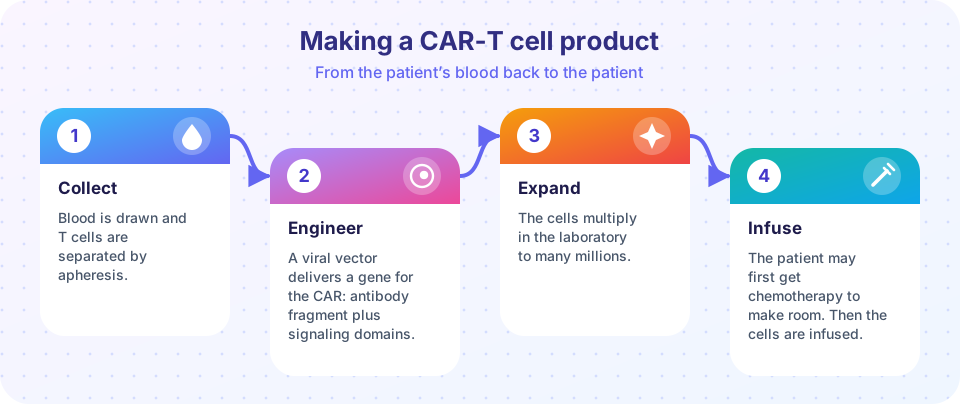
A chimeric antigen receptor is a lab-designed protein. Its outer part is the antigen-binding region of an antibody, held as a single chain (an scFv), and its inner part contains T cell signaling domains: CD3-zeta, which provides signal 1, and a co-stimulatory domain from CD28 or 4-1BB, which provides signal 2. A T cell carrying a CAR recognizes a surface antigen directly, without needing MHC, which is useful because many tumors hide MHC.
The therapy is personalized. The steps are shown below.
The best-known target is CD19, found on B cells and most B cell leukemias and lymphomas. Carl June's group at the University of Pennsylvania and Steven Rosenberg's group at the US National Cancer Institute carried out pioneering clinical work, and in 2017 the first CAR-T therapy, tisagenlecleucel, was approved in the United States for a form of childhood leukemia. A patient who receives anti-CD19 CAR-T also loses normal B cells, which means low antibodies, and may need replacement immunoglobulin.
The main risks are cytokine release syndrome, with fever and a drop in blood pressure that can be life-threatening, and neurologic toxicity (called ICANS). Both are managed by specialist teams, with drugs such as tocilizumab, which blocks the IL-6 receptor. CAR-T works best in blood cancers. Solid tumors are harder because of poor T cell entry, suppressive surroundings and heterogeneous antigens.
Monoclonal antibodies
In 1975 César Milstein and Georges Köhler made hybridoma cells by fusing an antibody-producing B cell with an immortal myeloma cell, giving an unlimited supply of one antibody. Along with Niels Jerne, they received the 1984 Nobel Prize. Today therapeutic monoclonal antibodies are engineered to reduce immune reactions to the drug.
Therapeutic antibodies work in several ways. They can:
- bind a protein on the tumor and signal other cells to destroy it, by antibody-dependent cellular cytotoxicity (ADCC), in which NK cells recognize the antibody's Fc region, or by activating complement;
- block a growth signal, such as HER2 (trastuzumab) or EGFR (cetuximab);
- deliver a toxin or radioactive payload to the tumor (antibody-drug conjugates);
- take the brakes off immune cells (checkpoint antibodies);
- bring T cells and tumor cells together (bispecific antibodies).
Rituximab, which targets CD20 on B cells, was approved in 1997 as the first monoclonal antibody for cancer.
Reading antibody names
The ending of a drug name carries information about its origin:
| Ending | Origin |
|---|---|
| -omab | mouse |
| -ximab | chimeric (mouse variable region, human constant region) |
| -zumab | humanized (only the antigen-binding loops are mouse) |
| -umab | fully human |
Other approaches
Researchers are developing tumor-infiltrating lymphocyte therapy, in which T cells are taken from a tumor, grown and returned; personalized neoantigen vaccines; oncolytic viruses that infect tumor cells selectively; and combinations of treatments. BCG, a weakened tuberculosis bacterium, has been used for decades to stimulate a local response in bladder cancer, an early example of immunotherapy. The HPV vaccine prevents cervical and other cancers caused by the virus, which is cancer prevention by vaccination.
Common misconceptions
"Immunotherapy is gentle because it uses your own immune system." It can cause serious inflammatory side effects, which is why it is given under specialist care.
"Immunotherapy works for every cancer." Responses depend on the cancer type and the tumor's features, and many patients do not respond.
"CAR-T cells are a drug in a bottle." Each product is made from the patient's own cells and is a living treatment.
Try it
The first example is a toy tumor model. A tumor grows, and T cells kill it, but the tumor's PD-L1 signal reduces killing. A blockade drug reduces that inhibition. All parameters are invented, and the curves show qualitative behaviour only, not predictions for any real patient.
Press Run (or Ctrl + Enter) to see the result here.
Program input · what you'd type while the program runs
Type the answers before you press Run, one per line. Each time the program reads a line (with input()), it gets the next line from this box.
The second example decodes antibody drug names from the ending.
Press Run (or Ctrl + Enter) to see the console output here.
No output.
Check your understanding
Quick check · 6 questions
of 6 answered You scored / 6 · perfect!
-
1. What does a PD-1 checkpoint inhibitor do?
By blocking PD-1 or PD-L1, the drug prevents inhibitory signaling to T cells. -
2. What is the main difference between a CAR and a normal T cell receptor?
CARs use an scFv from an antibody, so they do not need MHC presentation. -
3. Which is a major risk of CAR-T therapy?
Massive T cell activation can release large amounts of cytokines, causing fever and low blood pressure. -
4. What does the ending -zumab indicate?
-zumab marks humanized antibodies, whose antigen-binding loops come from a mouse. -
5. In immunoediting, which phase comes after equilibrium?
The three phases are elimination, equilibrium and escape. -
6. Which technique created the first monoclonal antibodies in 1975?
Köhler and Milstein's hybridoma method produced antibodies from a single clone.
Summary
- The immune system can detect tumor neoantigens, but tumors evolve to escape through immunoediting, loss of antigens and checkpoint ligands.
- Checkpoint inhibitors (anti-CTLA-4, anti-PD-1, anti-PD-L1) release T cell brakes and can cause immune-related side effects.
- CAR-T cells are a patient's own T cells equipped with an artificial receptor, effective in blood cancers, with risks of cytokine release syndrome and neurotoxicity.
- Monoclonal antibodies work by ADCC, complement, blocking signals or delivering payloads, and their names show their origin.
Next: Chapter 7 review
Track your progress
Create a free account to tick off lessons and pick up where you left off on any device.
of Immunology lessons completed