


















Lesson 22 of 46 · Antigens and Antibodies
Chapter 4 review: antigens and antibodies
Review chapter 4: antigens and epitopes, antibody structure, the five classes and their functions, and how B cells make and improve antibodies. Includes a recap table and a ten-question quiz.
Chapter 4 introduced the molecules that give adaptive immunity its precision. You now know what an antigen and an epitope are, how an IgG molecule is built, what the five classes do, and how B cells create, select and improve antibodies. This review brings it together.
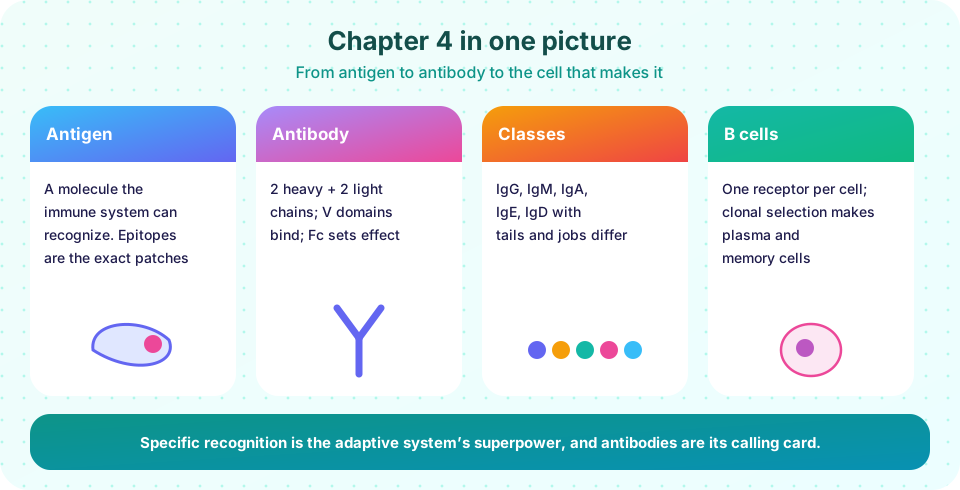
The chapter in one table
| Lesson | Key ideas | Numbers and names to remember |
|---|---|---|
| Antigens and epitopes | Antigen vs immunogen; epitopes; haptens; adjuvants | Size above about 10 kDa; MHC I peptides 8 to 10 aa, MHC II 13 to 25 aa; Landsteiner; alum |
| Antibody structure | Two heavy plus two light chains; V and C regions; CDRs; Fab and Fc | 150 kDa; 50 kDa heavy, 25 kDa light; papain gives 2 Fab and 1 Fc; Porter and Edelman |
| Antibody classes | IgG, IgM, IgA, IgE, IgD; six protective mechanisms | IgM pentamer (10 sites); IgG crosses placenta; secretory IgA dimer; IgE on mast cells |
| B cells | V(D)J, clonal selection, T-dependent response, germinal center, memory | RAG1/2, TdT, AID; Tonegawa; Burnet; plasma and memory cells |
Connecting the dots
- Specificity comes from the six CDR loops, which come from V(D)J recombination and mutation.
- Function comes from the Fc region, which comes from the heavy-chain class, which comes from class switching.
- Improvement comes from the germinal center: mutation plus selection.
- Memory comes from long-lived plasma cells and memory B cells, the basis of vaccines (Chapter 7).
A worked scenario
A baby receives a first vaccine dose at two months old and a booster at four months. Trace the antibodies.
- At birth, the baby carries maternal IgG that crossed the placenta. It protects for the first months and then declines.
- After dose 1, a few naive B cells meet the vaccine antigen in a lymph node. With help from T cells they form a germinal center. Early IgM appears within about a week, followed by IgG with mutated, higher-affinity receptors. Long-lived plasma cells and memory B cells form.
- After the booster, memory B cells respond within a day or two, produce more IgG and of higher affinity, and replenish the memory pool. Antibody levels are much higher than after dose 1.
- Over months, levels fall, but memory cells and long-lived plasma cells remain, giving fast protection on later exposure.
Notice that maternal antibodies are passive immunity and the vaccine response is active immunity.
Common exam pitfalls
- Saying an epitope is on the antibody (that is the paratope).
- Believing the antigen shapes the antibody rather than selecting a matching B cell.
- Forgetting that class switching changes the tail but not the specificity.
- Mixing up Fab (the arm, which binds) and Fc (the stem, which acts).
- Writing that IgE is the most abundant antibody in serum when it is the least abundant.
Explain it in your own words
Try these as a spoken explanation. What is the difference between an antigen and an epitope? Draw an IgG and label the six places where it is different from IgM. Why does the body need five classes instead of one? How can one B cell give rise to cells that make better antibodies than the original? Why does the booster dose beat the first dose? Notice which answers you can give without looking and which ones you cannot, and revisit those lessons. You will need all of this when T cells enter the story in Chapter 5.
Try it
Press Run (or Ctrl + Enter) to see the console output here.
No output.
Check your understanding
Quick check · 10 questions
of 10 answered You scored / 10 · perfect!
-
1. Which description of an epitope is correct?
The epitope is on the antigen; the paratope is on the antibody. -
2. Which part of an antibody carries out effector functions such as binding complement?
The Fc stem binds C1q and Fc receptors. -
3. A newborn is protected during its first weeks mainly by which maternal antibody?
Maternal IgG is carried across the placenta by FcRn. -
4. Which cell type secretes antibody in large amounts?
Plasma cells are the antibody factories. -
5. Which statement about IgM is correct?
IgM pentamers appear first and are efficient at starting the classical complement pathway. -
6. What distinguishes a T-independent from a T-dependent response?
Helper T cells drive switching, maturation and memory. -
7. What is the main reason secretory IgA is stable in the gut?
The secretory component is left attached after transport through epithelial cells. -
8. What is changed in class switching?
The V region (and thus specificity) stays the same. -
9. Which cells compete for antigen and T-follicular-helper cell help in a germinal center?
B cells with higher-affinity receptors win survival signals. -
10. A hapten like penicillin becomes immunogenic when it:
Hapten-carrier complexes provide peptides for T helper cells.
Summary
- Epitopes are recognized by antibodies; IgG has two heavy and two light chains with six CDR loops at each tip and effector functions in Fc.
- Five classes share arms but have different tails and jobs; antibodies neutralize, opsonize, activate complement, direct ADCC, agglutinate and protect mucosae.
- B cells build unique receptors by V(D)J recombination, are selected by antigen, improve in germinal centers and become plasma and memory cells.
- Chapter 5 turns to the other branch of adaptive immunity: T cells.
Track your progress
Create a free account to tick off lessons and pick up where you left off on any device.
of Immunology lessons completed