


















Lesson 44 of 46 · Projects and Practice
Glossary of immunology terms
A searchable glossary of about forty key immunology terms from this course, grouped by cells, molecules, processes and clinical ideas, with short definitions.
Immunology has a reputation for jargon, and the reputation is partly deserved. Many terms are abbreviations of abbreviations, and the same cell can be described by its function, its surface markers or its location. This glossary collects the key terms of the second half of the course, in alphabetical order, with definitions short enough to learn. Use it with the cheat sheet in the next lesson.
What you will learn
- The meaning of about forty key terms.
- How terms group into cells, molecules, processes and clinical ideas.
- How to look terms up quickly with a small search tool.
Key terms
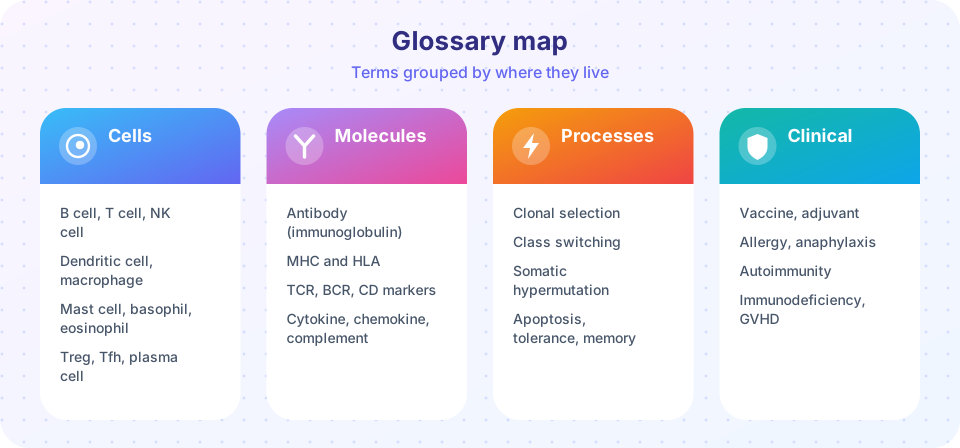
Cells are the actors: B cells, T cells, dendritic cells and others.
Molecules are the tools: antibodies, receptors, cytokines.
Processes are the actions: selection, switching, memory.
Clinical terms link biology to disease and treatment.
The glossary
| Term | Meaning |
|---|---|
| Adjuvant | A vaccine component that strengthens the immune response by activating innate immunity. |
| AIRE | A protein in thymic cells that displays tissue-specific antigens for negative selection. |
| Allergen | An antigen, usually harmless, that triggers an allergic reaction. |
| Anaphylaxis | A rapid, severe, whole-body allergic reaction that is a medical emergency. |
| Anergy | A state of unresponsiveness in a lymphocyte that met antigen without co-stimulation. |
| Antigen | A molecule that is recognized by an immune receptor. |
| Antigen-presenting cell (APC) | A cell that shows peptides on MHC to T cells and provides co-stimulation. |
| Apoptosis | Programmed, orderly cell death. |
| Autoantibody | An antibody directed against a self molecule. |
| B cell | A lymphocyte that makes antibodies after becoming a plasma cell. |
| CAR-T cell | A T cell engineered with a chimeric antigen receptor. |
| CD4 / CD8 | Co-receptors that mark helper (CD4) and cytotoxic (CD8) T cells and bind MHC II and I. |
| Checkpoint | An inhibitory receptor pair, such as PD-1 and PD-L1, that limits T cell activity. |
| Clonal expansion | Rapid division of an activated lymphocyte into many identical cells. |
| Co-stimulation | The second signal for T cells, usually CD28 binding B7. |
| Cytokine | A small signaling protein that influences other cells. |
| Cytotoxic T lymphocyte (CTL) | A CD8 T cell that kills infected or abnormal cells. |
| Dendritic cell | The most powerful antigen-presenting cell, linking innate and adaptive immunity. |
| Germinal center | A structure in lymph nodes where B cells mutate and are selected. |
| Granzyme | A protease delivered by cytotoxic cells that triggers apoptosis in the target. |
| Herd immunity | Indirect protection of a population when enough people are immune. |
| HLA | Human leukocyte antigen, the human version of MHC. |
| Hypersensitivity | An immune response that causes harm, classified as types I to IV. |
| Immunodeficiency | A state in which part of the immune system is missing or ineffective. |
| Immunoglobulin (Ig) | An antibody. Classes are IgM, IgG, IgA, IgE and IgD. |
| MHC | Major histocompatibility complex: molecules that display peptides to T cells. |
| Memory cell | A long-lived lymphocyte that responds faster on a second exposure. |
| Molecular mimicry | Similarity between a microbe and a self molecule that causes cross-reactive responses. |
| Monoclonal antibody | An antibody from a single clone, produced as a drug or tool. |
| Negative selection | Deletion of developing lymphocytes that bind self too strongly. |
| Perforin | A protein that forms pores in a target cell's membrane. |
| Plasma cell | An antibody-secreting cell derived from a B cell. |
| Positive selection | Survival of thymocytes whose receptors can engage self-MHC. |
| R0 | The number of cases one case causes in a fully susceptible population. |
| Regulatory T cell (Treg) | A Foxp3-positive CD4 T cell that suppresses immune responses. |
| Somatic hypermutation | Mutation of antibody variable genes that allows affinity maturation. |
| T cell receptor (TCR) | The antigen receptor of T cells, which reads peptide on MHC. |
| Th1, Th2, Th17, Tfh | Helper T cell subsets with different cytokines and roles. |
| Tolerance | The absence of a damaging response to self or harmless antigens. |
| Vaccine | A preparation that induces immune memory against a pathogen. |
A few tips for learning the terms
Learn the prefixes and suffixes. Auto- means self, anti- means against, -cyte means cell, -oma is a tumor, -penia is a shortage. The word immunoglobulin means a globulin protein with immune function.
Link a term to a picture. If you can draw the synapse, the thymus lobule or the four hypersensitivity types, the words attach themselves.
Test yourself actively. Cover the right-hand column and try to define each word. A term you can define in one sentence and use in a sentence of your own is one you know.
Try it
The first tool searches a small dictionary. Change the query variable to look up other words. (A full list of the terms would be too long to place in code; the ones here are a sample.)
Press Run (or Ctrl + Enter) to see the console output here.
No output.
The second example counts how many glossary terms fall into each of the four groups used in the picture. The assignment is a simple teaching choice, and some terms could belong to more than one group.
Press Run (or Ctrl + Enter) to see the result here.
Program input · what you'd type while the program runs
Type the answers before you press Run, one per line. Each time the program reads a line (with input()), it gets the next line from this box.
Check your understanding
Quick check · 4 questions
of 4 answered You scored / 4 · perfect!
-
1. Which term describes the unresponsiveness of a T cell that met antigen without co-stimulation?
Anergy is a functional shutdown of a lymphocyte. -
2. What is a plasma cell?
Plasma cells are specialized antibody factories. -
3. HLA is:
HLA is the name of the MHC genes and molecules in humans. -
4. Which term means an immune response that causes harm?
Hypersensitivity reactions are classified as types I to IV.
Summary
- Terms fall into four groups: cells, molecules, processes and clinical ideas.
- Learning prefixes, suffixes and pictures makes jargon easier.
- Active recall, covering the definition and recalling it, works better than rereading.
Next: Cheat sheet
Track your progress
Create a free account to tick off lessons and pick up where you left off on any device.
of Immunology lessons completed