


















Lesson 38 of 46 · Allergy, Autoimmunity and Immunodeficiency
Allergy and hypersensitivity: IgE, mast cells and the four types
Understand how IgE and mast cells cause allergic reactions, how anaphylaxis develops, and how Gell and Coombs types I to IV differ in mechanism and timing.
An allergy is a case of the immune system doing its job against the wrong target. The machinery is the one built to expel parasitic worms: IgE antibodies, mast cells and eosinophils. When that machinery is switched on against pollen, a food protein or an insect venom, the result is the itching, swelling and wheezing of an allergic reaction. In the most severe case it is anaphylaxis, a rapid, whole-body reaction that can be fatal.
Allergy is just one kind of hypersensitivity. In 1963, Philip Gell and Robin Coombs published a classification into four types, which is still the standard way to organize reactions that do harm. This lesson covers the allergic reaction in detail and then the four types.
What you will learn
- The steps of sensitization and of an IgE-mediated reaction.
- Which mediators cause which symptoms, and what happens in anaphylaxis.
- The four hypersensitivity types and an example of each.
- Current ideas about why allergy has become more common.
Key terms
IgE: the antibody class involved in allergy and defence against parasites.
Mast cell: a tissue cell packed with granules of histamine and other mediators.
FcεRI: the high-affinity receptor for IgE on mast cells and basophils.
Degranulation: the release of granule contents by a mast cell.
Anaphylaxis: a severe, rapid, potentially life-threatening systemic allergic reaction.
Type I: the allergic reaction
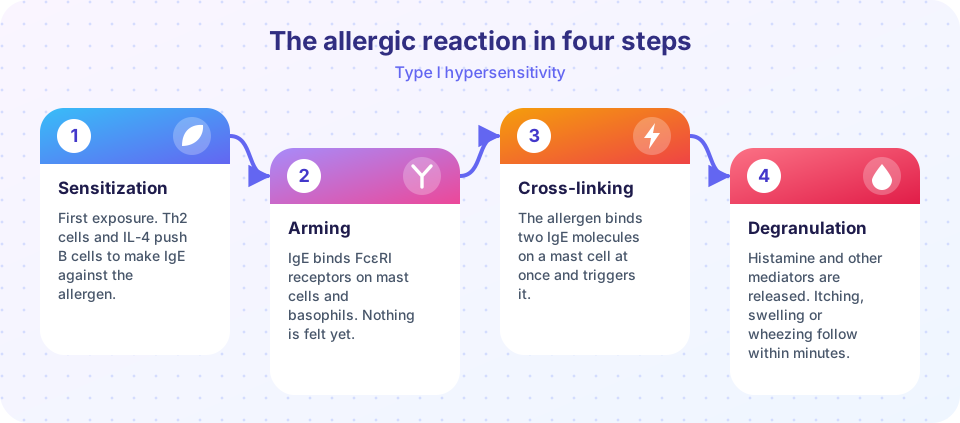
Sensitization. On first exposure, an allergen is taken up by a dendritic cell and presented to a CD4 T cell. In people prone to allergy, naive T cells become Th2 cells, which release IL-4 and IL-13. These cytokines tell the B cells that recognize the allergen to switch to IgE. Nothing is felt at this stage.
Arming. The IgE binds to the high-affinity receptor FcεRI on mast cells in the skin, airways and gut, and on blood basophils. The cells are now armed, and they stay armed for weeks or longer.
Cross-linking and degranulation. When the allergen is met again, it binds two or more IgE molecules on the same cell, pulling the receptors together. This signal makes the mast cell release granules within minutes. The key mediators are:
- Histamine, which dilates blood vessels, makes them leaky, causes itching, and contracts smooth muscle.
- Tryptase and other enzymes.
- Newly made lipid mediators, leukotrienes and prostaglandin D2, which cause bronchoconstriction and mucus secretion.
- Cytokines such as TNF, which continue the inflammation.
Hours later a late-phase reaction can follow, as eosinophils, Th2 cells and other cells are recruited. In asthma, repeated cycles can lead to chronic airway inflammation.
The symptoms depend on where the allergen enters. In the nose and eyes: sneezing, runny nose, itching (allergic rhinitis, hay fever). In the skin: hives and swelling. In the airways: wheezing and breathlessness. In the gut: vomiting and cramps. In the blood: anaphylaxis, with swelling of the airways, a sharp fall in blood pressure and shock. Anaphylaxis is a medical emergency, and the standard first-line emergency treatment is adrenaline (epinephrine), given by injection while emergency services are called.
Why do allergies happen, and why more now?
Risk is shaped by genes (a family history of allergy raises risk), by the skin barrier (damaged skin in eczema may allow sensitization through the skin), and by early life environment. The hygiene hypothesis, proposed by David Strachan in 1989 after noticing that children from larger families had less hay fever, suggested that fewer early infections might leave the immune system skewed towards Th2. Modern versions emphasize contact with a rich microbial environment, the microbiome and diet, rather than cleanliness itself. These remain active research areas, and the evidence is stronger for some factors than others.
One well-known clinical trial, the LEAP study (published in 2015), found that regularly feeding peanut products to infants at high risk of peanut allergy greatly reduced the chance of allergy by age 5, compared with avoiding peanut. Findings like this have changed guidelines in several countries, but decisions for any child belong with a pediatrician or allergist.
Management of allergy rests on avoiding the trigger, medicines such as antihistamines that block the histamine receptor, anti-inflammatory sprays, emergency adrenaline for anaphylaxis, and allergen immunotherapy, in which gradually increasing doses of allergen build tolerance in some patients, shifting the balance towards regulatory T cells and IgG that blocks the allergen.
The four hypersensitivity types
The Gell and Coombs classification groups reactions by the effector mechanism and the time they take.
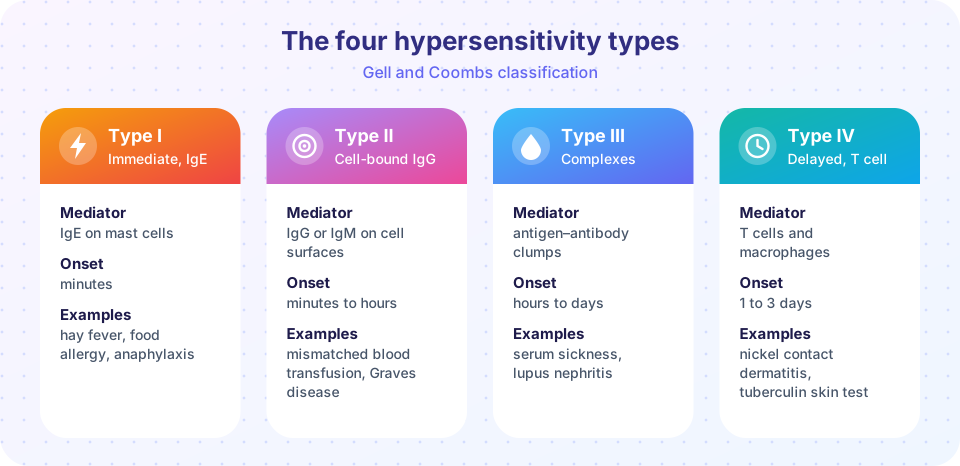
| Type | Mediator | Timing | Examples |
|---|---|---|---|
| I | IgE on mast cells | minutes | hay fever, food allergy, anaphylaxis, many cases of asthma |
| II | IgG or IgM against cell-surface or tissue antigens | minutes to hours | mismatched blood transfusion, hemolytic disease of the newborn, Graves disease, myasthenia gravis |
| III | Immune complexes of antigen and antibody deposited in tissues | hours to days | serum sickness, lupus nephritis, post-streptococcal glomerulonephritis |
| IV | T cells (and macrophages) | 1 to 3 days (delayed) | contact dermatitis from nickel or poison ivy, the tuberculin skin test |
Type II reactions occur when antibodies bind to our own cells and tag them for destruction by complement or phagocytes. The classic case is a blood transfusion with incompatible ABO type: pre-existing antibodies destroy the red cells. In Graves disease the antibodies stimulate the TSH receptor rather than destroying the cell, and in myasthenia gravis antibodies block the acetylcholine receptor at the muscle junction. Some authors classify those stimulating or blocking cases separately.
Type III reactions occur when soluble antigen and antibody form complexes that are not cleared and settle in small blood vessels, joints or kidney filters. They activate complement and attract neutrophils, which damage the tissue.
Type IV reactions are not mediated by antibodies. In contact dermatitis, small chemicals bind to skin proteins, become presented to T cells, and a T cell response occurs one to three days after re-exposure. The tuberculin skin test uses a Type IV response to show earlier exposure to the tuberculosis bacterium.
Common misconceptions
"An allergy is an infection." An allergy is an immune response to a harmless substance. It does not involve an infection, and it is not contagious.
"All adverse reactions to food are allergies." Intolerances, such as lactose intolerance, involve enzymes or other mechanisms and not IgE.
"A first exposure causes the reaction." Type I reactions need sensitization first, although it can be silent, and people may not recall the first exposure.
Try it
The first model shows the shape of a mast cell response to allergen dose. Mast cells are triggered when an allergen links two IgE molecules; too little allergen links few, and too much saturates each IgE with a separate allergen molecule so fewer pairs are linked. This is a general feature of cross-linking and gives a bell-shaped curve. The numbers are illustrative only.
Press Run (or Ctrl + Enter) to see the result here.
Program input · what you'd type while the program runs
Type the answers before you press Run, one per line. Each time the program reads a line (with input()), it gets the next line from this box.
The second tool is a classifier. Choose a scenario and it reports the likely Gell and Coombs type. It is a study aid: real cases can involve more than one mechanism.
Press Run (or Ctrl + Enter) to see the console output here.
No output.
Check your understanding
Quick check · 5 questions
of 5 answered You scored / 5 · perfect!
-
1. Which antibody class is central to type I hypersensitivity?
IgE binds to FcεRI on mast cells and triggers degranulation on cross-linking. -
2. Which cytokine drives class switching to IgE?
IL-4 and IL-13 from Th2 cells promote switching to IgE. -
3. A rash 48 hours after skin contact with nickel is which type?
Contact dermatitis is a delayed, T cell-mediated type IV reaction. -
4. Which hypersensitivity type involves immune complexes?
Type III reactions are caused by deposited antigen-antibody complexes. -
5. Why does an allergic reaction typically need a prior exposure?
IgE has to be made and bound to mast cells before re-exposure can trigger them.
Summary
- Type I allergy requires sensitization with Th2 help and IgE, arming of mast cells, and then cross-linking, which triggers degranulation within minutes.
- Histamine, leukotrienes and prostaglandin D2 produce the symptoms, and anaphylaxis is a medical emergency.
- Type II involves antibodies against cells, type III immune complexes, and type IV T cells, with timing from minutes to days.
- Genes, skin barrier, early exposure and microbial environment all contribute to allergy risk.
Next: Autoimmunity
Track your progress
Create a free account to tick off lessons and pick up where you left off on any device.
of Immunology lessons completed