


















Lesson 4 of 46 · Getting Started
Numbers in immunology: titers, counts and logarithms
Learn how immunologists measure immunity: serial dilutions and titers, geometric mean titers, fold rises, blood cell counts per microliter and why they use logarithmic scales.
Immunology is a quantitative science. When a doctor says a patient has "protective antibody levels", or a study reports that a vaccine "raised titers fourfold", they are using a small set of measurement ideas. If you understand these ideas now, you will read every later chapter with more confidence, and you will not be fooled by headlines that quote numbers without context.
This lesson covers four tools: the serial dilution and the titer, the fold change, cell counts per microliter, and the logarithmic scale that ties them together. The arithmetic is only doubling, dividing and counting zeros.
What you will learn
- How a twofold serial dilution works and how to read a titer.
- What a fold rise and a geometric mean titer mean.
- How blood cell counts are written and what a differential shows.
- Why antibody responses are plotted on log scales.
Key terms
- Titer: the highest dilution of a sample that still gives a positive result, reported as the reciprocal (1:64 is "64").
- Seroconversion: the change from antibody-negative to antibody-positive (or a defined rise) after infection or vaccination.
- Fold change: the ratio of a later value to an earlier one; a fourfold rise means four times higher.
- Geometric mean titer (GMT): an average suited to titers, found by averaging the logarithms.
- Differential: the percentage of each type of white blood cell in a sample.
Serial dilutions and titers
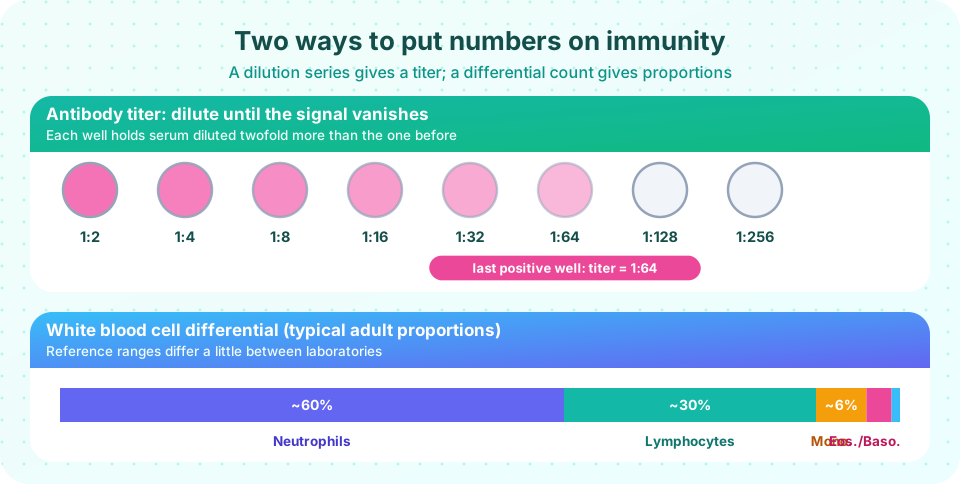
Antibodies are invisible, but we can detect how much a sample contains by asking: how far can I dilute it and still see an effect? You start with serum (the liquid part of blood after clotting), then make a chain of dilutions. In a twofold serial dilution, you mix one part of the previous tube with one part of fluid, so each tube is half as concentrated as the one before: 1:2, 1:4, 1:8, 1:16, 1:32 and so on.
Each dilution is tested with the target antigen, and a signal (a color change, agglutination, or cells that survive a virus) tells you whether antibodies are present. At some dilution the signal vanishes because there are too few antibodies. The titer is the reciprocal of the last positive dilution. If the last well that still reacts is 1:64, the titer is 64.
Because the steps are doublings, titers come out as 2, 4, 8, 16, 32, 64, 128, 256... A single well step is therefore a twofold difference; the measurement is only precise to within one step, which is why changes smaller than fourfold are treated with caution.
Worked example: finding the titer
A serum sample is tested in eight wells (1:2 through 1:256). Wells 1 to 6 are positive and wells 7 and 8 are negative. The last positive well is the sixth, 1:64, so the titer is 64. If you now diluted 100 microliters of serum into 100 microliters of buffer and repeated it for each step, how much does the concentration drop by the sixth well? Each step halves it, so after six steps the concentration is 1/2⁶ = 1/64 of the original.
Fold changes and seroconversion
Comparing a sample taken during illness (the acute sample) with one taken weeks later (the convalescent sample) can show whether an infection happened. A common rule of thumb in diagnostics is that a fourfold or greater rise in titer between paired samples indicates recent infection, because a twofold difference is within the normal variation of the assay. Vaccine trials report the same idea as the percentage of people who seroconvert.
If the acute titer is 16 and the convalescent titer is 128, the fold rise is 128 / 16 = 8, which exceeds fourfold.
Averaging titers: the geometric mean
Titers grow multiplicatively, so a normal average gives a misleading result. Suppose five people have titers 8, 16, 16, 32 and 512. The arithmetic mean is 116.8, dominated by the one huge value. The geometric mean is the fifth root of the product: (8 × 16 × 16 × 32 × 512)^(1/5) = 32 (the product is 2²⁵). It treats a doubling as the same step anywhere on the scale. Reports of vaccine immunogenicity almost always give the GMT.
Cell counts
A drop of blood holds millions of cells, so counts are expressed per volume: cells per microliter (µL), equivalent to cells per cubic millimeter (mm³). A typical healthy adult has roughly 4,000 to 11,000 white blood cells (leukocytes) per µL, plus about 4 to 6 million red cells per µL and 150,000 to 400,000 platelets per µL. Laboratories print their own reference ranges, and they differ a little by age, sex and method.
A differential count splits the white cells into types. In round numbers: neutrophils about 40 to 70%, lymphocytes about 20 to 40%, monocytes 2 to 8%, eosinophils 1 to 4% and basophils under 1%. A raised neutrophil count suggests bacterial infection or inflammation, a raised eosinophil count suggests allergy or parasites, and a very low lymphocyte count raises the question of immunodeficiency. These patterns support, but never replace, a clinician's judgment.
An adult has about 5 liters of blood, which is 5,000,000 µL. With 6,000 white cells per µL, that is about 3 × 10¹⁰ white blood cells in circulation. Most lymphocytes are in fact not in the blood but in lymph nodes, spleen and other tissues, so a blood count samples only a part of the system.
Why logarithms?
Immune responses change by factors, not by fixed amounts. A virus may increase a thousandfold in a few days; antibody titers may rise a hundredfold after a booster. On an ordinary (linear) graph the early events are squashed flat and the late ones run off the page. A logarithmic scale gives each tenfold (or twofold) step the same distance, so exponential growth becomes a straight line.
A useful bridge: log₁₀ counts the zeros. log₁₀(1,000) = 3. A "2-log reduction" in a virus load is a hundredfold drop, and a "log₂" scale counts doublings: log₂(64) = 6, the number of dilution steps to reach 1:64.
Common misconceptions
"A titer of 1:64 means 64 antibodies." The titer is a dilution factor, not a count. Two different assays can give very different titers for the same sample, so numbers from different tests cannot be compared directly.
"A higher titer always means better protection." Protection depends on which antibodies are present and on other immune parts. For some diseases there is a known protective threshold; for many there is not.
"The blood count tells you everything about immunity." Blood holds only a small sample of lymphocytes. The count is one clue, not a full picture.
Try it
Press Run (or Ctrl + Enter) to see the result here.
Program input · what you'd type while the program runs
Type the answers before you press Run, one per line. Each time the program reads a line (with input()), it gets the next line from this box.
Press Run (or Ctrl + Enter) to see the console output here.
No output.
Check your understanding
Quick check · 4 questions
of 4 answered You scored / 4 · perfect!
-
1. In a twofold serial dilution, wells 1:2 to 1:128 react and 1:256 does not. What is the titer?
The titer is the reciprocal of the last positive dilution, here 1:128, so 128. -
2. Why is a geometric mean preferred for averaging titers?
A single very high titer would dominate an ordinary mean; the geometric mean reflects the typical multiplicative level. -
3. A paired serum sample goes from a titer of 8 to 64. How large is the fold rise, and does it meet the usual fourfold rule?
64 divided by 8 is 8, which is at least four, so it meets the rule of thumb. -
4. A blood sample contains 5,000 white cells per microliter. How many are in 1 milliliter (1,000 microliters)?
5,000 cells per microliter times 1,000 microliters is 5,000,000 cells.
Summary
- A twofold serial dilution halves the concentration at each step; the titer is the reciprocal of the last positive dilution.
- A fourfold rise between paired samples is the usual sign of a real change; the geometric mean titer summarizes groups.
- Cell counts are given per microliter; the differential shows the percentage of each white-cell type.
- Immune quantities change multiplicatively, so log scales are natural.
- Numbers from different assays cannot be compared directly, and no single number describes immunity.
Next: Chapter 1 review
Track your progress
Create a free account to tick off lessons and pick up where you left off on any device.
of Immunology lessons completed