


















Lesson 28 of 46 · Immune Regulation and Memory
Chapter 6 overview: immune regulation and memory
A map of the chapter on how the immune system turns responses on and off, avoids attacking the body, and remembers past enemies for next time.
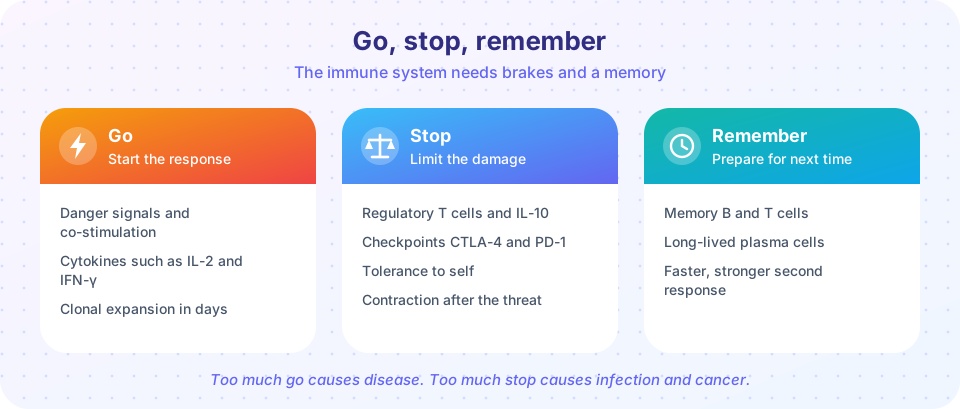
A powerful weapon needs a safety catch. The immune system can kill cells, flood tissues with inflammatory molecules and destroy organs. If it fired at every opportunity, you would not survive your own defences. If it never fired, you would not survive your first infection. This chapter is about the controls that keep the system in a useful middle zone, and about the single most useful feature of adaptive immunity: memory.
You already know the engines, B cells with antibodies and T cells with helpers and killers. Now you will learn about the brakes, the thermostat and the archive.
What you will learn
- Why an immune response must be limited as well as started.
- The kinds of tolerance that prevent attack on the self.
- How regulatory T cells and checkpoint receptors apply the brakes.
- How memory makes a second encounter faster and stronger.
Key terms
Tolerance: the state in which the immune system does not attack the body's own components.
Regulatory T cell (Treg): a CD4 T cell with the transcription factor Foxp3 that suppresses other immune cells.
Checkpoint: a receptor-ligand pair, such as PD-1 and PD-L1, that turns T cell activity down.
Memory cell: a long-lived lymphocyte that remains after a response and reacts faster the next time.
Homeostasis: keeping a system in a stable balance.
Why regulation matters
Consider the numbers. An infection might drive one T cell clone to multiply thousands of times in a week. The cytokines released can cause fever, tissue damage and, in extreme cases, the whole-body inflammation called a cytokine storm. A system that expands this way must contain a mechanism for stopping. Equally, the random way receptors are made guarantees that some will recognize self. The system must have a way to discard or silence those cells, or autoimmune disease would be the rule instead of the exception.
The same logic applies in reverse. A system tuned to be very safe will miss infections and cancers. Many of the most successful cancer treatments, which you will see in Chapter 7, work by releasing a brake that tumors exploit.
Why regulate?
The brakes
The archive
An analogy, and its limits
A common way to picture regulation is a car. The adaptive response is the engine. Tolerance is the steering, which keeps the car pointed at the threat and away from the pavement. Regulatory cells and checkpoints are the brakes, and memory is the satellite navigation system that remembers the route for the next trip.
Like all analogies, this one is imperfect. A car has one driver, while the immune system has none: control emerges from millions of cells exchanging signals, and the same cell can act as accelerator in one setting and brake in another. A regulatory T cell, for example, can protect against autoimmunity and at the same time make a tumor harder to attack. Keep the analogy for orientation and trust the mechanisms for detail.
A map of the chapter
- Tolerance and regulatory T cells covers the layers of tolerance, Tregs and the checkpoints that stop responses.
- Immune memory compares the primary and secondary response and explains where memory lives.
- Chapter review is a recap with a ten-question quiz.
Common misconceptions
"A strong immune system is always better." Overactivity is the cause of allergy, autoimmune disease and cytokine storm. The aim is a response of the right size.
"Tolerance is a single event in the thymus." Central tolerance is only the first layer. Several peripheral mechanisms act on mature cells throughout life.
Try it
A small program shows how a response needs a stop signal. A simple loop adds a growth term to a population of effector cells and optionally a suppression term. It is a teaching toy with invented numbers.
Press Run (or Ctrl + Enter) to see the console output here.
No output.
Check your understanding
Quick check · 3 questions
of 3 answered You scored / 3 · perfect!
-
1. Why does the immune system need regulation?
Cytotoxicity and inflammation can harm normal tissue, so responses must be limited. -
2. Which cell type with the transcription factor Foxp3 suppresses immune responses?
Foxp3 marks regulatory T cells. -
3. What is the main benefit of immune memory?
Memory cells respond more quickly and with higher affinity.
Summary
- The immune system needs brakes because its weapons are dangerous and its receptors are random.
- Tolerance, regulatory T cells and checkpoints provide those brakes.
- Memory cells give the adaptive system a faster, stronger second response.
Track your progress
Create a free account to tick off lessons and pick up where you left off on any device.
of Immunology lessons completed