


















Lesson 37 of 46 · Allergy, Autoimmunity and Immunodeficiency
Chapter 8 overview: allergy, autoimmunity and immunodeficiency
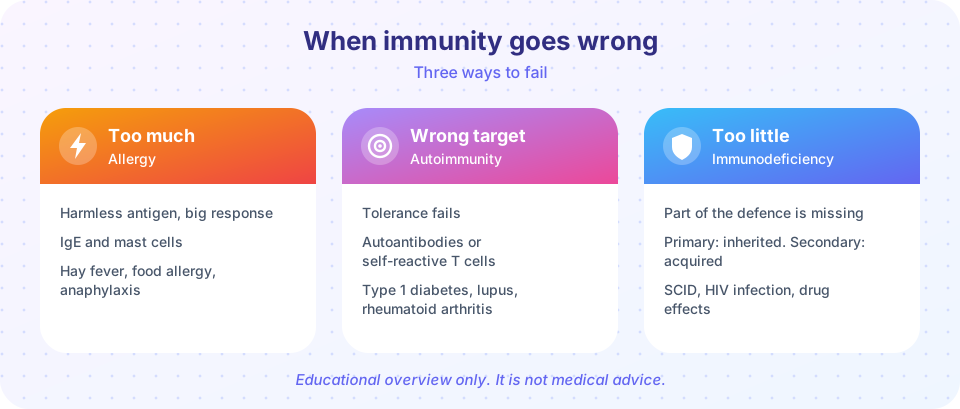
A map of the chapter on immune disease: allergy as an exaggerated response, autoimmunity as an attack on self, and immunodeficiency as a response that is too weak.
A system that can recognize almost any molecule, kill cells and flood tissues with inflammatory mediators can go wrong in several ways. It can react strongly to something harmless, like pollen or peanuts. It can attack the body itself. Or it can fail to react when it should. Immunologists group these failures into hypersensitivity (including allergy), autoimmunity, and immunodeficiency.
This chapter treats each in turn and ends with a look at transplantation, where the immune system's strength is a problem for the patient who needs a foreign organ. As always, the aim is to understand the mechanisms. It is not to diagnose or advise.
What you will learn
- How the four types of hypersensitivity differ in mediator and timing.
- Why tolerance sometimes fails and what factors contribute to autoimmune disease.
- How inherited and acquired immunodeficiencies show up.
- Why transplants are rejected and how rejection is controlled.
Key terms
Hypersensitivity: an exaggerated or inappropriate immune response that causes tissue damage.
Allergen: an antigen, usually harmless, that triggers an allergic reaction.
Autoantibody: an antibody directed against the body's own molecules.
Immunodeficiency: a state in which part of the immune system is missing or ineffective.
Rejection: immune attack on transplanted tissue.
The same machinery, different problems
None of these diseases involves new biology. Allergy uses antibodies and mast cells, which are designed for parasites. Autoimmunity uses T cells and antibodies, whose targets happen to be self. Immunodeficiency removes pieces you met in earlier chapters, B cells, T cells, phagocytes or complement, and the pattern of infections tells you which piece is missing.
That is why a good grounding in normal immunity makes these diseases understandable. You can often predict what goes wrong from what the missing part normally does.
Too much
Wrong target
Too little
Why the same system can fail in opposite ways
It can seem paradoxical that a single system produces diseases of too much activity and of too little. The explanation is that the immune system is not one dial. It is a network of many cell types, signals and checks. A change in one place can raise activity in one direction and lower it in another.
An example is the treatment of an autoimmune disease with a drug that blocks a cytokine. It reduces the unwanted inflammation but can also reduce defence against some infections. The reverse also holds: restoring an immune response in cancer with a checkpoint inhibitor can cause inflammatory side effects. Throughout this chapter, notice how each therapy trades one risk for another, and why clinicians monitor patients so closely.
A map of the chapter
- Allergy and hypersensitivity describes IgE-mediated reactions and the four Gell and Coombs types.
- Autoimmunity explains why tolerance fails and gives examples of organ-specific and systemic disease.
- Immunodeficiency and transplantation covers primary and secondary immune deficiency, rejection and immunosuppression.
- Chapter review summarizes the chapter and ends with a ten-question quiz.
Educational information only. Allergy, autoimmune and immune conditions are serious and vary between individuals. Nothing here is a diagnosis or treatment advice. Anyone with symptoms or concerns should talk to a qualified clinician, and anyone having a severe allergic reaction needs emergency medical care straight away.
Common misconceptions
"Allergies and autoimmunity are the same." Allergy is a response to an outside antigen, usually IgE-mediated. Autoimmunity is a response to the body's own antigens.
"Immunodeficiency means no immunity at all." Most immunodeficiencies affect one part, and the infections reveal which part.
Try it
This short program sorts example problems into the three categories of the chapter.
Press Run (or Ctrl + Enter) to see the console output here.
No output.
Check your understanding
Quick check · 3 questions
of 3 answered You scored / 3 · perfect!
-
1. Which category describes an immune attack on the body's own thyroid?
Attack on self antigens is autoimmunity. -
2. Allergy to pollen is a response to:
Allergens are foreign antigens that are not truly dangerous. -
3. What do the types of infection in an immunodeficiency tell you?
Antibody, T cell, phagocyte and complement defects each cause a typical pattern.
Summary
- Immune disease comes from the same machinery as normal immunity, misdirected, exaggerated or missing.
- Hypersensitivity includes allergy. Autoimmunity is loss of tolerance. Immunodeficiency can be primary or secondary.
- Transplant rejection is a normal immune response to foreign tissue.
Track your progress
Create a free account to tick off lessons and pick up where you left off on any device.
of Immunology lessons completed