


















Lesson 40 of 46 · Allergy, Autoimmunity and Immunodeficiency
Immunodeficiency and transplantation: too little defence, and a foreign graft
Learn how primary and secondary immunodeficiencies are recognized by infection patterns, how HIV damages CD4 cells, and how HLA matching and drugs control transplant rejection.
If allergy is an immune response that is too strong and autoimmunity one that is aimed wrongly, immunodeficiency is one that is too weak. The immune system is made of several arms, and a defect in one leaves a recognizable gap. A child with no antibodies gets repeated sinus and lung infections with certain bacteria. A child with no T cells gets overwhelming viral and fungal infections in the first months of life. The pattern of infection is a clue to the missing part.
This lesson also covers transplantation, because the central problem of transplantation is that a healthy immune system recognizes a donor organ as foreign. Controlling that response means deliberately causing a mild immunodeficiency, with all the infection risks that follow.
What you will learn
- The difference between primary and secondary immunodeficiency, with examples.
- How the type of infection points to a type of defect.
- How HIV causes acquired immunodeficiency.
- How HLA matching, rejection mechanisms and immunosuppressive drugs fit together.
Key terms
Primary immunodeficiency: an inherited defect in immune function, also called an inborn error of immunity.
Secondary immunodeficiency: an acquired defect caused by infection, drugs, malnutrition, cancer or other illness.
SCID: severe combined immunodeficiency, with absent or very low T cell (and often B cell) function.
HLA matching: comparing donor and recipient HLA types to reduce rejection.
Graft-versus-host disease (GVHD): attack on the recipient's tissues by donor immune cells in a bone marrow or stem cell transplant.
Primary immunodeficiencies
Hundreds of different inherited immune defects have been described, and new ones are found every year. Most are rare, and many are caused by a mutation in a single gene. Some are recognized only in adults. Examples that illustrate the logic of the course:
- X-linked agammaglobulinemia. Ogden Bruton described a boy with no gamma globulin in 1952, which was the first primary immunodeficiency to be recognized. The cause is a mutation in the gene for BTK, an enzyme needed for B cell development, so there are almost no B cells or antibodies. Affected boys are prone to bacterial infections of the sinuses and lungs after maternal antibodies fade, and they are treated with regular immunoglobulin replacement.
- Severe combined immunodeficiency (SCID). Several genes cause SCID, including IL2RG on the X chromosome, ADA (adenosine deaminase), and RAG1 or RAG2, the recombination enzymes you met in the thymus lesson. Without functional T cells, infants develop serious infections, diarrhea and poor growth in the first months, which can be fatal without treatment. Treatments include bone marrow or stem cell transplantation and, for some types, gene therapy. Many places screen newborns for a marker of T cell production (TREC) so that SCID can be diagnosed before serious infections occur.
- DiGeorge syndrome. A small deletion on chromosome 22 interferes with development of the thymus and other structures, so T cell numbers are low and vary in degree.
- Chronic granulomatous disease. Phagocytes cannot produce the reactive oxygen species of the respiratory burst, because of a defect in the NADPH oxidase complex. Patients have recurrent abscesses and infections with certain bacteria and fungi, and granulomas form.
- Complement deficiencies. Defects in early components such as C1q, C2 or C4 are associated with lupus-like disease. Defects in the terminal components C5 to C9 are associated with repeated Neisseria infections.
- Common variable immunodeficiency (CVID). Among the commonest symptomatic primary immunodeficiencies, with low antibody levels and poor antibody responses, often recognized in adulthood.
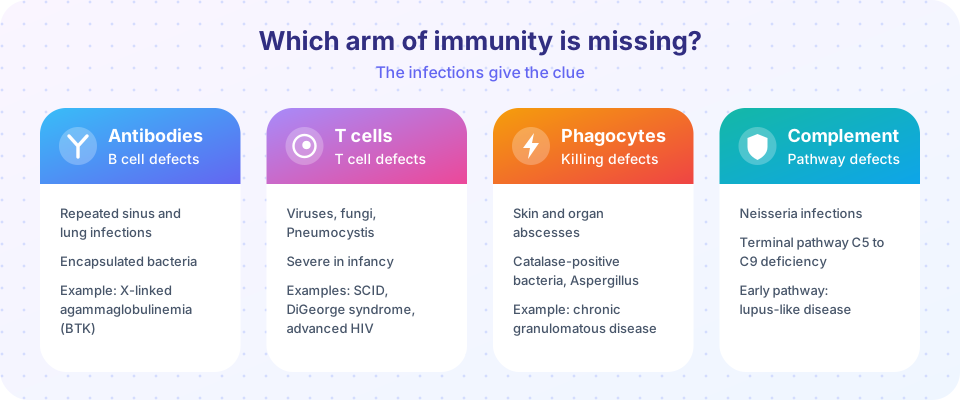
Reading the pattern
| Missing arm | Typical clues | Examples |
|---|---|---|
| Antibodies | Repeated sinus, ear and lung infections with encapsulated bacteria, beginning after infancy | X-linked agammaglobulinemia, CVID |
| T cells | Early, severe viral, fungal and Pneumocystis infections, poor growth | SCID, DiGeorge syndrome, advanced HIV |
| Phagocytes | Skin and organ abscesses, infections with catalase-positive bacteria and molds such as Aspergillus | Chronic granulomatous disease |
| Complement | Neisseria infections, or autoimmune disease | Terminal component or early component defects |
These patterns are guides for professionals and are not diagnostic by themselves. Many other illnesses cause repeated infections.
Secondary immunodeficiency and HIV
Far more people have secondary than primary immunodeficiency. Causes include malnutrition, diabetes, cancers of the blood, aging, removal of the spleen, kidney disease and treatments such as chemotherapy, high-dose corticosteroids and other immunosuppressive drugs.
The most important infectious cause is HIV, the human immunodeficiency virus. HIV infects CD4 T cells (along with macrophages) by binding to the CD4 molecule and a co-receptor, then inserts a DNA copy of its genome into the host DNA. Over years, infection depletes CD4 T cells and damages immune regulation. When the CD4 count falls low, below 200 cells per microliter of blood, or when certain opportunistic infections or cancers occur, the condition is called AIDS. Because CD4 cells coordinate B cells, CD8 cells and macrophages, the damage is broad. Modern antiretroviral therapy suppresses the virus, allows the CD4 count to recover, and has turned HIV into a manageable chronic condition for people who can access treatment. Treatment also greatly reduces transmission when the virus is suppressed to undetectable levels.
Transplantation
Many organs can be transplanted, including kidney, liver, heart, lung and bone marrow. The first successful kidney transplant, between identical twins, was done in Boston in 1954 by Joseph Murray and colleagues, and identical twins matter because their tissues are genetically identical, so no rejection occurs. Murray shared the 1990 Nobel Prize with E. Donnall Thomas, who developed bone marrow transplantation.
For others, the main barrier is the HLA system. T cells in the recipient recognize donor HLA molecules as foreign, and a surprisingly large fraction of a person's T cells react to any foreign HLA type. Matching HLA between donor and recipient reduces this response. Because each person has two HLA haplotypes, one inherited from each parent, a sibling has a 25 percent chance of being a full HLA match.
Types of rejection
- Hyperacute rejection happens within minutes to hours, if the recipient already has antibodies against the graft, for example against ABO blood group antigens or HLA after previous transplants or pregnancies. Antibodies activate complement and the graft's vessels clot. It is largely prevented by blood group and antibody crossmatch tests.
- Acute rejection appears days to weeks after transplant. T cells attack the graft. It is the commonest form and it can usually be reversed with more immunosuppression.
- Chronic rejection develops over months to years, with slow damage to the graft's blood vessels and tissue, due to both antibodies and T cells.
In graft-versus-host disease, which occurs after bone marrow or stem cell transplants, the donor's T cells in the graft attack the recipient's tissues, mainly the skin, gut and liver. At the same time, the donor's T cells can attack remaining leukemia cells, a useful graft-versus-leukemia effect.
Controlling rejection
Drugs include calcineurin inhibitors (cyclosporine and tacrolimus), which block IL-2 production in T cells, antimetabolites such as mycophenolate that block lymphocyte proliferation, corticosteroids, and antibodies that block T cells or IL-2 receptors. Patients usually need medicines for the rest of life and face higher risks of infection and some cancers, so balance is needed. Inducing tolerance to a graft without lifelong drugs, perhaps using regulatory T cells, is a major research aim.
Common misconceptions
"Immunodeficiency means no immunity." Most defects affect only one arm.
"HIV and AIDS are the same." HIV is the virus. AIDS is a late stage defined by low CD4 counts or by certain opportunistic illnesses, and it can be avoided by effective treatment.
"Transplant rejection is a failure of the organ." It is a normal immune response to foreign HLA.
Try it
The first example calculates the chance that at least one sibling in a family is a full HLA match for a patient, using the 25 percent figure for each sibling. It assumes siblings are inherited independently and that the parents' haplotypes are all different.
Press Run (or Ctrl + Enter) to see the result here.
Program input · what you'd type while the program runs
Type the answers before you press Run, one per line. Each time the program reads a line (with input()), it gets the next line from this box.
The second tool is a pattern reader. Enter a type of infection and it suggests the arm of immunity to think about. It is a study exercise and not a diagnostic tool.
Press Run (or Ctrl + Enter) to see the console output here.
No output.
Check your understanding
Quick check · 6 questions
of 6 answered You scored / 6 · perfect!
-
1. Which defect is associated with repeated Neisseria infections?
The membrane attack complex (C5 to C9) is especially important against Neisseria. -
2. What does the HIV virus mainly infect?
HIV enters cells carrying CD4 and a co-receptor, which depletes CD4 T cells. -
3. What are the chances that a sibling is a full HLA match for a given patient?
Each parent has two haplotypes, so a sibling shares both with 1 in 4 probability. -
4. Which type of rejection is caused by pre-existing antibodies and happens within minutes to hours?
Pre-formed antibodies activate complement and quickly destroy the graft. -
5. What is the main action of cyclosporine and tacrolimus?
Calcineurin inhibitors prevent IL-2 production, limiting T cell activation. -
6. In which disease do phagocytes fail to make reactive oxygen species?
A defect in the NADPH oxidase complex causes chronic granulomatous disease.
Summary
- Primary immunodeficiencies are inherited. Secondary ones are acquired, and HIV is the most important infectious cause.
- The type of infection points to the missing arm: antibodies, T cells, phagocytes or complement.
- Transplants are rejected because recipient T cells and antibodies recognize donor HLA. Matching and immunosuppressive drugs reduce rejection.
- Rejection can be hyperacute, acute or chronic, and in marrow transplants donor cells can cause graft-versus-host disease.
Next: Chapter 8 review
Track your progress
Create a free account to tick off lessons and pick up where you left off on any device.
of Immunology lessons completed