


















Lesson 21 of 46 · Antigens and Antibodies
B cells and antibody production: diversity, selection and memory
Follow a B cell from bone marrow to plasma cell: V(D)J recombination, the B-cell receptor, clonal selection, T-dependent activation, germinal centers, somatic hypermutation, class switching and memory.
There are perhaps a few hundred antibody-coding gene segments in your DNA, yet your body can produce antibodies against an almost endless variety of molecules, including ones that did not exist when humans evolved. How? Each B cell builds its own unique antibody gene by cutting and pasting pieces. Then, once an infection occurs, the cells that fit multiply, mutate their genes and compete to improve the fit. This is evolution at high speed, running inside your lymph nodes over a couple of weeks.
This lesson follows that story from the bone marrow to the plasma cell, and it ties together what you learned in the previous lessons about epitopes, antibody structure and lymph nodes.
What you will learn
- How V(D)J recombination generates a huge variety of antibodies.
- How clonal selection chooses the cell that fits, and what plasma and memory cells are.
- How T-dependent and T-independent responses differ.
- What happens in the germinal center: somatic hypermutation, affinity maturation and class switching.
Key terms
- BCR: B-cell receptor, a membrane-bound antibody with signaling partners.
- V(D)J recombination: the joining of variable (V), diversity (D) and joining (J) gene segments, done by the enzymes RAG1 and RAG2.
- Clonal selection: antigen selects the lymphocyte that already fits, which then expands as a clone.
- Somatic hypermutation (SHM): a high rate of point mutation in the V genes of activated B cells.
- Class switching: changing the heavy-chain constant region (for example from IgM to IgG) while keeping the same V region.
- Plasma cell: a terminally differentiated B cell that secretes large amounts of antibody.
Making a B cell: V(D)J recombination
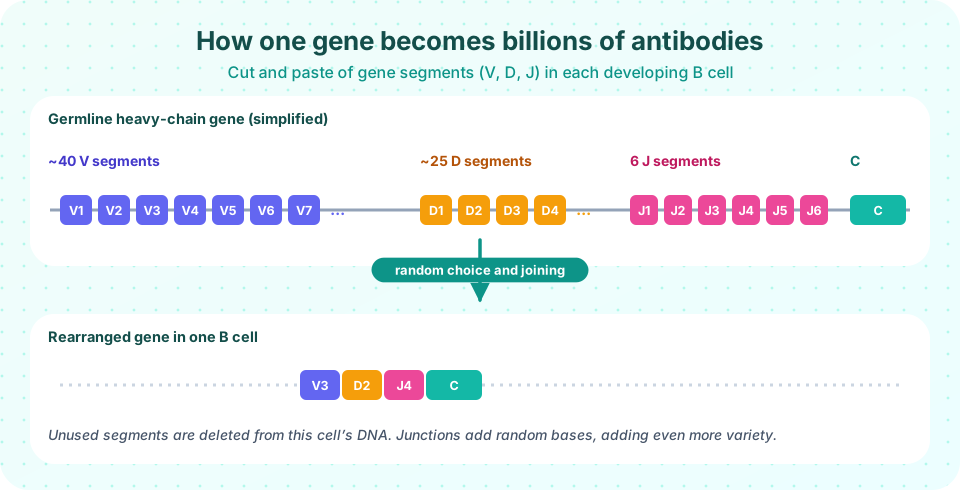
B cells are made from stem cells in the bone marrow. In the germline (every cell other than lymphocytes), the heavy-chain gene is not a ready-to-use gene but a library: dozens of V segments, a few dozen D segments, six J segments and the constant (C) genes. In a developing B cell, the enzymes RAG1 and RAG2 cut the DNA at special signal sequences and the cell's repair machinery joins one V, one D and one J together. DNA between them is deleted. The light chains are built the same way from V and J segments only (no D). Susumu Tonegawa showed in 1976 that antibody genes are rearranged in this way.
How much diversity?
The exact counts differ between people, but the human numbers are roughly:
| Segment | Approximate functional count |
|---|---|
| Heavy chain V (VH) | about 40 |
| Heavy chain D (DH) | about 25 |
| Heavy chain J (JH) | 6 |
| Kappa V and J | about 40 V and 5 J |
| Lambda V and J | about 30 V and 4 J |
Multiplying: heavy chains 40 × 25 × 6 = 6,000 combinations. Light chains: kappa 40 × 5 = 200 and lambda 30 × 4 = 120, so about 320. Pairing any heavy with any light gives about 6,000 × 320 ≈ 1.9 million combinatorial possibilities. But that is only the start:
- Junctional diversity. Where segments are joined, the cutting is imprecise and the enzyme TdT adds random nucleotides ("N" additions), so the junction (the heart of CDR3) is different in almost every B cell.
- Somatic hypermutation (below) adds more later.
Together, the number of possible antibodies is estimated in the billions to trillions or more, far more than the roughly 10¹⁰ to 10¹¹ B cells a person has at any moment. This means that at any time your body carries only a sample of the possible repertoire, but a large one: any given epitope is typically recognized by a small fraction of B cells, perhaps one in a hundred thousand or fewer.
Each B cell expresses only one heavy and one light chain (allelic exclusion) so that all the BCRs of a cell have the same specificity. If the first attempt at rearrangement produces a non-functional gene, the cell can try again on the other chromosome.
Quality control
Newly formed immature B cells are tested in the bone marrow. Cells whose receptor binds strongly to self molecules either edit their receptor (by rearranging another light chain), are deleted, or are made unresponsive. This is central tolerance (Chapter 6). Survivors leave as naive mature B cells carrying IgM and IgD, and circulate through lymph nodes and spleen.
Clonal selection
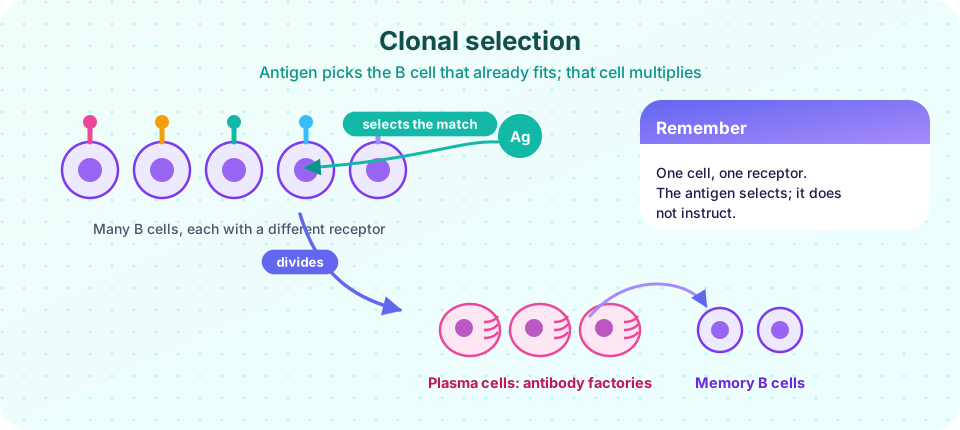
When an antigen enters a lymph node, the rare B cells whose BCR fits an epitope bind it. Binding selects these cells, as Macfarlane Burnet proposed. The cell takes in the antigen, processes it and shows peptides on MHC class II to a helper T cell (next chapter). With signals from the helper T cell, it divides repeatedly, giving a clone of cells with the same specificity.
T-dependent and T-independent responses
- T-dependent responses (most protein antigens): B cells need help from CD4 T cells through the CD40 receptor on the B cell binding CD40 ligand on the T cell, plus cytokines. These responses produce class switching, affinity maturation and good memory. Children and adults make them well.
- T-independent responses (some polysaccharides and repetitive antigens): extensive cross-linking of BCRs, plus a danger signal, can activate B cells without T cells. They produce mostly IgM, with weak memory. Infants respond poorly to polysaccharides, which is why conjugate vaccines attach the polysaccharide to a carrier protein (see antigens and epitopes) to bring in T-cell help.
The germinal center: where antibodies get better
Within a few days of activation, some B cells go to the edge of a follicle and form a germinal center, which is a kind of evolutionary workshop.
- Somatic hypermutation. An enzyme called AID (activation-induced cytidine deaminase) introduces mutations in the V regions of the heavy and light chains at a rate far higher than elsewhere in the genome, on the order of one mutation per thousand bases per division. Most mutations are harmful or neutral. A few make the antibody bind better.
- Selection. B cells compete for antigen displayed on follicular dendritic cells and for help from T follicular helper cells. Cells with higher affinity win; those with lower affinity die by apoptosis. After many rounds, the average affinity rises. This is affinity maturation. It explains why antibodies produced late in a response, or after a booster, bind more tightly.
- Class switch recombination. AID also directs the cell to cut out the μ constant region and join the same V region to a different constant region (γ, α or ε). The choice is guided by cytokines. For example, IL-4 favors IgE and some IgG subclasses, TGF-β favors IgA, and IFN-γ favors other IgG subclasses. The specificity stays the same; only the tail (the effector function) changes.
- Exit. Cells leave as plasma cells or memory B cells.
The outputs
- Plasma cells: a cell packed with rough endoplasmic reticulum that can secrete thousands of antibody molecules per second. Many are short-lived, but some become long-lived plasma cells that migrate to the bone marrow and keep secreting antibody for years, often decades. That is one reason antibody levels after some vaccines last a long time.
- Memory B cells: quiescent cells that carry a mutated, class-switched, higher-affinity receptor. On re-exposure they respond faster and more strongly than naive cells, which explains the secondary response.
Both the mutated V regions and the class switch are permanent changes to the DNA of that B-cell lineage, but not to the rest of your body (they are somatic, not inherited).
Common misconceptions
"The antigen teaches the B cell what shape to make." Antigen selects among cells that already exist; it does not instruct them.
"One B cell makes many kinds of antibody." One B cell and its clone make one specificity (though the class can switch).
"Somatic hypermutation makes antibodies worse." Most mutations harm, but selection keeps only those that improve fit.
Try it
Press Run (or Ctrl + Enter) to see the console output here.
No output.
Press Run (or Ctrl + Enter) to see the result here.
Program input · what you'd type while the program runs
Type the answers before you press Run, one per line. Each time the program reads a line (with input()), it gets the next line from this box.
Press Run (or Ctrl + Enter) to see the result here.
Program input · what you'd type while the program runs
Type the answers before you press Run, one per line. Each time the program reads a line (with input()), it gets the next line from this box.
Check your understanding
Quick check · 5 questions
of 5 answered You scored / 5 · perfect!
-
1. Which enzymes cut DNA to start V(D)J recombination?
RAG1 and RAG2 recognize signal sequences and cut the DNA; AID acts later in activated B cells. -
2. What is affinity maturation?
Mutation creates variants and selection favors those that bind antigen more tightly. -
3. What changes during class switching?
The same V region is joined to a different constant region. -
4. Why are conjugate vaccines used for polysaccharide antigens in infants?
Polysaccharides alone give T-independent responses with weak memory in young children. -
5. Which cell secretes large amounts of antibody and can live in the bone marrow for years?
Long-lived plasma cells keep antibody levels up long after an infection or vaccination.
Summary
- Each B cell builds a unique antibody gene by joining V, D and J segments (RAG1/2), with random junction additions, giving billions of possible receptors.
- Clonal selection: antigen selects the B cell that already fits; the cell expands into a clone.
- T-dependent responses use CD4 T-cell help and give switching, maturation and memory; T-independent responses give mostly IgM.
- In germinal centers, AID drives somatic hypermutation and class switching; selection yields higher-affinity antibodies.
- The outputs are plasma cells (antibody factories, some long-lived) and memory B cells (faster second response).
Next: Chapter 4 review
Track your progress
Create a free account to tick off lessons and pick up where you left off on any device.
of Immunology lessons completed