


















Lesson 6 of 46 · Overview of the Immune System
Chapter 2 overview: the immune system at a glance
A map of the immune system before the details: where its organs are, which cells exist, how innate and adaptive immunity cooperate and how lymph connects them.
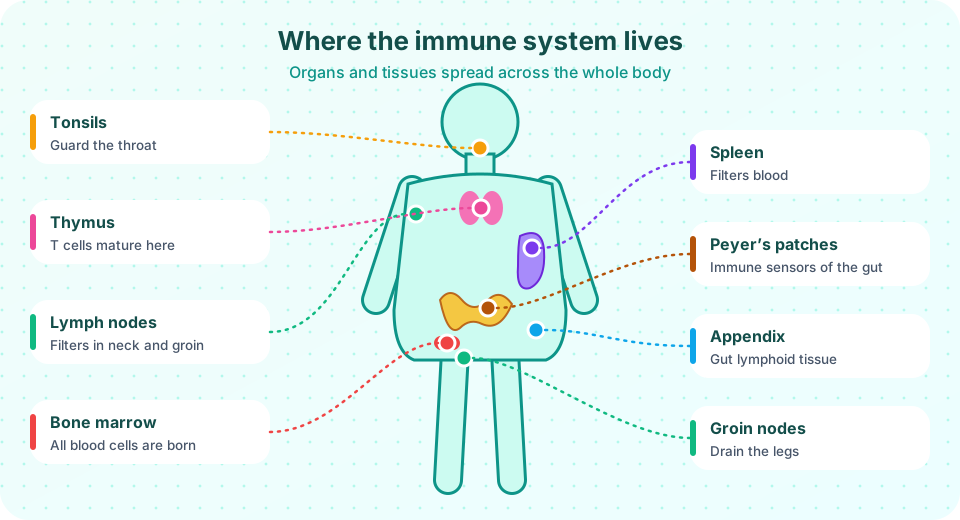
Unlike the heart or the stomach, the immune system has no single address. It is spread across your whole body: a few organs where cells are made and trained, a network of vessels and nodes that carry and filter fluid, and trillions of cells that patrol the blood and tissues. That makes it hard to picture at first. This overview gives you a map to hang the details on, and the four lessons that follow fill in each region.
The big picture in five steps
- Cells are made
- Cells are schooled
- Cells meet antigen
- Two branches act
- Lymph connects
Cells travel between all of these places.
What each lesson covers
- Lymphoid organs and cells. Primary organs (bone marrow, thymus) where lymphocytes are born and educated, secondary organs (nodes, spleen, mucosal tissue) where they meet antigen, and the family tree of blood cells that starts from one stem cell.
- Innate versus adaptive immunity. The two branches compared on speed, receptors and memory, and how they cooperate rather than compete.
- The lymphatic system and lymph nodes. How fluid leaks from capillaries, is collected as lymph, filtered in nodes and returned to the blood, and why a node swells during infection.
- Chapter 2 review. One picture, one table and ten questions.
Why a map first?
Imagine reading about a city's bus routes without a street plan. Later chapters keep mentioning things like "dendritic cells carry antigen to the lymph node" or "B cells mature into plasma cells in the germinal center". With the map in your head, each sentence has a place to land. Take a moment now to look at the hero picture and find three organs you have already heard of. You will be able to describe each one in your own words by the end of the chapter.
Questions this chapter answers
- Where are immune cells made, and where do they learn what to ignore?
- Which organs are called primary and which secondary, and why does it matter?
- How can a handful of cells find one rare antigen in a body of tens of trillions of cells?
- What is different about innate and adaptive immunity, and why do we need both?
- Why do glands in the neck swell when you have a sore throat?
Terms you will meet
A few words will appear repeatedly, so it helps to see them once now: hematopoiesis (the making of blood cells), naive lymphocyte (one that has not yet met its antigen), MALT (lymphoid tissue under mucosal surfaces), lymph (fluid drained from tissues), germinal center (where B cells improve their antibodies), cytokine (a signaling protein) and CD marker (a numbered surface label such as CD4 or CD8). Do not try to memorize them yet; each is explained in its own lesson.
How this chapter connects to the rest
Chapter 3 zooms in on the innate branch you will meet here for the first time, and Chapter 4 on antibodies. The map of organs reappears in Chapter 5, where T cells are educated in the thymus, and in Chapter 7, where vaccines act in the lymph nodes and spleen. If you ever feel lost later, come back to the body picture and ask: where is this happening?
A study tip for this chapter
Because the immune system is spread across the body, the most helpful habit is to draw. After each lesson, sketch the body outline from the hero picture and add the organ you just studied, with one phrase about what it does. By the end of the chapter your drawing will contain every organ and the main cell lineages, and you will have memorized the map almost without noticing.
Try it
Press Run (or Ctrl + Enter) to see the console output here.
No output.
Check your understanding
Quick check · 3 questions
of 3 answered You scored / 3 · perfect!
-
1. Where do all blood cells, including immune cells, begin?
Hematopoietic stem cells in the bone marrow give rise to every blood cell lineage. -
2. Which organs are called secondary lymphoid organs?
Secondary organs are where mature lymphocytes meet antigen; primary organs are where they are produced and trained. -
3. Why is a map of the system useful before studying the details?
Organizing the details around a simple map speeds learning and recall.
Summary
- The immune system is distributed: organs, vessels and circulating cells.
- Cells are made in marrow, educated in the thymus (T cells) and marrow (B cells), and meet antigen in secondary organs.
- Two branches, innate and adaptive, cooperate; lymph and blood connect all the sites.
Track your progress
Create a free account to tick off lessons and pick up where you left off on any device.
of Immunology lessons completed