


















Lesson 1 of 46 · Getting Started
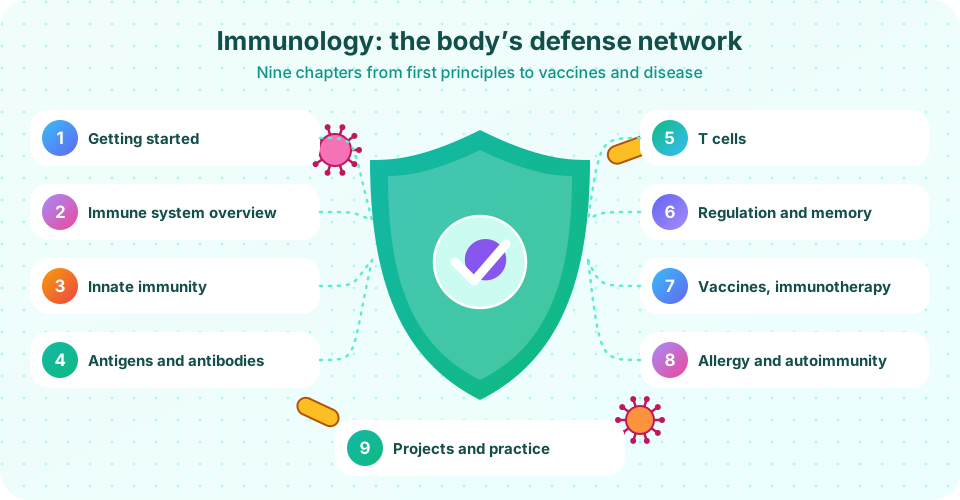
Course map: how this immunology course works
Start here: who the immunology course is for, what you need first, how the nine chapters fit together and how to study them with quizzes, plots and simulations.
Every second of your life, your body is negotiating with a crowded world. You breathe in spores, swallow bacteria and brush against viruses. Almost always, nothing happens. When something does go wrong, a coordinated network of cells, organs and molecules springs into action: it finds the intruder, destroys it, and remembers it for next time. That network is the immune system, and the science that studies it is immunology.
This course takes you from the basic idea (how the body tells "self" from "nonself") to modern topics such as vaccines, allergy, autoimmune disease and cancer immunotherapy. It follows the international common core of upper-secondary and first-year university biology (Cambridge A Level, IB Biology and US AP Biology), then goes a little deeper where the ideas are beautiful.
Educational information only. This course explains how the immune system works. It is not medical advice and cannot diagnose or treat anything. If you or someone you know is unwell, talk to a doctor or another qualified health professional. The interactive tools in the lessons are demonstrations, not tests.
Who this course is for
- Students aged about 14 to 18 who meet immunology in a biology syllabus and want a clear second explanation.
- First-year university students in biology, medicine, nursing, pharmacy or biomedical science who want an overview before a heavy textbook.
- Curious adults who want to understand vaccines, allergies and the news about new therapies.
You need only school-level biology: what a cell is, that DNA codes for proteins, and that proteins fold into shapes. A little arithmetic helps in places (powers of two, percentages, logarithms), and we explain each time it appears. Nothing here needs programming skills; the Python and JavaScript examples run in your browser, and you can change a number and press Run.
The nine chapters
Foundations
Chapters 1 and 2 give you the vocabulary.
The first responders
Recognition
The specialists
Balance and memory
Using immunity
When it goes wrong
Practice
Apply everything to real situations.
Chapters 1 to 4 (this part of the course) build the foundation: what the immune system is, where its parts live, how the fast innate response works, and how antibodies recognize their targets. Chapters 5 to 9 add T cells, regulation, vaccines, disease and practice.
What you will be able to do
By the end of chapters 1 to 4 you should be able to explain, in your own words, how the body tells self from nonself; name the organs and cells of the immune system and say where each one works; follow an infection through its first hours of innate defense; and describe how antibodies are built, how they differ and how B cells make them. You will also be able to read simple immunological numbers such as titers and cell counts without being intimidated.
A note on honesty
Every number in the lessons is either a well-established textbook value, clearly marked as approximate, or part of a simulation that is labeled as a demonstration. The plots show schematic shapes, not measured data, and the interactive tools are teaching toys. Where scientists still disagree, the lessons say so.
How to study
- Read the "What you will learn" list first. It tells you what you should be able to do afterward.
- Look at the picture before the text. Each lesson has an illustration of its central idea. Cover the caption and try to explain it.
- Run every Try it block. Change one number and predict the result before you press Run.
- Take the quiz without looking back. The explanations matter more than the score.
- Finish with the chapter review. It mixes questions from the whole chapter, which is the best way to remember.
Plan on roughly 40 to 60 minutes per lesson. The 22 lessons of chapters 1 to 4 fit into about eight weeks at three lessons a week (the planner below does the arithmetic).
Try it
Press Run (or Ctrl + Enter) to see the console output here.
No output.
Check your understanding
Quick check · 3 questions
of 3 answered You scored / 3 · perfect!
-
1. What is immunology?
Immunology studies the cells, organs and molecules that defend the body, and what happens when they work too little, too much or against the wrong target. -
2. Which background do you need before starting?
Only basic biology is needed. Any code in the lessons runs in your browser and can be edited by changing a number. -
3. How should you use the Try it blocks?
Predicting and then testing is the fastest way to build intuition. The tools are demonstrations only and never medical tests.
Summary
- Immunology studies how the body defends itself and what happens when the defense errs.
- The course has nine chapters, from foundations to practice; this part covers chapters 1 to 4.
- You need only basic biology; examples run in the browser.
- Study by looking at the picture first, running the examples and taking the quiz cold.
- This is educational material and not medical advice.
Next: What is immunology?
Track your progress
Create a free account to tick off lessons and pick up where you left off on any device.
of Immunology lessons completed