


















Lesson 33 of 46 · Vaccines and Immunotherapy
Vaccine types and adjuvants: platforms, trade-offs and design
Compare live attenuated, inactivated, subunit, toxoid, conjugate, mRNA and vector vaccines, and learn what adjuvants add and why boosters are used.
Designing a vaccine is a balancing act. The best vaccine looks enough like the real pathogen to train the right memory, but is safe enough to give to millions of healthy people. Different pathogens need different trade-offs, which is why there are several kinds of vaccine rather than one. A vaccine against a toxin like tetanus has to work differently from one against a respiratory virus.
In this lesson you will meet each major vaccine platform, with examples, strengths and limits, and then the extra ingredients that make a vaccine work: adjuvants, and the dosing schedules that build memory.
What you will learn
- The main vaccine platforms and a typical example of each.
- Why live vaccines usually work well but are not suitable for everyone.
- How conjugate vaccines recruit T cell help for sugar antigens.
- What adjuvants are, and how boosters build memory.
Key terms
Attenuated: weakened so it can replicate a little but not cause disease in healthy people.
Subunit vaccine: contains only a purified part of the pathogen, such as a protein.
Toxoid: a toxin that has been chemically inactivated but still induces antibodies against the toxin.
Conjugate vaccine: a polysaccharide linked to a carrier protein.
Adjuvant: a vaccine component that boosts the immune response to the antigen.
Live attenuated vaccines
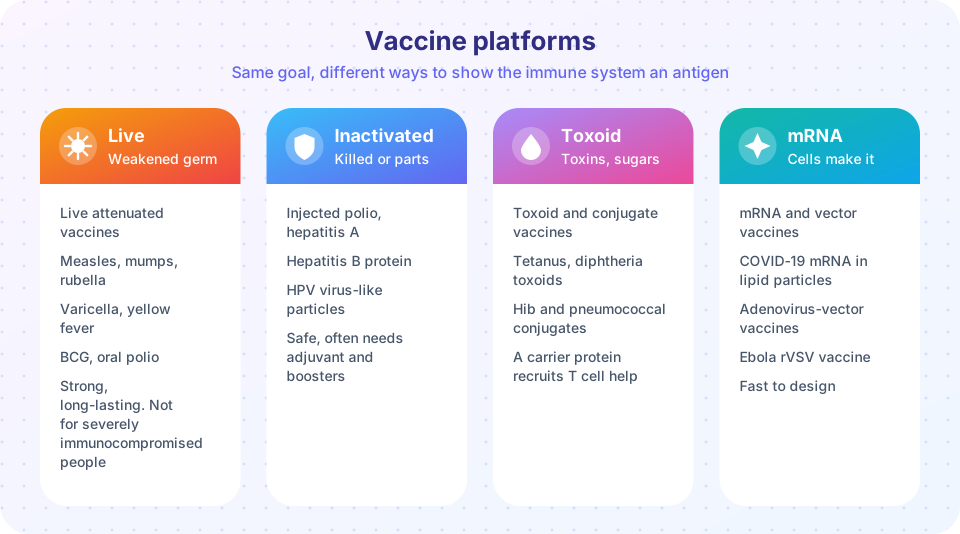
A live attenuated vaccine uses a weakened form of the real pathogen. It infects a few cells and multiplies in a limited way, so it presents antigens in the same way as a natural infection and stimulates strong B and T cell responses. Examples include measles, mumps and rubella (MMR), varicella (chickenpox), yellow fever, BCG against tuberculosis, rotavirus and the oral polio vaccine.
Strengths: often one or two doses give long-lasting immunity, and they stimulate cellular as well as antibody responses. Limits: because they replicate, they are generally avoided in people with severe immunodeficiency and in pregnancy, they often need a cold chain, and in rare cases a weakened virus can revert. The oral polio vaccine is the standard example: the weakened virus can spread to contacts, which helps protect communities, but in very rare circumstances in under-immunized populations the vaccine virus can regain virulence.
Inactivated and subunit vaccines
An inactivated vaccine uses whole pathogens that have been killed, for example by formalin. Injected polio vaccine, hepatitis A, and rabies vaccines are of this type. A subunit or recombinant protein vaccine contains only a purified part, which avoids any risk of infection. The hepatitis B vaccine uses a surface protein made in yeast by recombinant DNA. The HPV vaccine uses virus-like particles, empty shells that self-assemble from a viral protein and look like the real virus to the immune system but contain no viral genes.
These vaccines are very safe, including for people with weak immunity, but because they do not replicate, they usually produce weaker, shorter responses. They typically need several doses and adjuvants. The acellular pertussis (whooping cough) vaccine is a subunit vaccine whose protection fades faster than that of the older whole-cell vaccine, which has led to booster recommendations.
Toxoid and conjugate vaccines
Some bacteria harm us mainly through a toxin. Tetanus and diphtheria are examples. A toxoid vaccine modifies the toxin chemically so that it no longer poisons, but antibodies raised against it still neutralize the real toxin.
Other bacteria, such as Streptococcus pneumoniae, Haemophilus influenzae type b (Hib) and Neisseria meningitidis, are covered in a capsule of sugar. Pure sugars (polysaccharides) are poor at engaging T cells, so they trigger mostly weak IgM responses, and infants under about two years respond badly. The solution, developed in the 1980s, was the conjugate vaccine: the sugar is chemically bonded to a carrier protein. B cells recognize the sugar, take up the whole conjugate and show carrier peptides on MHC class II to helper T cells. This T cell help produces class switching, memory and good responses even in infants. Conjugate vaccines sharply reduced Hib disease where they were introduced.
Nucleic acid and vector vaccines
Newer platforms deliver the instructions for the antigen instead of the antigen.
An mRNA vaccine contains messenger RNA encoding an antigen, such as the spike protein of SARS-CoV-2, wrapped in lipid nanoparticles that carry it into cells. Cells translate it into protein, which is displayed to the immune system, and the mRNA is soon degraded. A key advance was the use of modified nucleosides, which Katalin Karikó and Drew Weissman showed could reduce unwanted innate immune activation of the RNA; they received the 2023 Nobel Prize in Physiology or Medicine. mRNA vaccines can be designed quickly once a sequence is known, but they need careful cold storage.
A viral vector vaccine uses a harmless virus, such as a modified adenovirus or vesicular stomatitis virus, to carry the gene for the antigen into cells. Examples include several COVID-19 vaccines and a vaccine against Ebola. A limitation is that the body can develop immunity to the vector itself, which might reduce repeated use of the same vector.
Adjuvants
Pure protein antigens often do not provide a danger signal, so the immune system may ignore them, as you saw with co-stimulation in the previous chapter. An adjuvant supplies that signal and improves the response. Several are used in licensed vaccines:
- Aluminium salts ("alum"), in use since the 1920s, in many vaccines including tetanus and hepatitis B. They help retain the antigen and activate innate cells.
- MF59, an oil-in-water emulsion used in some influenza vaccines for older adults.
- AS04, which combines alum with a derivative of a bacterial molecule (MPL) that activates Toll-like receptor 4.
- AS01, used in a vaccine against shingles, which combines MPL with a plant extract.
- CpG oligonucleotides, which activate Toll-like receptor 9, used in a hepatitis B vaccine.
Adjuvants work by activating the innate immune system so that antigen-presenting cells express co-stimulatory molecules and cytokines. They are also a reason why a safe, purified antigen can generate a strong response.
Doses, boosters and schedules
A single exposure gives a primary response with modest memory. A second dose, given weeks to months later, triggers a secondary response, with higher affinity and more memory cells. Many vaccines therefore use a prime and boost schedule. A longer interval often gives better affinity maturation, because germinal centers have more time. Some vaccines, such as tetanus in adults, need boosters every so often because antibody levels fall.
Passive immunization is different. Instead of triggering memory, it gives ready-made antibodies, for example after exposure to rabies or tetanus, or as monoclonal antibodies. It acts immediately but protects only for weeks to months, until the antibodies are cleared.
Common misconceptions
"Newer is always better." Each platform has strengths. Live vaccines are strong but not for everyone. Subunit vaccines are safe but need adjuvants and boosters.
"mRNA vaccines change your DNA." The mRNA stays in the cytoplasm, is not converted into DNA by human cells under normal conditions, and is degraded within days.
"Adjuvants are unsafe additives." They are tested components, designed to give the immune system a signal it needs. Their safety is monitored as part of each vaccine.
Try it
The first example is a vaccine platform explorer. You pick a platform and get its main facts. It summarizes this lesson and is not a clinical reference.
Press Run (or Ctrl + Enter) to see the console output here.
No output.
The second example shows why a booster matters, using a toy model on a log scale. Each dose multiplies the antibody level by a boost factor, and then the level decays with a half-life. All numbers are invented for illustration.
Press Run (or Ctrl + Enter) to see the result here.
Program input · what you'd type while the program runs
Type the answers before you press Run, one per line. Each time the program reads a line (with input()), it gets the next line from this box.
Check your understanding
Quick check · 5 questions
of 5 answered You scored / 5 · perfect!
-
1. Why is a conjugate vaccine more effective in infants than a pure polysaccharide vaccine?
Linking the sugar to a protein lets B cells receive help from CD4 T cells, producing memory and class switching. -
2. Which type of vaccine is typically avoided in people with severe immunodeficiency?
Live vaccines replicate and can cause disease in people who cannot control the weakened pathogen. -
3. What does an adjuvant do?
Adjuvants activate innate immune cells, which then provide co-stimulation and cytokines. -
4. The HPV vaccine uses:
Virus-like particles are empty shells that mimic the virus without any genetic material. -
5. Where does mRNA from an mRNA vaccine act?
mRNA is translated by ribosomes in the cytoplasm and then broken down.
Summary
- Live attenuated vaccines are strong but unsuitable for some groups. Inactivated, subunit and toxoid vaccines are safe but need boosters and adjuvants.
- Conjugate vaccines link a sugar to a protein to recruit T cell help.
- mRNA and vector vaccines deliver the instructions for an antigen.
- Adjuvants supply danger signals, and boosters build higher-affinity memory.
Next: Herd immunity
Track your progress
Create a free account to tick off lessons and pick up where you left off on any device.
of Immunology lessons completed