


















Lesson 18 of 46 · Antigens and Antibodies
Antigens and epitopes: what the immune system recognizes
Learn the difference between antigen and immunogen, what an epitope is, how B-cell and T-cell epitopes differ, why haptens need carriers and what makes a molecule immunogenic.
The word antigen was coined for "antibody generator", a molecule that could make the body produce antibodies. Today it has a broader meaning: any substance that can be bound by an antibody or by a T-cell receptor. That sounds simple, but the details are surprisingly rich. Not every antigen provokes a response, antibodies and T cells see antigens in very different ways, and tiny changes in an antigen can make it invisible to the immune system. Understanding these details explains why vaccines are designed as they are, why some viruses can reinfect us, and why a few drugs cause allergies.
What you will learn
- The difference between an antigen and an immunogen.
- What an epitope is and how B-cell and T-cell epitopes differ.
- Why haptens need a carrier to provoke antibodies.
- The factors that make a molecule immunogenic, and why microbes change their antigens.
Key terms
- Antigen (Ag): a molecule that can be bound by an antibody or a T-cell receptor.
- Immunogen: an antigen that actually triggers an immune response.
- Epitope (antigenic determinant): the specific part of an antigen that is bound.
- Paratope: the part of the antibody or receptor that binds the epitope.
- Hapten: a small molecule that can be bound by an antibody but cannot trigger a response alone.
- Adjuvant: a substance added to a vaccine to strengthen the response.
Antigen versus immunogen
Every immunogen is an antigen, but not every antigen is an immunogen. A tiny molecule such as a drug can be bound by an antibody (so it is an antigen) yet be unable to start a response (so it is not immunogenic). This distinction matters for vaccine design: the goal is to build an immunogen that causes protective antibodies against the right epitopes.
What makes a good immunogen?
| Factor | Why it matters |
|---|---|
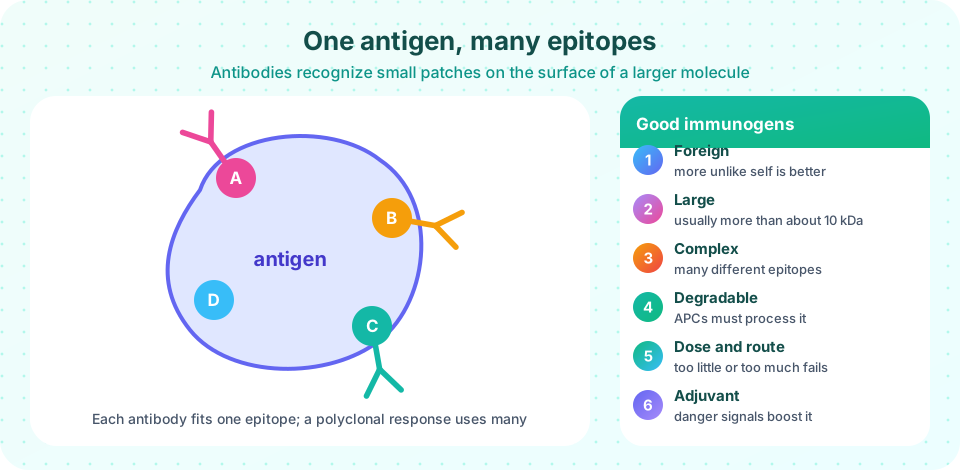
| Foreignness | Molecules very different from self are strongly immunogenic; self molecules are tolerated. |
| Size | Molecules larger than about 10 kDa (kilodaltons) are usually good; below about 1 kDa they are rarely immunogenic alone. |
| Chemical complexity | Proteins, with 20 different amino acids and shapes, are the best immunogens. Polysaccharides and lipids are weaker. Nucleic acids are weak. Repeated simple polymers are poor. |
| Degradability | Antigen-presenting cells must be able to take up and process the antigen so T cells can see it. |
| Dose and route | Very low or very high doses can fail; how an antigen enters the body (skin, muscle, mucosa) changes the response. |
| Adjuvants and danger signals | Innate activation by microbial patterns makes dendritic cells deliver the second signal that T cells require. |
Vaccines for very pure or small antigens therefore add an adjuvant. The oldest and most widely used are aluminum salts ("alum"), introduced into vaccines in the 1920s.
What is an epitope?
An antibody does not bind a whole protein; it binds a small surface patch of it, perhaps 5 to 15 amino acids' worth of contact, depending on how you count. A typical protein of a few hundred amino acids presents many different epitopes, and a response to it is usually polyclonal: many different B-cell clones each make antibody to a different epitope. A monoclonal antibody, by contrast, comes from a single clone and binds one epitope. Monoclonal antibodies are central to modern diagnostics and medicines.
Two kinds of epitope for B cells
- Linear (continuous) epitopes: a stretch of consecutive amino acids. They are recognized even when a protein is unfolded.
- Conformational (discontinuous) epitopes: residues that are far apart in the sequence but close together in the folded three-dimensional shape. Most antibodies that neutralize viruses bind conformational epitopes, which is why a heated or denatured protein may lose them.
B-cell epitopes are usually on the surface of the antigen, because the antibody has to reach them. They can be proteins, carbohydrates, lipids or even DNA.
T-cell epitopes are different
T-cell receptors do not see whole proteins. They see short linear peptides held in the groove of an MHC molecule on the surface of a cell. The cell first chops the antigen into pieces inside (a step called processing) and loads suitable fragments onto MHC. Typical peptide lengths are about 8 to 10 amino acids for MHC class I and about 13 to 25 for MHC class II. These peptides can come from anywhere in the protein, including the hidden interior, which is why the T-cell response can target parts of a virus that antibodies cannot reach. We return to this in Chapter 5.
| Feature | B-cell epitope | T-cell epitope |
|---|---|---|
| Recognized by | Antibody or B-cell receptor | T-cell receptor |
| Form | Surface patch of native antigen | Linear peptide plus MHC |
| Chemistry | Protein, carbohydrate, lipid, nucleic acid | Peptides only (mostly) |
| Location in antigen | Exposed surface | Anywhere, including inside |
| Processing needed | No | Yes |
Haptens and carriers
In the early 1900s, Karl Landsteiner studied small chemical groups attached to proteins. He found that a small chemical (a hapten) alone could not cause antibodies, but when it was coupled to a large carrier protein, the animal made antibodies that recognized the hapten. The carrier supplies T-cell help, since the carrier's peptides are presented to helper T cells that then help the B cell that bound the hapten. This explains some drug allergies: a small drug molecule such as penicillin or its breakdown products can bind to a body protein, and the combination is seen as foreign. Urushiol from poison ivy acts similarly on skin proteins. The same idea is used deliberately in conjugate vaccines, where a bacterial polysaccharide is chemically linked to a protein carrier so infants can respond to it.
Kinds of antigen by origin
- Exogenous: from outside, such as microbes, pollen or food.
- Endogenous: made inside cells, such as viral proteins in an infected cell or abnormal proteins in a tumor.
- Autoantigen: a normal self molecule; the target in autoimmune disease.
- Alloantigen: a molecule that differs between individuals of the same species, such as ABO blood group sugars and MHC molecules (key in transfusion and transplantation).
- Allergen: an antigen that triggers allergy (pollen, dust mite protein).
- Superantigen: a toxin (for example from some Staphylococcus strains) that grabs MHC and T-cell receptors outside the normal grooves and activates a huge fraction of T cells, causing dangerous cytokine release.
When the epitope changes
Microbes survive by changing their epitopes. In influenza, small mutations accumulate in the surface proteins hemagglutinin and neuraminidase (antigenic drift), so that antibodies against last year's strain bind less well; occasionally whole gene segments are swapped between viruses (antigenic shift), which can produce a very different virus. This is why flu vaccines are updated regularly. HIV mutates quickly within a patient; the trypanosomes that cause sleeping sickness switch their coat proteins again and again.
Opposite to variation is cross-reactivity: an antibody raised against one antigen binds a similar epitope on another. Jenner's cowpox protected against smallpox for this reason. Cross-reactivity can also cause trouble; in some cases of autoimmune disease, antibodies to a microbe are thought to bind similar-looking self molecules (molecular mimicry), though proving this in each disease is difficult.
Common misconceptions
"An antigen is always a foreign invader." Self molecules can also be antigens, for example in autoimmune disease or on cells in a transplant.
"Antibodies bind the whole microbe." They bind specific epitopes; many epitopes on a microbe are not useful targets.
"Any protein will cause a response." Dose, context and danger signals decide whether the result is immunity or tolerance.
Try it
Press Run (or Ctrl + Enter) to see the console output here.
No output.
Press Run (or Ctrl + Enter) to see the result here.
Program input · what you'd type while the program runs
Type the answers before you press Run, one per line. Each time the program reads a line (with input()), it gets the next line from this box.
Check your understanding
Quick check · 5 questions
of 5 answered You scored / 5 · perfect!
-
1. What is the difference between an antigen and an immunogen?
Haptens are antigens (they bind antibodies) but not immunogens on their own. -
2. Which description fits a T-cell epitope?
T-cell receptors recognize processed peptides presented by MHC. -
3. Why does a hapten need a carrier?
Helper T cells recognize carrier peptides and then help the B cell that bound the hapten. -
4. Which change in an influenza virus describes small mutations that accumulate in surface proteins?
Drift is gradual change; shift is a sudden reassortment of gene segments. -
5. Which type of epitope is destroyed when a protein is denatured?
Conformational epitopes depend on the folded 3-D structure.
Summary
- An antigen is anything bound by an antibody or T-cell receptor; an immunogen also triggers a response.
- Immunogenicity depends on foreignness, size, complexity, degradability, dose, route and danger signals; adjuvants boost vaccines.
- B-cell epitopes are surface patches (linear or conformational); T-cell epitopes are processed peptides on MHC.
- Haptens need carriers; conjugate vaccines use this principle.
- Antigenic drift and shift help microbes escape antibodies; cross-reactivity explains Jenner's cowpox success and some autoimmunity.
Next: Antibody structure
Track your progress
Create a free account to tick off lessons and pick up where you left off on any device.
of Immunology lessons completed