


















Lesson 20 of 46 · Antigens and Antibodies
Antibody classes and what antibodies do
Compare the five antibody classes (IgG, IgM, IgA, IgE, IgD) by structure, location and job, and learn how antibodies protect: neutralization, opsonization, complement, ADCC and mucosal defense.
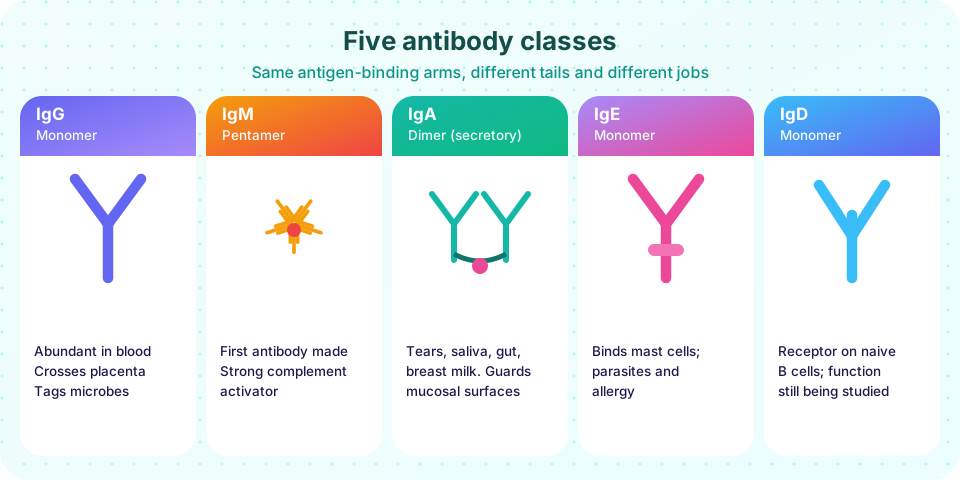
All antibodies share the same basic design, yet your body produces five different classes. They differ in the heavy-chain constant region, which means they differ in the tail (the Fc part) while the arms can be identical. Different tails send different messages and take the antibody to different places: into the bloodstream, across the placenta, into tears and milk, or onto the surface of mast cells.
This lesson introduces each class and then groups what antibodies do into six mechanisms. Antibodies, remember, rarely kill anything by themselves: they are guides and flags that recruit the destroyers.
What you will learn
- The structure, location and main job of each antibody class.
- The six main ways antibodies protect the body.
- What active and passive immunity are, and how maternal antibodies protect newborns.
- Typical blood levels of the classes and why they differ so much.
Key terms
- Isotype: the class of an antibody, set by its heavy-chain constant region (IgG, IgM, IgA, IgE, IgD).
- J chain: a small protein that joins IgM monomers into a pentamer and IgA monomers into a dimer.
- Secretory component: a piece added when dimeric IgA crosses epithelial cells; it protects IgA from digestion in the gut.
- Neutralization: blocking a toxin or virus so it can no longer bind its target.
- Passive immunity: protection from antibodies made by someone else.
The five classes
| Class | Heavy chain | Form | Share of serum Ig (approx.) | Where | Main jobs |
|---|---|---|---|---|---|
| IgG | γ | Monomer, 4 subclasses (IgG1 to IgG4) | 75% | Blood, tissues, crosses placenta | Neutralization, opsonization, complement, ADCC; long half-life (about 3 weeks) |
| IgM | μ | Pentamer with J chain (about 900 kDa, 10 binding sites); monomer on B cells | 10% | Mostly blood | First antibody in a response; strong complement activation; agglutination |
| IgA | α | Monomer in blood; dimer (with J chain and secretory component) in secretions | 15% in serum; the most produced overall | Tears, saliva, gut, airways, milk | Blocks microbes at mucosal surfaces |
| IgE | ε | Monomer | Tiny (well under 1%) | Bound to mast cells and basophils | Parasite defense, allergy |
| IgD | δ | Monomer | Under 1% | Surface of naive B cells | B-cell receptor; secreted role less clear |
IgG: the workhorse
IgG is the most abundant antibody in blood and in tissue fluid. Its subclasses differ in how well they activate complement and bind Fc receptors, but all of them are long-lived because the receptor FcRn rescues them from breakdown. FcRn also carries maternal IgG across the placenta into the baby's blood, so a newborn starts life with a borrowed set of antibodies against the infections the mother has met. This protection fades over the first months.
IgM: first and strong
IgM appears first in a primary response, before class switching. Because it has ten binding sites in one molecule, it is excellent at binding repetitive surfaces such as bacterial capsules even when each individual site is weak, and its pentamer shape lets it activate the classical complement pathway very efficiently (one IgM bound to a surface can be enough to start the cascade). The ABO "natural antibodies" that cause transfusion reactions are mostly IgM.
IgA: the guard at the gates
Your gut, airways and glands produce more IgA than any other antibody, grams every day, but most of it never enters the blood. Plasma cells under the mucosa secrete a dimer joined by a J chain. A transport receptor on the epithelial cell carries it through the cell and releases it into the lumen, still holding a piece of the receptor called the secretory component, which shields the molecule from digestive enzymes. Secretory IgA binds microbes and toxins in the mucus and keeps them from attaching to the epithelium (immune exclusion), without causing inflammation. Breast milk is rich in secretory IgA, which protects the baby's gut. Some people lack IgA; many of them have no symptoms, though some have more infections or allergies.
IgE: rare but powerful
IgE is the least abundant antibody in blood, yet it is extremely potent. Mast cells and basophils carry high-affinity receptors (FcεRI) that grab IgE and hold it on their surface for weeks. When an antigen cross-links two or more IgE molecules on the cell, it releases histamine and other mediators in seconds. This is the mechanism of immediate allergy (Chapter 8), but its evolutionary job was probably defense against large parasites such as worms, together with eosinophils.
IgD
IgD is displayed together with IgM on the surface of mature naive B cells as part of the receptor. A little is secreted; it appears to help in respiratory mucosal immunity, but the full role is still being studied.
Six ways antibodies protect
- Neutralization. The antibody covers the part of a toxin or virus that it needs to bind to a host cell, blocking infection. This alone is the main mechanism of most vaccines.
- Opsonization. Antibodies coating a microbe are recognized by Fc receptors on phagocytes, which grab and engulf it much more efficiently.
- Complement activation. C1q binds clustered IgG or IgM Fc regions and starts the classical pathway of the complement system: tagging, recruiting and lysing.
- ADCC. NK cells and other cells bind antibody-coated targets through Fc receptors and kill them.
- Agglutination and precipitation. Bivalent and multivalent antibodies cross-link particles into clumps that are cleared more easily; this is the basis of some blood-typing tests.
- Mucosal protection and delivery. Secretory IgA blocks microbes at surfaces, and IgG carried across the placenta or IgA in milk protects infants.
IgE adds a seventh, special route: arming mast cells to respond to antigens within seconds.
Active and passive immunity
- Active immunity: your own immune system makes the antibodies and memory cells, after infection or vaccination. It takes days to develop and lasts months to lifetimes.
- Passive immunity: you receive antibodies made elsewhere. Examples: maternal IgG across the placenta and IgA in milk; injected antibody preparations (such as antivenom, antitoxin or immune globulin after certain exposures); and monoclonal antibodies. It acts immediately but fades within weeks to months because no memory is created.
Typical serum levels
Concentrations vary a lot between people and laboratories, but in adults the broad picture is: IgG roughly 7 to 16 mg/mL, IgA about 0.7 to 4 mg/mL, IgM about 0.4 to 2.3 mg/mL, IgD around 0.03 mg/mL and IgE only about 0.0001 to 0.0004 mg/mL (roughly one fifty-thousandth of the IgG level). This spread of more than four orders of magnitude is why the plot below uses a log axis.
Common misconceptions
"Antibodies kill bacteria." Antibodies mostly neutralize, tag and recruit; killing is done by complement, phagocytes and NK cells.
"Maternal antibodies give a baby lifelong immunity." They protect for weeks to months and then decline; vaccines and the infant's own immune system take over.
"IgE exists only to cause allergy." It evolved for defense against parasites; allergy is a misdirected use.
Try it
Press Run (or Ctrl + Enter) to see the result here.
Program input · what you'd type while the program runs
Type the answers before you press Run, one per line. Each time the program reads a line (with input()), it gets the next line from this box.
Press Run (or Ctrl + Enter) to see the console output here.
No output.
Check your understanding
Quick check · 5 questions
of 5 answered You scored / 5 · perfect!
-
1. Which antibody class crosses the placenta?
IgG is transported across the placenta by the receptor FcRn. -
2. Which class is a pentamer joined by a J chain and is the first made in a primary response?
IgM pentamers have ten binding sites and activate complement strongly. -
3. What does the secretory component do?
It stays attached to dimeric IgA after transport through epithelial cells. -
4. Which class is bound by high-affinity receptors on mast cells and basophils?
IgE binds FcεRI; antigen cross-linking triggers degranulation. -
5. Injected antibodies that give immediate but temporary protection are an example of:
Passive immunity transfers ready-made antibodies and creates no memory.
Summary
- The five classes (IgG, IgM, IgA, IgE, IgD) share arms but differ in tails, structure and location.
- IgG is the main blood antibody and crosses the placenta; IgM is the first, strongly complement-activating pentamer; IgA guards mucosae; IgE arms mast cells; IgD is a B-cell receptor.
- Antibodies protect by neutralization, opsonization, complement activation, ADCC, agglutination and mucosal exclusion.
- Active immunity gives memory; passive immunity gives immediate but temporary protection.
Track your progress
Create a free account to tick off lessons and pick up where you left off on any device.
of Immunology lessons completed