


















Lesson 23 of 46 · T Cells and Cellular Immunity
Chapter 5 overview: T cells and cellular immunity
A map of the chapter on T cells: how they are made in the thymus, how they recognize antigen on MHC, and how helper and killer cells do their work.
Antibodies get most of the attention in popular accounts of immunity, but they cannot do the whole job. Viruses hide inside your cells, where antibodies cannot reach. Some bacteria live inside macrophages. Cancer cells are your own cells gone wrong. For all of these problems the body relies on cellular immunity, the branch of the adaptive immune system run by T lymphocytes, or T cells.
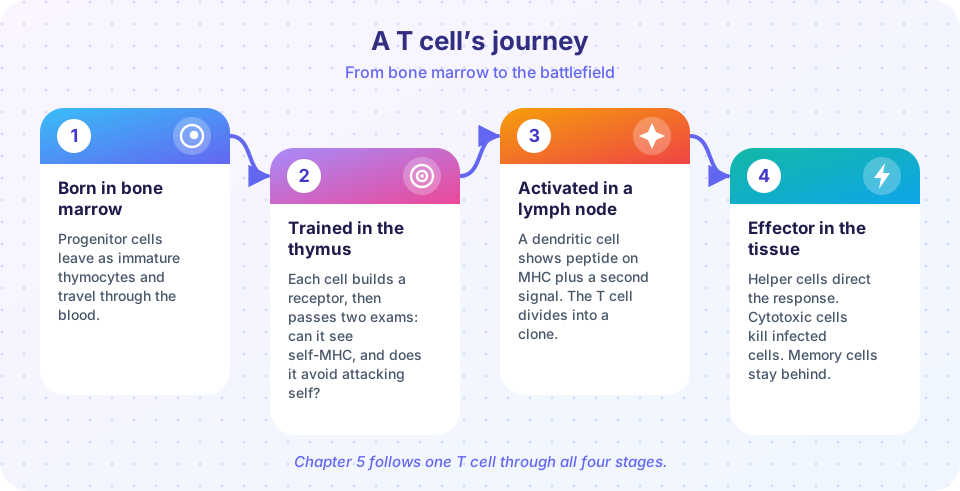
This chapter follows a single T cell from birth to battlefield. You will see how it is built, how it is trained not to attack you, how it learns that an infection is under way, and what it does once it knows.
What you will learn
- Why the immune system needs a branch that works on infected cells and not only on free microbes.
- The four stages in the life of a T cell: development, training, activation and effector work.
- How the lessons in this chapter fit together.
Key terms
T cell: a lymphocyte that matures in the thymus and carries a T cell receptor (TCR).
Cellular immunity: immune responses carried out by cells, mainly T cells, rather than by antibodies.
Antigen: any molecule that an immune receptor can recognize.
MHC: major histocompatibility complex, the cell-surface molecules that display peptide fragments to T cells.
Effector cell: an activated cell that carries out the response, for example by killing or by secreting cytokines.
Why a second branch of adaptive immunity?
An antibody is a protein that floats in the blood and tissue fluid and grips a molecule on the surface of a microbe or toxin. That works well for bacteria growing between your cells, for free virus particles and for toxins. It fails the moment a virus slips inside a cell. From there the virus copies itself using the cell's own machinery, and the only part of it visible from outside is a set of tiny fragments that the cell displays on its surface.
T cells were evolution's answer. A T cell cannot see a whole microbe. It reads peptides, short chains of amino acids, which are held up for inspection by MHC molecules. This design has two big consequences, and you will meet both over and over in the next lessons:
- T cells can detect things that are hidden inside cells, because infected cells advertise what they contain.
- T cells must learn to tell your own peptides from foreign ones, and that training is a major theme of immunology.
The cast of characters
There are two main families of T cells, named after the co-receptor protein they carry.
- CD4 T cells are mostly helpers. They read peptides on MHC class II molecules and give instructions to other immune cells by releasing signaling proteins called cytokines.
- CD8 T cells are mostly killers. They read peptides on MHC class I molecules and destroy cells that display a foreign peptide.
A third group, the regulatory T cells, are a specialized type of CD4 cell that keep immune responses in check. They get their own lesson in Chapter 6.
Chapter 5 at a glance
How a T cell sees
What activated T cells do
A map of the chapter
- Development in the thymus explains how a T cell builds its receptor and why most thymocytes die in training.
- MHC and the T cell receptor shows how peptides are displayed and what a T cell needs before it will act.
- Helper and killer T cells describes the effector subsets and how a cytotoxic cell executes its target.
- Chapter review pulls everything together with a ten-question quiz.
Common misconceptions
"T cells make antibodies." They do not. B cells and their descendants, the plasma cells, make antibodies. Helper T cells assist the B cells, but the antibody itself comes from the B cell lineage.
"T cells attack whole bacteria and viruses." A T cell sees only a peptide presented by MHC. It never touches the intact microbe.
Try it
This tiny program lists the four stages and prints which stage each cell type has reached. It is only a labelled demonstration of the sequence, not a model of real biology.
Press Run (or Ctrl + Enter) to see the console output here.
No output.
Check your understanding
Quick check · 4 questions
of 4 answered You scored / 4 · perfect!
-
1. Why can antibodies alone not clear a virus that has entered cells?
Antibodies circulate outside cells. Once a virus is inside a cell, other mechanisms, mainly cytotoxic T cells, are needed. -
2. What does a T cell actually recognize?
The T cell receptor reads a short peptide displayed by an MHC molecule. -
3. Which T cell family mainly acts as killers?
CD8 T cells are mostly cytotoxic. CD4 T cells are mostly helpers. -
4. Where do T cells get their training?
T cells mature in the thymus, which is why they are called T cells.
Summary
- Cellular immunity handles threats that hide inside cells and tumors made of our own cells.
- T cells read peptides displayed on MHC molecules.
- CD4 cells mostly help, CD8 cells mostly kill, and regulatory T cells restrain.
- Every T cell passes four stages: development, training, activation and effector work.
Track your progress
Create a free account to tick off lessons and pick up where you left off on any device.
of Immunology lessons completed