


















Lesson 42 of 46 · Projects and Practice
Practice: six immunology case studies
Work through six teaching cases on measles coverage, antibody deficiency, rheumatic fever, vaccine timing, anaphylaxis and kidney rejection, using a four-question method.
Knowing the parts of the immune system is one skill. Using them to reason about a new situation is another, and it is the skill that tests and clinical reasoning reward. This lesson gives you a method and six short cases. Each is a teaching scenario invented for this course, based on well-known patterns, and not a real patient. They are for study. They do not teach anyone to diagnose or treat disease, and real clinical decisions need a qualified professional.
For each case, try to answer before reading the worked answer. Writing a sentence or two for each of the four questions is a good habit.
What you will learn
- A four-question method for any immunology case.
- How to use numbers from earlier chapters, such as thresholds and half-lives, in a real-looking situation.
- How to recognize patterns in infections, timing and tests.
Key terms
Differential: the list of possible explanations considered before settling on one.
Effective reproduction number (Re): new cases per case in the current population.
Serology: testing blood for antibodies.
Titer: a measure of antibody concentration, often reported as a dilution.
Crossmatch: a test that checks whether a recipient has antibodies against donor cells.
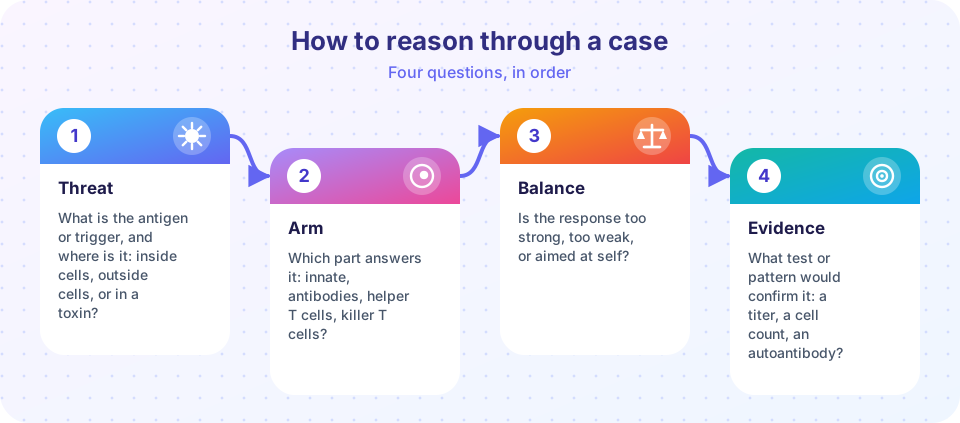
The four-question method
- Threat. What is the antigen or trigger, and where does it live: inside cells, outside cells, in a toxin, or is it self or a harmless substance?
- Arm. Which part of the immune system answers it: innate cells, antibodies, helper T cells, killer T cells?
- Balance. Is the response too strong, too weak, or aimed wrongly?
- Evidence. What test, timing or pattern would confirm the idea?
Case 1: A school and measles
A school has 400 pupils. Records show 88 percent have received the full two-dose measles vaccination course, which is assumed to be 97 percent effective. A case of measles (R0 about 15) enters the school. Is an outbreak likely, and what coverage would be needed?
Worked answer. The immune fraction is 0.88 × 0.97 = 0.854, so the susceptible fraction is 0.146. The effective reproduction number is Re = 15 × 0.146 ≈ 2.2, which is above 1, so spread is possible. The herd immunity threshold is 1 − 1/15 ≈ 93.3 percent, so the required coverage is 0.933 / 0.97 ≈ 96 percent. At 88 percent coverage the school sits below the threshold. A few percent of pupils clustered in one class could make it worse. The first TryIt below lets you compute this.
Case 2: A boy with repeated infections
A boy aged two has had four serious bacterial lung and sinus infections. His T cell counts are normal. Blood tests show very low levels of IgG, IgA and IgM and almost no B cells. He was healthy for the first six months of life.
Worked answer. The threat is extracellular bacteria, which antibodies handle. The arm that is missing is antibody production. Normal T cell counts argue against SCID. The delay of about six months is explained by maternal IgG, which crosses the placenta and protects babies for a while before fading. Absent B cells in a boy suggest X-linked agammaglobulinemia, caused by mutation in BTK, and genetic testing could confirm it. Replacement immunoglobulin supplies the missing antibodies. This follows the pattern table of the last chapter.
Case 3: Joint pain after a sore throat
A fifteen-year-old develops fever and painful, swollen joints about three weeks after a sore throat that was never treated. Blood tests show antibodies to Streptococcus pyogenes.
Worked answer. This pattern is typical of acute rheumatic fever. The trigger was an infection. The immune response made antibodies and T cells against streptococcal proteins, and some cross-react with human tissue, including heart valves and joints, through molecular mimicry. The delay of weeks reflects the time to build an adaptive response. The balance question is "wrongly aimed". The evidence is the earlier infection and the antibody response. Prompt treatment of strep throat is part of prevention.
Case 4: A vaccine and a booster
A new protein vaccine gives a mean antibody level of 100 units one month after dose 1, falling by half every 40 days. A second dose is given on day 60. After the second dose the level rises to about 20 times what it would have been without it. What explains the rise, and what level is expected shortly after dose 2?
Worked answer. The rise is the secondary response: memory B cells formed after dose 1 respond faster and more strongly. At day 30 the level is 100. From day 30 to day 60 is 30 days, so the factor is 0.5^(30/40) ≈ 0.59, giving about 59 units just before dose 2. Multiplying by 20 gives about 1,190 units. The numbers are invented, but the calculation of exponential decay followed by a boost is the same as in real serology.
Case 5: Reaction to a wasp sting
A woman is stung by a wasp. Within five minutes she has hives all over her body, a feeling of tightness in her throat and light-headedness. A year earlier she had a milder, local swelling after a sting.
Worked answer. The threat is venom, an allergen. The rapid time course and the hives point to a type I reaction with IgE on mast cells. The earlier mild reaction was the sensitization, and now re-exposure gives a stronger systemic reaction, with signs of anaphylaxis: throat tightness and a drop in blood pressure. It is an emergency, and the standard first treatment is intramuscular adrenaline with emergency services. Later, testing for IgE to venom and venom immunotherapy can be considered by an allergist.
Case 6: A kidney graft
A man receives a kidney from a deceased donor and is taking tacrolimus, mycophenolate and prednisone. On day 10 his blood creatinine, a marker of kidney function, rises and a biopsy shows lymphocytes invading the kidney tissue.
Worked answer. The timing, days after transplant, and the lymphocytic infiltrate suggest acute cellular rejection: recipient T cells attack donor HLA. It is a normal response, not a failure of the donor kidney. Treatment usually involves a short course of high-dose corticosteroids or other T cell-directed drugs. Hyperacute rejection would have appeared within minutes to hours, and chronic rejection takes months to years.
Try it
The first tool is a calculator for Case 1. Change the coverage, vaccine effectiveness and R0 to see Re and the threshold.
Press Run (or Ctrl + Enter) to see the console output here.
No output.
The second example plots Re against vaccination coverage for Case 1 and marks the point where Re reaches 1.
Press Run (or Ctrl + Enter) to see the result here.
Program input · what you'd type while the program runs
Type the answers before you press Run, one per line. Each time the program reads a line (with input()), it gets the next line from this box.
Check your understanding
Quick check · 5 questions
of 5 answered You scored / 5 · perfect!
-
1. In Case 1, why is the school vulnerable at 88% coverage?
0.88 x 0.97 = 85%, which is below the 1 - 1/15 = 93% threshold. -
2. Why was the boy in Case 2 protected for his first months?
Maternal IgG crosses the placenta and fades over the first months. -
3. Which mechanism explains the joint and heart involvement in Case 3?
Antibodies and T cells against streptococci cross-react with human tissue. -
4. Which sign in Case 5 suggests anaphylaxis rather than a local reaction?
Involvement of several organ systems, such as airway and circulation, characterizes anaphylaxis. -
5. In Case 6, which type of rejection fits the timing and the lymphocyte infiltrate?
A T cell attack days to weeks after transplantation is acute cellular rejection.
Summary
- Use four questions: threat, arm, balance and evidence.
- Numbers from the course, thresholds, half-lives and probabilities, apply directly to realistic situations.
- Infection patterns, timing and mechanism usually point to the part of the immune system involved.
- Cases here are teaching scenarios and not clinical guidance.
Track your progress
Create a free account to tick off lessons and pick up where you left off on any device.
of Immunology lessons completed