


















Lesson 17 of 46 · Antigens and Antibodies
Chapter 4 overview: antigens and antibodies
A map of chapter 4: what antigens and epitopes are, how antibodies are built, the five antibody classes and how B cells make them.
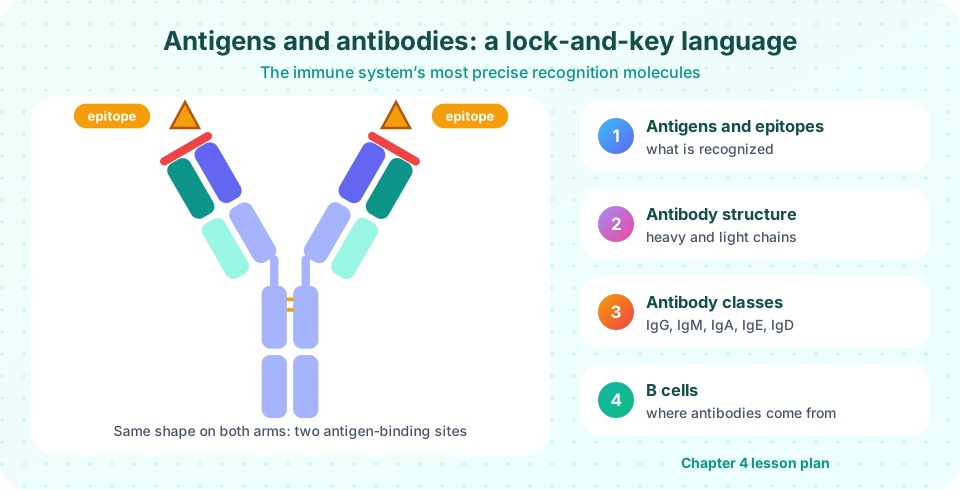
Innate receptors read patterns. Antibodies read shapes. An antibody can distinguish one protein from another that differs by a single amino acid, and it can be made against virtually any molecule that exists, including man-made chemicals that never occurred in nature. Behind that power are two ideas you will meet in this chapter: a vast library of receptors made by gene shuffling, and the selection of the right one by the antigen itself.
This overview explains the vocabulary and the plan.
The big ideas
Antigen
Antibody
Five classes
B cells
One B cell makes one kind of antibody.
What each lesson covers
- Antigens and epitopes. What makes a molecule an antigen, what an epitope is, the difference between B-cell and T-cell epitopes, haptens and adjuvants.
- Antibody structure. Heavy and light chains, domains, variable and constant regions, hinge, Fab and Fc, and how the variable loops give each antibody its fit.
- Antibody classes and functions. The five isotypes, what each does, and the six main ways antibodies protect: neutralization, opsonization, complement activation, ADCC, agglutination and mucosal protection.
- B cells and antibody production. The B-cell receptor, V(D)J recombination, clonal selection, plasma and memory cells, class switching and affinity maturation.
- Chapter 4 review. One picture, one table, ten questions.
Two words you will need
- Specificity: an antibody binds one epitope (or a few closely related ones) and ignores the rest.
- Affinity: how tightly it binds. Higher affinity means better protection, and the immune system improves affinity over time.
Questions this chapter answers
- How can the body make antibodies against molecules that never existed before, including man-made chemicals?
- Which part of an antibody grips the target and which part sets what happens next?
- Why is IgE so rare in blood while IgA is made in gram quantities every day?
- How do antibodies get better during an infection?
- Why does a booster dose give a bigger response than the first dose?
Terms you will meet
Epitope (the recognized patch) and paratope (the matching patch on the antibody), Fab and Fc (arm and stem), isotype (the class, such as IgG), affinity (binding strength of one site), avidity (combined strength of many sites) and plasma cell (the antibody factory). You will also meet three enzymes by their initials: RAG, TdT and AID.
How this chapter connects to the rest
Antibodies are only half of adaptive immunity. In Chapter 5 you will see that most B-cell responses need help from T cells. Chapter 7 shows how vaccines are designed to produce high-quality antibodies and memory, and Chapter 8 returns to IgE (allergy), to antibodies that mistakenly attack self (autoimmunity) and to the diseases in which antibodies are missing.
A study tip for this chapter
This chapter contains a lot of structure and many names. Draw an antibody large on a sheet of paper and keep adding to it lesson by lesson: first the chains and domains, then the CDR loops, then Fab and Fc, then what each class changes about the tail. Seeing everything on one picture turns a list of facts into a single mental model that you can rotate and question.
A preview of the difficulty
This chapter is full of new names, but only a handful of ideas carry the weight: recognition by shape, a constant part that acts and a variable part that binds, and a selection process that improves binding over time. If you hold on to those three, the details such as IgA dimers and the J chain will slot into place without effort.
Try it
Press Run (or Ctrl + Enter) to see the console output here.
No output.
Check your understanding
Quick check · 3 questions
of 3 answered You scored / 3 · perfect!
-
1. What is an epitope?
An antigen is the whole molecule; the epitope is the specific site that is recognized. -
2. What does 'affinity' describe?
Affinity is binding strength; the response improves affinity over time. -
3. Which antibody class is usually produced first in a new infection?
IgM is the first class made; later B cells switch to IgG, IgA or IgE.
Summary
- Antibodies read shapes: an antigen carries epitopes, and each antibody binds one.
- The chapter covers antigens, antibody structure, five classes with their functions and the B cells that make them.
- Specificity and affinity are the two key properties of antibody binding.
Next: Antigens and epitopes
Track your progress
Create a free account to tick off lessons and pick up where you left off on any device.
of Immunology lessons completed