


















Lesson 44 of 44 · Projects and Practice
Where to go next
Plan your next steps after fluid mechanics: advanced topics such as CFD and turbulence, related courses on this site, and how to practice with real problems.
You have covered dimensional analysis, pipe flow, boundary layers and drag, compressible flow and machinery. That is the core of an undergraduate fluid mechanics course. The next step depends on what you want to do with it. This page maps the options and gives practice habits that make the knowledge stick.
What you will learn
- Which advanced topics follow from this course.
- Which other courses on this site connect to fluid mechanics.
- How to practice so the methods become automatic.
Key terms
CFD (computational fluid dynamics): solving the flow equations numerically on a computer.
Navier-Stokes equations: the full equations of motion for a viscous fluid, from which most of this course's results are special cases.
Turbulence modeling: methods to predict the effects of turbulent fluctuations without resolving them all.
Open-channel flow: flow with a free surface, such as rivers and canals.
Advanced topics that follow
- The Navier-Stokes equations. The pipe and boundary-layer formulas of this course are solutions or approximations of these equations. A deeper course derives them, studies exact solutions and introduces vorticity.
- Turbulence. Why eddies form, how energy cascades from large to small scales, and how engineers model it (RANS, large-eddy simulation).
- Computational fluid dynamics. Mesh generation, discretization, stability, validation. CFD does not replace understanding; it needs it, to judge whether a result is plausible.
- Open-channel flow and hydraulics. Rivers, spillways, hydraulic jumps, flood routing.
- Aerodynamics. Lift, wings, compressible flow around bodies, oblique shocks and supersonic design.
- Heat transfer. Convection couples the boundary layers of this course to temperature.
- Multiphase and non-Newtonian flow. Slurries, foams, polymer melts, blood.
- Turbomachinery design. Velocity triangles, blade design, cascades, compressor stability.
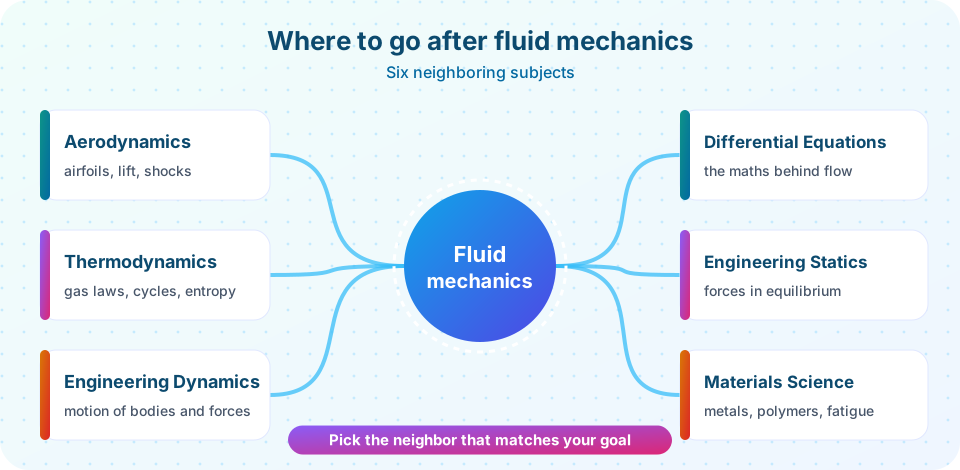
Courses on this site that connect
| Track | Why it helps |
|---|---|
| Aerodynamics | wings, lift, compressible flow around bodies |
| Engineering Thermodynamics | gas laws, entropy and cycles behind compressible flow and turbines |
| Engineering Dynamics | motion and forces, the other half of Newtonian mechanics |
| Differential Equations | the mathematics behind flow equations and models |
| Engineering Statics | forces in equilibrium, including loads on pipes and dams |
| Materials Science | what pipes, blades and wings are made of, and how they fail |
How to practice
- Re-derive, do not memorize. Write the Hagen-Poiseuille profile from a force balance once a month until it feels easy.
- Always estimate first. Before using a formula, guess the answer to within a factor of ten. A bad guess teaches more than a lucky computation.
- Write code for the iterative problems. The three pipe problems, the nozzle back pressures and the pump operating point all become routine with a small script.
- Look at real flows. A stream around a rock, steam over a hot cup, smoke from a candle: ask which regime it is in and why.
- Keep a units habit. Check dimensions at every line; it catches most errors.
Common misconceptions
"CFD makes hand calculations obsolete." Hand calculations give the sanity check CFD needs and often the answer itself in design work.
"Fluid mechanics is only about water." Air, blood, oil, magma, plasma and the interstellar medium follow the same principles.
"Finishing a course means mastering the field." Fluid mechanics is a lifelong subject; most of the interesting open problems, such as turbulence, are still unsolved.
Try it
First, a self-assessment. Tick what you can do without notes, and the meter shows how ready you are for the next level. It is a study aid, not a test.
Second, a small planner that suggests a track on this site for a goal.
Press Run (or Ctrl + Enter) to see the result here.
Program input · what you'd type while the program runs
Type the answers before you press Run, one per line. Each time the program reads a line (with input()), it gets the next line from this box.
Check your understanding
Quick check · 4 questions
of 4 answered You scored / 4 · perfect!
-
1. What are the Navier-Stokes equations?
They are the full equations of motion for a viscous fluid; the course's results are special cases or approximations. -
2. Which habit best prevents large errors in a fluid problem?
Estimates and unit checks catch most mistakes before they cost time. -
3. Which topic studies fluid flow with a free surface, such as a river?
Open-channel flow deals with rivers, canals and spillways. -
4. Why is CFD not a replacement for understanding?
CFD output depends on modeling choices; physical understanding is needed for checking and interpreting results.
Summary
- The core of fluid mechanics is covered; next come Navier-Stokes, turbulence, CFD, hydraulics and aerodynamics.
- Neighboring courses on this site: aerodynamics, thermodynamics, dynamics, differential equations, statics, materials.
- Practice by deriving, estimating, coding and observing real flows.
Track your progress
Create a free account to tick off lessons and pick up where you left off on any device.
of Fluid Mechanics lessons completed