


















Lesson 7 of 44 · Fluid Properties and Statics
Fluid Properties: Density, Viscosity and Surface Tension
Learn the key fluid properties: density, specific weight, specific gravity, viscosity, bulk modulus, surface tension and vapor pressure, with typical values.
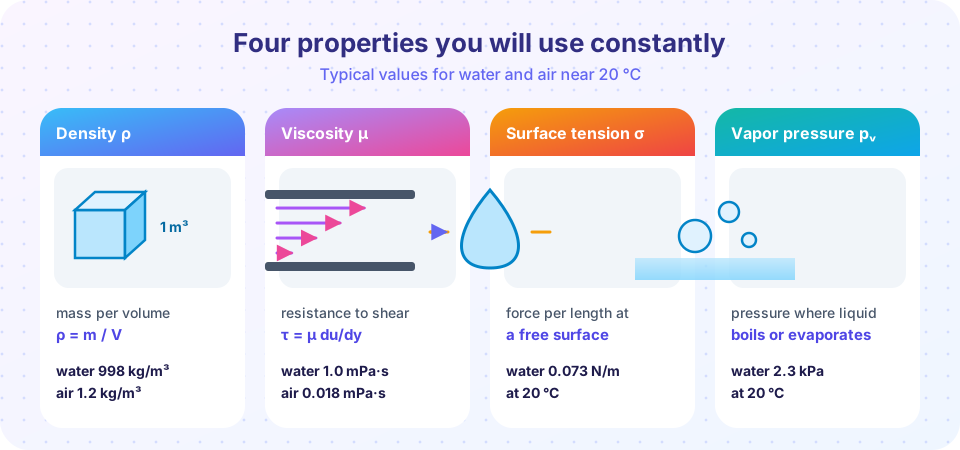
Every fluid problem needs numbers: how heavy is the fluid, how thick, how stretchy, how likely to boil? Those numbers are the fluid's properties. This lesson defines each one, gives typical values for water, air and mercury, and shows two effects that surprise newcomers: how steeply the viscosity of a liquid falls when it is heated, and why water climbs up a thin tube.
What you will learn
- Define density, specific weight and specific gravity and convert between them.
- Distinguish dynamic and kinematic viscosity and describe how each varies with temperature.
- Use the bulk modulus to estimate compressibility.
- Calculate capillary rise and explain vapor pressure and cavitation.
Key terms
Density (ρ): mass per unit volume, kg/m³.
Specific gravity (SG): density of a liquid divided by the density of water at 4 °C (about 1000 kg/m³); dimensionless.
Kinematic viscosity (ν): μ/ρ, units m²/s.
Bulk modulus (K): K = −Δp / (ΔV/V), how much pressure is needed for a given fractional volume change.
Vapor pressure (pᵥ): the pressure at which a liquid boils at a given temperature.
Density, specific weight and specific gravity
Density ρ = m/V is the most basic property. Specific weight is the weight per volume, γ = ρ g, in N/m³; for water γ ≈ 998 × 9.81 ≈ 9790 N/m³. Specific gravity compares a liquid with water: mercury with ρ = 13 546 kg/m³ has SG = 13.5 (often quoted as 13.6 at 0 °C).
| Fluid (20 °C, 1 atm) | ρ (kg/m³) | μ (Pa·s) | ν (m²/s) |
|---|---|---|---|
| Water | 998 | 1.00 × 10⁻³ | 1.0 × 10⁻⁶ |
| Seawater | about 1025 | about 1.1 × 10⁻³ | about 1.1 × 10⁻⁶ |
| Air | 1.20 | 1.8 × 10⁻⁵ | 1.5 × 10⁻⁵ |
| Mercury | 13 546 | 1.5 × 10⁻³ | 1.1 × 10⁻⁷ |
| Light machine oil | about 880 | about 0.1 | about 1.1 × 10⁻⁴ |
The density of a gas follows the ideal gas law, ρ = p/(R T) with R = 287 J/(kg·K) for air. At 20 °C and 101.3 kPa: ρ = 101 325 / (287 × 293.15) ≈ 1.204 kg/m³.
Viscosity
Chapter 1 defined dynamic viscosity through τ = μ du/dy. In many formulas μ arrives divided by density, which defines the kinematic viscosity ν = μ/ρ. It measures how quickly momentum diffuses through a fluid.
Temperature matters enormously, and in opposite directions:
- Liquids thin out when heated: the molecules escape each other's attraction more easily. Water's viscosity drops by a factor of about 6 between 0 °C and 100 °C.
- Gases thicken when heated: faster molecules exchange momentum more often. Air's viscosity rises roughly as
T^0.7.
A well-known empirical fit for water is μ = A · 10^(B/(T − C)) with A = 2.414 × 10⁻⁵ Pa·s, B = 247.8 K, C = 140 K and T in kelvin.
Press Run (or Ctrl + Enter) to see the result here.
Program input · what you'd type while the program runs
Type the answers before you press Run, one per line. Each time the program reads a line (with input()), it gets the next line from this box.
The run uses Sutherland's formula for air, a standard model of gas viscosity.
Compressibility
Liquids resist volume change strongly. The bulk modulus K is the pressure increase needed for a fractional volume decrease: ΔV/V = −Δp / K. For water K ≈ 2.2 GPa, so a pressure rise of 1 MPa (10 atm) shrinks the volume by 10⁶ / 2.2 × 10⁹ ≈ 4.5 × 10⁻⁴, or 0.045 %. That is why most liquid flows are modeled as incompressible. Gases are very different: at constant temperature an ideal gas has K = p, about 0.1 MPa for air at atmospheric pressure, 22 000 times softer than water.
The speed of sound ties these together: c = √(K/ρ). For water c = √(2.2 × 10⁹ / 998) ≈ 1485 m/s. For air, c = √(γ R T) ≈ 343 m/s.
Surface tension and capillary rise
Molecules at a liquid surface are pulled inward by their neighbors, so the surface acts like a stretched skin with surface tension σ (N/m). For water at 20 °C, σ ≈ 0.073 N/m. It makes raindrops round, lets some insects walk on water, and drives capillary rise in thin tubes. In a clean glass tube of radius r, with contact angle θ:
h = 2 σ cos θ / (ρ g r)
For water in clean glass, θ ≈ 0°. With r = 0.5 mm: h = 2 × 0.0728 / (998 × 9.81 × 0.0005) ≈ 0.030 m = 30 mm. Mercury has θ ≈ 140°, so cos θ is negative and the mercury level is depressed in glass tubes.
Press Run (or Ctrl + Enter) to see the result here.
Program input · what you'd type while the program runs
Type the answers before you press Run, one per line. Each time the program reads a line (with input()), it gets the next line from this box.
Vapor pressure and cavitation
Every liquid has a vapor pressure pᵥ that rises with temperature. If the local pressure falls to pᵥ, the liquid boils, even when cold. Water at 20 °C has pᵥ ≈ 2.3 kPa; at 100 °C it is 101.3 kPa, which is why it boils at sea level at 100 °C. Boiling caused by low pressure rather than high temperature is called cavitation. Vapor bubbles form where pressure drops (at the tip of a fast propeller or in a pump inlet) and then collapse violently, pitting metal and making noise. Chapter 4 shows how to find where the pressure gets lowest.
When a pump or propeller design calls for avoiding cavitation, the check is always the same: make sure the lowest absolute pressure in the flow stays well above pᵥ.
Common misconceptions
"More viscous means denser." Not necessarily. Mercury is 13.5 times denser than water but has about the same viscosity. Light oil is less dense than water but 100 times more viscous.
"Warm liquids are thicker." The opposite: heating a liquid lowers its viscosity. (It is warm gases that become thicker.)
"Surface tension is a force on the whole body of liquid." It acts along the surface only and matters for small scales (drops, thin tubes); at large scales gravity dominates.
Check your understanding
Quick check · 5 questions
of 5 answered You scored / 5 · perfect!
-
1. Mercury has density 13 546 kg/m³. Its specific gravity is about
SG = 13 546 / 1000 ≈ 13.5. -
2. Kinematic viscosity ν is defined as
ν = μ/ρ has units m²/s. -
3. Heating water from 20 °C to 80 °C makes its dynamic viscosity
Liquid viscosity decreases with temperature; at 80 °C water has less than half its 20 °C viscosity. -
4. Water (σ = 0.0728 N/m, ρ = 998 kg/m³, θ = 0°) rises in a tube of radius 1 mm by about
h = 2σ/(ρ g r) = 2 × 0.0728 / (998 × 9.81 × 0.001) ≈ 0.0149 m ≈ 15 mm. -
5. Cavitation occurs when
Local pressure reaching pᵥ makes the liquid vaporize, forming bubbles that later collapse.
Summary
- Density
ρ, specific weightγ = ρgand specific gravitySG = ρ/ρ_waterdescribe how heavy a fluid is. - Dynamic viscosity μ falls with temperature in liquids and rises in gases;
ν = μ/ρ. - The bulk modulus
K(water 2.2 GPa) shows liquids are nearly incompressible;c = √(K/ρ)gives the speed of sound. - Surface tension causes capillary rise
h = 2σ cos θ / (ρ g r). - When pressure drops to
pᵥa liquid cavitates.
Track your progress
Create a free account to tick off lessons and pick up where you left off on any device.
of Fluid Mechanics lessons completed