


















Lesson 43 of 44 · Projects and Practice
Fluid mechanics cheat sheet
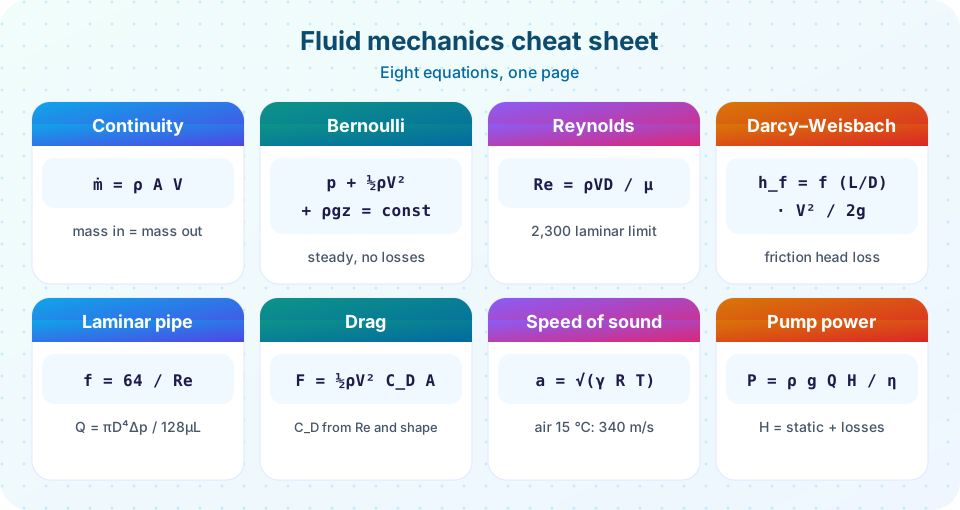
A one-page recap of the most used fluid mechanics equations, dimensionless numbers, typical values and rules of thumb, plus a code toolbox to check your answers.
Most fluid mechanics problems use the same handful of tools. This page puts the essential equations on one poster, followed by typical values and rules of thumb that help you tell at a glance whether an answer is reasonable.
What you will learn
- The equations that solve most problems in this chapter range.
- Typical property values to sanity-check results.
- A short checklist for every problem.
Key terms
Sanity check: a rough calculation or known value that shows whether an answer is the right size.
Order of magnitude: the nearest power of ten of a quantity.
Rule of thumb: a simple approximation that works within useful accuracy.
Toolbox: the set of functions you reuse from problem to problem.
Equations at a glance
| Topic | Equation |
|---|---|
| Continuity (steady) | ṁ = ρ A V is constant along a stream tube; incompressible: A₁V₁ = A₂V₂ |
| Hydrostatics | p = p₀ + ρ g h |
| Bernoulli (no losses) | p + ½ρV² + ρ g z = const along a streamline |
| Energy equation | p₁/ρg + V₁²/2g + z₁ + h_p = p₂/ρg + V₂²/2g + z₂ + h_L |
| Reynolds number | Re = ρ V D / μ = V D / ν |
| Darcy-Weisbach | h_f = f (L/D) V²/2g |
| Laminar pipe | f = 64/Re, Q = π D⁴ Δp / (128 μ L) |
| Turbulent pipe | Colebrook 1/√f = −2 log₁₀( ε/(3.7D) + 2.51/(Re√f) ) |
| Minor loss | h_m = K V²/2g |
| Plate boundary layer | δ = 5x/√Re_x, C_D = 1.328/√Re_L (laminar), 0.074/Re_L^0.2 (turbulent) |
| Drag, lift | F_D = C_D ½ρV²A, F_L = C_L ½ρV²S |
| Stokes drag | F = 3πμVD for Re < 1 |
| Speed of sound | a = √(γRT) |
| Isentropic (air) | T₀/T = 1 + 0.2Ma², p₀/p = (T₀/T)^3.5 |
| Choked mass flow (air) | ṁ ≈ 0.0404 A* p₀/√T₀ |
| Pump power | P = ρ g Q H / η |
| Affinity laws | Q ∝ N, H ∝ N², P ∝ N³ (same pump) |
Typical values
| Quantity | Value |
|---|---|
| Water density, 20 °C | 998 kg/m³ |
| Water dynamic viscosity, 20 °C | 1.0 × 10⁻³ Pa·s |
| Water kinematic viscosity | 1.0 × 10⁻⁶ m²/s |
| Air density, 20 °C, sea level | 1.20 kg/m³ |
| Air dynamic viscosity | 1.8 × 10⁻⁵ Pa·s |
| Air kinematic viscosity | 1.5 × 10⁻⁵ m²/s |
| Speed of sound in air, 15 °C | 340 m/s |
| Standard atmosphere | 101.325 kPa |
| Gravitational acceleration | 9.81 m/s² |
| Pressure of 10 m of water | about 98 kPa (about 1 bar) |
Rules of thumb
- Water mains and pump discharge lines run at 1 to 2 m/s; suction lines at 0.5 to 1.5 m/s.
- A pipe flow is turbulent if
Re > 4,000. Almost all water pipes are turbulent. - Friction factors for turbulent flow in ordinary pipes are between 0.01 and 0.05.
- Treat gas flow as incompressible below
Ma = 0.3. - Drag coefficients: sphere 0.47, streamlined body 0.05, cars 0.25 to 0.35, flat plate facing flow 1.2.
- Hydraulic power in kW is about
Q (L/s) × H (m) / 102. - Doubling the speed of a pump multiplies the power by eight.
A checklist for every problem
- Draw a sketch and choose the control volume or the two points.
- List the knowns, the unknown and the assumptions (steady? incompressible? frictionless?).
- Convert everything to SI.
- Compute the dimensionless numbers (
Re,Ma) before choosing a formula. - Solve; write units in every line.
- Sanity check with a typical value from the tables above.
Try it
First, a toolbox of the functions you will reuse, with a sanity run for each.
Press Run (or Ctrl + Enter) to see the result here.
Program input · what you'd type while the program runs
Type the answers before you press Run, one per line. Each time the program reads a line (with input()), it gets the next line from this box.
Second, three quick estimates, the kind used to check a design before any detailed calculation.
Press Run (or Ctrl + Enter) to see the result here.
Program input · what you'd type while the program runs
Type the answers before you press Run, one per line. Each time the program reads a line (with input()), it gets the next line from this box.
Check your understanding
Quick check · 4 questions
of 4 answered You scored / 4 · perfect!
-
1. Which equation gives friction head loss in a pipe?
h_f = f (L/D) V^2 / 2g is the Darcy-Weisbach equation. -
2. Approximately how many meters of water correspond to 1 bar?
p = rho g h gives h = 1e5 / (998 x 9.81) = 10.2 m. -
3. A pump delivers 10 L/s against 40 m. The hydraulic power is about:
P = 10 x 40 / 102 = 3.9 kW. -
4. What should you compute before choosing a friction law?
Re tells you whether the pipe flow is laminar or turbulent, and which friction law applies.
Summary
- A small set of equations covers most problems: continuity, Bernoulli with losses, Reynolds number, Darcy-Weisbach, drag and lift, sound speed, pump power.
- Keep typical values in mind; they catch mistakes quickly.
- Use the six-step checklist every time.
Next: Where to go next
Track your progress
Create a free account to tick off lessons and pick up where you left off on any device.
of Fluid Mechanics lessons completed