


















Lesson 13 of 44 · Control Volumes and Conservation
Conservation of Mass and the Continuity Equation
Derive and use the continuity equation rho A V = constant for steady flow, handle draining tanks and branching pipes, with worked examples and a simulation.
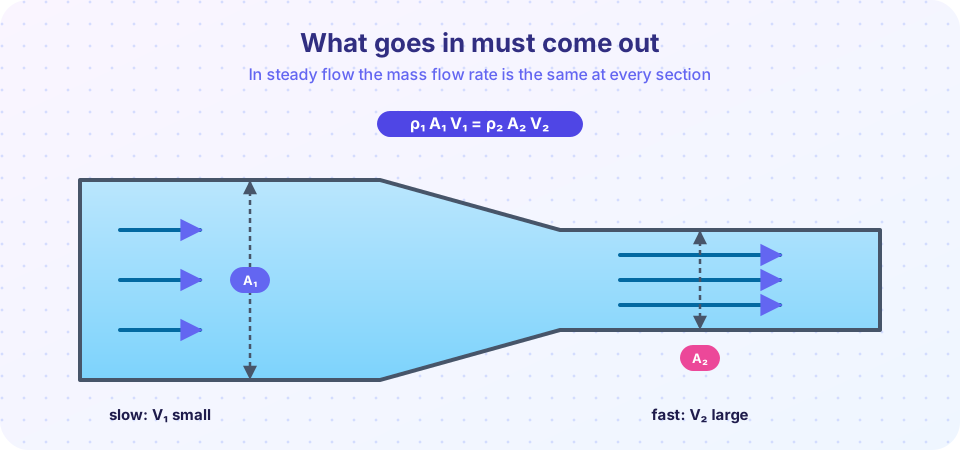
Mass cannot be created or destroyed. In everyday terms: if you pinch a garden hose, the water speeds up. The flow of water out of a hose with a smaller nozzle is faster than in the hose. This lesson turns that obvious fact into the continuity equation, the first and often simplest of the three conservation laws in fluid mechanics. You will use it in nearly every later problem to find a velocity or a flow rate that you do not yet know.
What you will learn
- Define mass flow rate
ṁ = ρ A Vand volume flow rateQ = A V. - Apply the steady continuity equation to pipes with one inlet and outlet and with branches.
- Handle an unsteady control volume such as a draining tank.
- Use average velocity correctly.
Key terms
Mass flow rate (ṁ): mass crossing a surface per unit time, kg/s.
Volume flow rate (Q): volume crossing a surface per unit time, m³/s.
Average velocity (V): Q / A, the uniform speed that would carry the same flow.
Incompressible flow: density is constant, so continuity reduces to Q₁ = Q₂.
From Reynolds to continuity
Apply the transport theorem with B = m and b = 1. The mass of a system cannot change, so dm_sys/dt = 0, and
0 = d/dt ∫_CV ρ dV + ∮_CS ρ (V · n) dA
The surface term is the net mass flow out. If the velocity is uniform over each opening this becomes
d m_CV / dt = Σ ṁ_in − Σ ṁ_out, ṁ = ρ A V
- Steady flow (
dm_CV/dt = 0) with one inlet and one outlet:ρ₁ A₁ V₁ = ρ₂ A₂ V₂. - Steady, incompressible:
A₁ V₁ = A₂ V₂, i.e.Q₁ = Q₂. - Several branches:
Σ ṁ_in = Σ ṁ_out.
Real velocity varies across a pipe (zero at the wall). The average velocity V = Q/A is used in the equations. Chapter 6 shows the corrections needed in energy calculations.
Worked example 1: a narrowing pipe
Water flows at 2.0 m/s in a 100 mm pipe that narrows to 50 mm. The area ratio is (100/50)² = 4, so the speed rises fourfold to 8.0 m/s.
Q = (π/4)(0.1)² × 2.0 = 0.01571 m³/s, and ṁ = 998 × 0.01571 = 15.7 kg/s. The numbers are the same at both sections.
Worked example 2: a branching pipe
A main pipe carries 0.06 m³/s of water. It splits into two branches. Branch 1 (diameter 80 mm) has a speed of 4.0 m/s. What flows in branch 2 (diameter 60 mm)?
- Branch 1:
Q₁ = (π/4)(0.08)²(4.0) = 0.02011 m³/s. - By continuity:
Q₂ = 0.06 − 0.02011 = 0.03989 m³/s. - Speed in branch 2:
V₂ = Q₂ / A₂ = 0.03989 / (π/4 × 0.06²) = 14.1 m/s.
A speed of 14 m/s is very high for a pipe (typical design speeds are 1 to 3 m/s), so a good engineer would question the design.
Press Run (or Ctrl + Enter) to see the result here.
Program input · what you'd type while the program runs
Type the answers before you press Run, one per line. Each time the program reads a line (with input()), it gets the next line from this box.
Unsteady example: a draining tank
A cylindrical tank of area A_t has water at height h. It drains through a small hole of area a at the bottom. (Chapter 4 shows the exit speed is √(2 g h) for an ideal hole; for now take it as given.) The control volume is the tank. Mass balance:
ρ A_t dh/dt = − ρ a √(2 g h) ⇒ dh/dt = −(a / A_t) √(2 g h)
The level falls faster when h is large and slows as it empties. Separating variables gives h(t) = (√h₀ − (a/A_t) √(g/2) t)², and the tank is empty at
t_empty = (A_t / a) √(2 h₀ / g)
For A_t = 1 m², a 20 mm hole (a = 3.14 × 10⁻⁴ m²) and h₀ = 2 m: t = 3183 × √(4/9.81) = 3183 × 0.6386 ≈ 2033 s, about 34 minutes. A real hole has a contraction and a discharge coefficient around 0.6, so it takes 2033/0.6 ≈ 3400 s or 56 minutes.
Press Run (or Ctrl + Enter) to see the result here.
Program input · what you'd type while the program runs
Type the answers before you press Run, one per line. Each time the program reads a line (with input()), it gets the next line from this box.
Common misconceptions
"Water speeds up in a narrow pipe because it is squeezed." It speeds up because the same volume per second has less area to pass through. (Pressure also changes; chapter 4 explains how.)
"Continuity says V₁ = V₂." It says A₁ V₁ = A₂ V₂. Equal velocities occur only for equal areas.
"For gases A V is always constant." Only if density is constant. For compressible flow use ρ A V (chapter 8).
Check your understanding
Quick check · 5 questions
of 5 answered You scored / 5 · perfect!
-
1. Water flows at 3 m/s in a 60 mm pipe that expands to 120 mm. The speed in the larger pipe is
Area is four times larger, so V₂ = 3/4 = 0.75 m/s. -
2. For steady incompressible flow, which statement is true?
Q = A V is constant because density is constant and nothing is stored. -
3. A pipe of 0.05 m³/s splits into two branches. One carries 0.02 m³/s. The other carries
Q₂ = 0.05 − 0.02 = 0.03 m³/s. -
4. A tank with area 2 m² has Q_in = 4 L/s and Q_out = 1 L/s. The level
dh/dt = (4 − 1) × 10⁻³ / 2 = 1.5 × 10⁻³ m/s. -
5. Why does a draining tank slow its fall rate as it empties?
The outflow depends on √(2 g h), which decreases with height.
Summary
- Mass balance on a control volume: storage rate = mass in − mass out, with
ṁ = ρ A V. - Steady incompressible flow:
A₁ V₁ = A₂ V₂, so speed varies inversely with area. - Branches:
Q_main = ΣQ_branches. - Unsteady problems (draining tanks) give differential equations such as
A_t dh/dt = −a √(2 g h).
Next: The Momentum Equation
Track your progress
Create a free account to tick off lessons and pick up where you left off on any device.
of Fluid Mechanics lessons completed