


















Lesson 28 of 44 · Viscous Flow in Pipes
Turbulent flow and the friction factor
Find the Darcy friction factor for turbulent pipe flow with roughness, the Colebrook and Haaland equations and the Moody chart, with a worked head-loss example.
Almost every real pipe carries turbulent flow, and there is no exact solution. The velocity jumps around, eddies mix fluid from the center to the wall, and friction is several times larger than a laminar flow would give.
Engineers rely on experiments. Johann Nikuradse measured friction in pipes lined with sand grains in the 1930s, and Cyril Colebrook and Lewis Moody turned the data for commercial pipes into the formulas and chart still used today.
What you will learn
- What relative roughness
ε/Dis and where to findε. - How to read the Moody chart, including the smooth and fully rough limits.
- How to compute
fwith the Colebrook and Haaland equations. - How to solve the three standard pipe problems.
Key terms
Absolute roughness (ε): the typical height of bumps on the pipe wall, in meters or millimeters.
Relative roughness (ε/D): roughness divided by diameter. Roughness matters less in a wide pipe.
Hydraulically smooth: a turbulent flow whose viscous sublayer is thick enough to cover the roughness, so f depends only on Re.
Fully rough: a high-Re flow where f depends only on ε/D.
Why roughness matters only in turbulence
Right next to the wall there is a thin viscous sublayer where flow is laminar. At low Re the sublayer is thicker than the bumps, so the pipe behaves as if it were smooth. At high Re the sublayer shrinks, the bumps poke through, and each one sheds small wakes. Friction then depends on ε/D and no longer on Re.
Typical roughness values:
| Pipe material | ε (mm) |
|---|---|
| Drawn tubing, glass, plastic (PVC) | 0.0015 |
| Commercial steel, wrought iron | 0.045 |
| Galvanized iron | 0.15 |
| Cast iron | 0.26 |
| Concrete | 0.3 to 3 |
These are typical for new pipe. Old pipes corrode and scale, and their ε can be several times larger.
The Moody chart
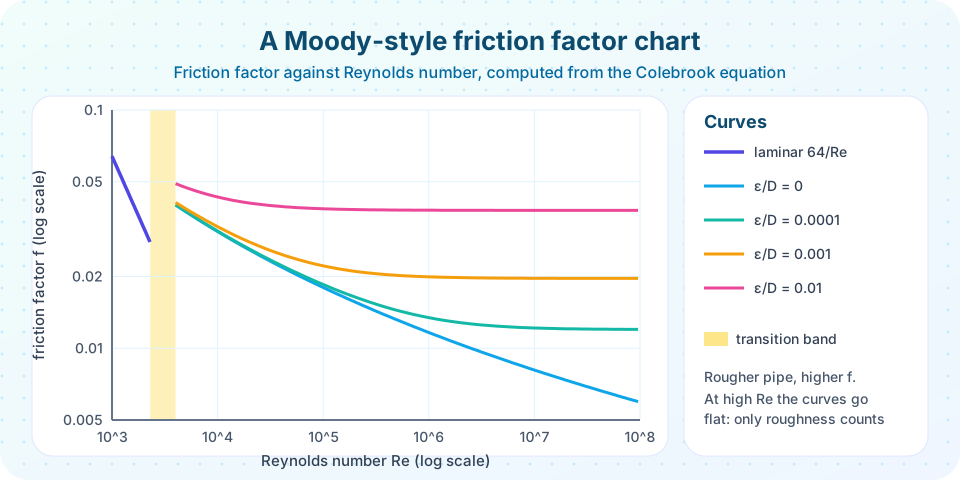
The chart in the picture plots f against Re on logarithmic axes:
- For
Re < 2,300the straight laminar linef = 64/Re. - A shaded transition band between 2,300 and 4,000 where the value is uncertain.
- For
Re > 4,000a family of curves, one for eachε/D. The lowest curve is the smooth-pipe limit. The curves become horizontal at highRe: the fully rough regime.
You enter with Re and ε/D, read off f, then use Darcy-Weisbach.
The Colebrook and Haaland equations
Reading a chart by eye is imprecise and cannot be used in code. The Colebrook equation (1939) describes the curves exactly:
1 / √f = −2 log₁₀( (ε/D) / 3.7 + 2.51 / (Re √f) )
It is implicit: f appears on both sides, so you solve by iteration. Start with f = 0.02, evaluate the right side to get a new f, and repeat. It converges in a few steps.
Haaland's explicit approximation (1983) is accurate to within about 2 percent for turbulent flow:
1 / √f = −1.8 log₁₀( ((ε/D)/3.7)^1.11 + 6.9/Re )
It is perfect for a first estimate or a spreadsheet.
A worked example
Water at 20 °C (ρ = 998 kg/m³, μ = 1.002 × 10⁻³ Pa·s) flows at V = 2 m/s in a commercial steel pipe, D = 100 mm, L = 100 m.
- Reynolds number:
Re = 998 × 2 × 0.1 / 1.002 × 10⁻³ ≈ 199,000. Turbulent. - Relative roughness:
ε/D = 0.045 / 100 = 0.00045. - Colebrook gives
f ≈ 0.0186. Haaland gives0.0184. - Head loss:
h_f = f (L/D) V²/(2g) = 0.0186 × 1,000 × 4 / 19.62 ≈ 3.8 m. - Pressure drop:
Δp = ρ g h_f ≈ 998 × 9.81 × 3.79 ≈ 37 kPa.
So moving this water 100 m costs roughly 3.8 meters of head, about 0.37 bar.
The three standard problems
Pipe flow problems come in three flavors, and the difficulty differs:
- Find the head loss given
Q(orV),D,L,ε. Easy: computeRe,f, thenh_f. - Find the flow rate given
h_f,D,L,ε.Vis unknown, soReandfare unknown. Iterate: guessf, computeV, updateReandf, repeat. - Find the diameter given
Q,h_f,L,ε.Dappears inRe,ε/Dand the loss formula. Iterate onD, or use a solver.
Computers make types 2 and 3 as easy as type 1.
Common misconceptions
"Rougher pipe means more loss at any speed." At low Reynolds numbers roughness hides in the viscous sublayer and has little effect. It matters most at high Re.
"The friction factor is a constant of the pipe." It changes with Re until the fully rough limit is reached. Reusing f from another flow rate is a common error.
"Fanning and Darcy friction factors are the same." They differ by a factor of 4 (f_Darcy = 4 f_Fanning). This course always uses Darcy.
Try it
First, solve Colebrook by iteration, compare it with Haaland, and compute the worked-example head loss.
Press Run (or Ctrl + Enter) to see the result here.
Program input · what you'd type while the program runs
Type the answers before you press Run, one per line. Each time the program reads a line (with input()), it gets the next line from this box.
Second, rebuild the Moody chart yourself. Change the list of roughness values to see how the family of curves moves.
Press Run (or Ctrl + Enter) to see the result here.
Program input · what you'd type while the program runs
Type the answers before you press Run, one per line. Each time the program reads a line (with input()), it gets the next line from this box.
Check your understanding
Quick check · 5 questions
of 5 answered You scored / 5 · perfect!
-
1. What is the relative roughness of a 50 mm commercial steel pipe (eps = 0.045 mm)?
eps/D = 0.045 mm / 50 mm = 0.0009. -
2. In the fully rough regime the friction factor depends on:
At very high Re the curves go flat, so f is set by the relative roughness alone. -
3. Why is the Colebrook equation solved by iteration?
The unknown f is inside a logarithm on the right-hand side, so it is implicit and needs repeated substitution. -
4. Which problem needs iteration even with a computer-free Moody chart?
When V is unknown, Re and therefore f are unknown, so you guess and refine. -
5. A Fanning friction factor is 0.005. What is the Darcy factor?
f_Darcy = 4 f_Fanning = 0.02.
Summary
- Turbulent pipe friction depends on
Reandε/D; roughness matters only when the viscous sublayer is thin. - Use the Moody chart, the implicit Colebrook equation or the explicit Haaland approximation.
- The standard workflow:
Re,ε/D,f,h_f = f (L/D) V²/2g. - Flow-rate and diameter problems need iteration.
- This course uses the Darcy friction factor.
Track your progress
Create a free account to tick off lessons and pick up where you left off on any device.
of Fluid Mechanics lessons completed