


















Lesson 24 of 44 · Dimensional Analysis
Similarity and model testing
How engineers test small models of ships, cars and aircraft: geometric, kinematic and dynamic similarity, Froude and Reynolds scaling and what to do when they conflict.
A shipbuilder cannot launch a hundred test hulls. An aircraft maker cannot crash a wing to see where the air separates. Instead they build a model, test it in a tank or a wind tunnel, and then predict what the prototype, the real thing, will do.
The model result is only trustworthy if the two flows are similar. This lesson explains what similarity means, how to scale speeds and forces, and what to do when the physics will not let you match everything at once.
What you will learn
- The three kinds of similarity and what each requires.
- How to scale speed and force using the Froude and Reynolds rules.
- Why a model often cannot match every dimensionless group.
- How to turn model measurements into prototype predictions.
Key terms
Geometric similarity: the model has the same shape as the prototype, all lengths scaled by one factor λ = L_p / L_m.
Kinematic similarity: velocities at corresponding points are in the same direction and in a constant ratio.
Dynamic similarity: forces at corresponding points are in a constant ratio. It needs the relevant dimensionless groups to be equal.
Scale ratio: λ, the prototype length divided by the model length (for example 25 for a 1:25 model).
Three levels of similarity
- Geometric. Every length on the model is the prototype length divided by
λ, including the roughness of the surface. Angles are unchanged. A model with the wrong shape tells you about the wrong flow. - Kinematic. If the shapes match, then flow patterns match when streamlines have the same form at corresponding points. The velocity at each point is the prototype value times a fixed constant.
- Dynamic. Forces are in the same ratios. This is the hard one.
Geometric similarity you build into the model. Dynamic similarity is a physics requirement: if the problem's dimensionless groups, found by the Pi method, are equal for model and prototype, then the dimensionless result Π₁ = φ(Π₂, …) is the same, and kinematic similarity follows. The recipe is therefore:
- Find the groups for the problem.
- Choose the model speed (and fluid) so the important group matches.
- Measure the dimensionless output on the model.
- Convert back to dimensional values for the prototype.
Froude scaling: ships and open channels
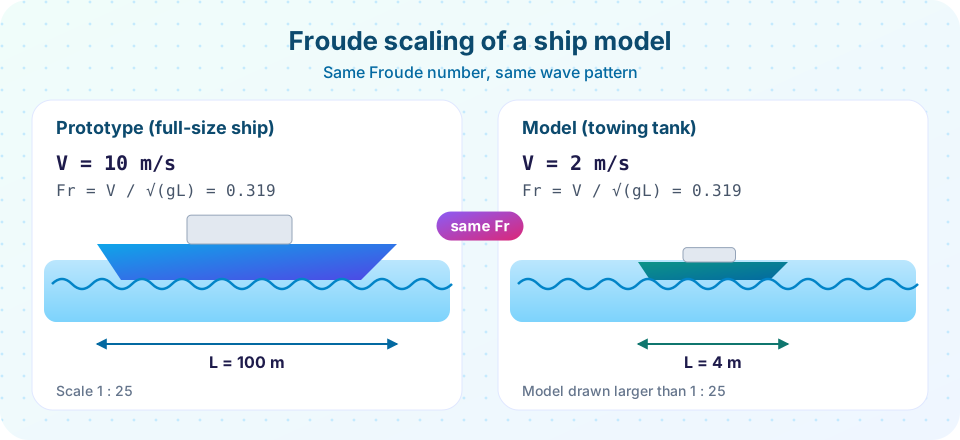
When gravity drives the flow, as with waves on water, the Froude number must match: V_m / √(g L_m) = V_p / √(g L_p). Gravity is the same for both, so
V_m = V_p / √λ.
For the ship in the figure, V_p = 10 m/s and λ = 25, so V_m = 10/5 = 2 m/s. Other quantities follow from the scale ratio when the same fluid is used (both in water):
| Quantity | Scale (prototype / model) |
|---|---|
| Length | λ |
| Speed | λ^½ |
| Time | λ^½ |
| Force | λ³ |
| Power | λ^3.5 |
A model force of 20 N therefore means a prototype force of 20 × 25³ = 312,500 N. This works because the dimensionless force coefficient F / (ρ V² L²) is the same for both flows, and with equal ρ, V² ∝ L gives F ∝ L³.
Strictly, a ship also feels viscous friction, which depends on Reynolds number. Naval architects split the drag into a wave part (scaled by Froude) and a friction part (computed separately), a method pioneered by William Froude in the nineteenth century.
Reynolds scaling: wind tunnels and pipes
When viscosity dominates, as around a car or in a pipe, the Reynolds number must match: V_m L_m / ν_m = V_p L_p / ν_p.
If the model is tested in the same fluid, then V_m = V_p λ. A smaller model needs a faster flow. That is the problem.
Worked example: a car in a wind tunnel. A prototype car, L_p = 4 m, drives at V_p = 30 m/s in air with ν = 1.5 × 10⁻⁵ m²/s. A 1:5 model has L_m = 0.8 m.
- Same air:
V_m = 30 × 5 = 150 m/s. In air at 20 °C that is a Mach number of about 0.44, so compressibility would corrupt the result. A new group has entered, and we cannot match it. - Water instead of air:
ν_water ≈ 1.0 × 10⁻⁶ m²/s, soV_m = 30 × 5 × (1.0×10⁻⁶ / 1.5×10⁻⁵) = 10 m/s. A water tunnel at 10 m/s is easy to build.
Force then scales through the force coefficient: F_p / F_m = (ρ_p / ρ_m)(V_p / V_m)²(L_p / L_m)² = (1.2/998)(3)²(5)² ≈ 0.27. The full-size car in air feels only about a quarter of the force measured on the model in water, although it is five times larger. Fluid density does that.
Incomplete similarity
A real model usually cannot match all groups at once.
- Matching both
ReandFrwould needν_m / ν_p = λ^1.5, so forλ = 25a model fluid 125 times less viscous than water. No such liquid exists. - Matching
ReandMafor high-speed aircraft needs impossible conditions unless the tunnel changes the gas temperature and pressure (cryogenic and pressurized wind tunnels do exactly that).
The usual response is to match the group that dominates the physics and manage the others:
- Ships: match
Fr, then correct the friction drag with a Reynolds-based formula. - Rivers and harbors: use distorted models with a larger vertical than horizontal scale, and tune the roughness.
- Low-speed aerodynamics: match
Reas closely as possible. Above a certainRemany flows become insensitive to it (the drag coefficient of a bluff body hardly changes), so an approximate match is enough. - Cavitation tests: match the cavitation number
σ = (p − p_v) / (½ ρ V²).
Always state which groups were matched and which were not. An honest model test comes with a list of the mismatched groups.
Common misconceptions
"A smaller model needs a slower flow." For Reynolds scaling the opposite is true: smaller means faster. For Froude scaling a smaller model is indeed slower, which is why the rule matters.
"Geometric similarity is enough." A model with the right shape but the wrong Reynolds number can have a different flow pattern, because laminar and turbulent flows around the same body can behave very differently.
"Forces scale with length squared." Only if speed is fixed. The correct scaling depends on which group is matched: λ³ for Froude scaling in the same fluid, other values otherwise.
Try it
The first example scales a model test for you. Change lam, the speeds and the fluids and read off the model conditions and the prototype force.
Press Run (or Ctrl + Enter) to see the result here.
Program input · what you'd type while the program runs
Type the answers before you press Run, one per line. Each time the program reads a line (with input()), it gets the next line from this box.
The second example is a live explorer. Drag the slider to change the scale ratio and watch the two scaling rules diverge: the Froude-matched model slows down while the Reynolds-matched model must speed up.
Check your understanding
Quick check · 5 questions
of 5 answered You scored / 5 · perfect!
-
1. A 1:16 ship model is tested using Froude scaling. The prototype speed is 12 m/s. What is the model speed?
V_m = V_p / sqrt(lambda) = 12 / 4 = 3 m/s. -
2. In the same fluid, how does force scale (prototype over model) under Froude scaling?
The force coefficient F/(rho V^2 L^2) is equal, and V^2 is proportional to L, so F is proportional to L^3. -
3. Why is a small wind-tunnel model in air often hard to match by Reynolds number?
Re matching in the same fluid gives V_m = V_p * lambda, so the flow can approach the speed of sound and Mach number then matters. -
4. What does dynamic similarity require?
When the governing dimensionless groups are equal, the force coefficients are equal and the flows are dynamically similar. -
5. A designer cannot match both Re and Fr for a ship model. What is the standard practice?
Waves (Froude) dominate ship resistance, so the model is run at the Froude-scaled speed and the friction part is computed with a Reynolds-based formula.
Summary
- Geometric similarity means the same shape; dynamic similarity means equal dimensionless groups.
- Froude scaling (gravity-driven flows) gives
V_m = V_p / √λand force scalingλ³in the same fluid. - Reynolds scaling (viscous flows) gives
V_m = V_p λ ν_m/ν_p: smaller models need faster flows, unless you switch to a fluid with a smaller kinematic viscosity, such as water instead of air. - Models usually cannot match every group, so match the dominant one and state what is mismatched.
Next: Chapter 5 review
Track your progress
Create a free account to tick off lessons and pick up where you left off on any device.
of Fluid Mechanics lessons completed