


















Lesson 37 of 44 · Compressible Flow and Machinery
Nozzles and shock waves
See how back pressure changes the flow in a converging-diverging nozzle, and use the normal shock relations to find the jump in Mach number, pressure and temperature.
An isentropic nozzle is a clean idea, but a real nozzle exhausts into a pressure it did not choose. The back pressure p_b of the surrounding region decides what happens inside. Sometimes the answer is a smooth flow. Sometimes it is a shock wave, a thin region, only a few molecular mean free paths thick, across which the gas properties jump.
This lesson explains the regimes of nozzle flow and gives the formulas for the simplest kind of shock, the normal shock that stands perpendicular to the flow.
What you will learn
- The regimes of a converging-diverging nozzle as the back pressure falls.
- What a normal shock is and why it cannot reverse.
- How to compute downstream Mach number and property ratios.
- Why shocks lose stagnation pressure.
Key terms
Back pressure (p_b): the pressure in the region the nozzle exhausts into.
Normal shock: a shock wave perpendicular to the flow direction; the flow goes from supersonic to subsonic across it.
Overexpanded / underexpanded: exit pressure below / above the back pressure for a choked nozzle.
Stagnation pressure loss: p₀₂ < p₀₁ across a shock, a measure of the irreversibility.
How back pressure shapes nozzle flow
Take a nozzle with exit-to-throat area ratio A_e/A* = 1.6875, fed from a large chamber at stagnation pressure p₀. The designer wants the supersonic exit state Ma_e = 2, which has p_e/p₀ = 0.128. Lower the back pressure from p₀ downward and the flow goes through the following stages:
Back pressure ratio p_b/p₀ |
What happens |
|---|---|
| 1.0 | no flow |
| from 1.0 to about 0.909 | subsonic everywhere; the throat is below Ma = 1, the nozzle behaves as a venturi |
| 0.909 | the throat just reaches Ma = 1; subsonic flow in the diverging part (exit Ma = 0.372); the nozzle is choked |
| between 0.909 and 0.575 | choked; a normal shock stands inside the diverging part and moves toward the exit as p_b drops |
| 0.575 | the shock reaches the exit plane |
| between 0.575 and 0.128 | choked; the flow in the nozzle is fully supersonic, but the exit pressure is below the back pressure, so oblique shocks form outside (overexpanded) |
| 0.128 | design condition: no shocks, perfectly expanded |
| below 0.128 | underexpanded; expansion waves form outside the exit |
Once the nozzle is choked (p_b/p₀ below 0.909), the mass flow rate no longer changes. The value 0.575 comes from the normal shock at the exit: the design exit pressure ratio 0.128 times the shock pressure ratio 4.5.
The normal shock relations
Across a stationary normal shock mass, momentum and energy are conserved, while entropy rises. For an ideal gas with γ = 1.4, if the upstream Mach number is Ma₁ (which must exceed 1):
Ma₂² = (1 + 0.2 Ma₁²) / (1.4 Ma₁² − 0.2)
p₂ / p₁ = 1 + (7/6)(Ma₁² − 1)
ρ₂ / ρ₁ = 2.4 Ma₁² / (0.4 Ma₁² + 2)
T₂ / T₁ = (p₂/p₁) / (ρ₂/ρ₁)
The stagnation temperature does not change across the shock (no heat is added), but the stagnation pressure falls.
For Ma₁ = 2:
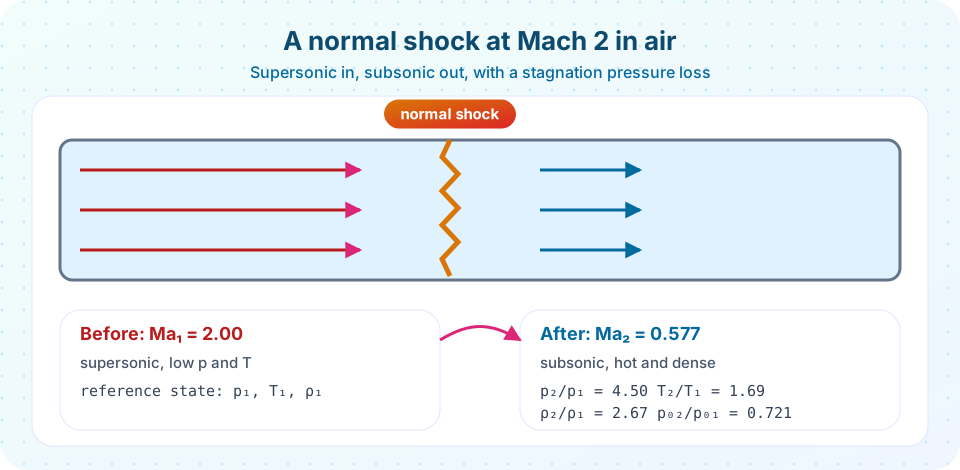
Ma₂ = 0.577(subsonic),p₂/p₁ = 4.50,ρ₂/ρ₁ = 2.67,T₂/T₁ = 1.69,p₀₂/p₀₁ = 0.721.
So a shock slows, compresses and heats the gas, and it destroys 28 percent of the stagnation pressure, energy that is no longer available to do useful work. This is why shocks in engine inlets are carefully managed.
Some facts about shocks:
- A shock can only go from supersonic to subsonic. The reverse (an "expansion shock") would decrease entropy and violates the second law.
- The stronger the shock (larger
Ma₁), the larger the pressure jump and the larger the loss. AsMa₁ → ∞,ρ₂/ρ₁approaches 6 forγ = 1.4, whileMa₂approaches 0.378. - A weak shock (
Ma₁just above 1) is nearly isentropic.
Real bodies at supersonic speed also produce oblique shocks, which are inclined to the flow and weaker than normal shocks; the flow behind them is often still supersonic. Wedge angles, shock angles and Ma are linked by the θ-β-Ma relation, which is a topic for a compressible-flow or aerodynamics course.
Common misconceptions
"A shock wave is just a loud sound." A shock is a thin region with a huge change in pressure, density and temperature. The sonic boom is the pressure signature of a shock reaching the ground.
"Temperature stays constant across a shock." Static temperature rises (1.69 times at Mach 2). Only the stagnation temperature stays constant.
"A choked nozzle has a fixed exit velocity." The mass flow is fixed by the throat; the exit conditions still depend on the back pressure and shock position.
Try it
First, a normal shock calculator for a range of Mach numbers.
Press Run (or Ctrl + Enter) to see the result here.
Program input · what you'd type while the program runs
Type the answers before you press Run, one per line. Each time the program reads a line (with input()), it gets the next line from this box.
Second, compute the back-pressure thresholds of the nozzle in the table above.
Press Run (or Ctrl + Enter) to see the result here.
Program input · what you'd type while the program runs
Type the answers before you press Run, one per line. Each time the program reads a line (with input()), it gets the next line from this box.
Check your understanding
Quick check · 5 questions
of 5 answered You scored / 5 · perfect!
-
1. A normal shock forms in air with upstream Mach number 2. What is the downstream Mach number?
Ma2 = sqrt((1 + 0.2 x 4) / (1.4 x 4 - 0.2)) = sqrt(1.8/5.4) = 0.577. -
2. Which quantity stays the same across a normal shock?
The energy equation gives constant stagnation temperature; stagnation pressure drops because entropy rises. -
3. Why can a shock only go from supersonic to subsonic?
Entropy rises across a normal shock; the reverse process would decrease it. -
4. A choked nozzle's back pressure is lowered further. The mass flow rate:
The throat is already sonic; pressure signals from downstream cannot travel upstream through it. -
5. At the design condition of a nozzle, the exit pressure equals:
At design the flow is perfectly expanded: the exit pressure equals the ambient back pressure.
Summary
- Back pressure decides nozzle behavior: subsonic, choked with an internal shock, overexpanded, designed or underexpanded.
- Normal shock (air,
Ma₁ = 2):Ma₂ = 0.577,p₂/p₁ = 4.5,ρ₂/ρ₁ = 2.67,T₂/T₁ = 1.69,p₀₂/p₀₁ = 0.721. - Shocks go only from supersonic to subsonic and always lose stagnation pressure.
- Stagnation temperature is constant across a shock.
Next: Pumps and turbines
Track your progress
Create a free account to tick off lessons and pick up where you left off on any device.
of Fluid Mechanics lessons completed