


















Lesson 40 of 44 · Projects and Practice
Project: Design a pumped pipeline
A complete worked project: size a pump for a 500 m water pipeline, add friction and fitting losses, compute power, and choose the diameter that minimizes cost.
Engineers rarely get a tidy textbook problem. They get a goal ("move 20 liters per second of water to the storage tank") and some constraints, and then they must make choices. This project walks through one realistic design from start to finish, using everything from Chapters 5, 6 and 8: Reynolds number, friction factor, minor losses, the energy equation, pump power and the operating point.
What you will learn
- How to set up and solve a complete pipeline problem step by step.
- How to turn the result into a pump specification.
- How to compare pipe diameters on cost, not just on head.
- How to check your own answer with sanity rules.
Key terms
Design flow: the flow rate the system must deliver.
Total dynamic head: the head the pump must supply, static lift plus all losses.
Life-cycle cost: the sum of the capital cost of pipe and pump and the cost of energy over the system's life.
Sanity check: a quick estimate to see whether an answer is the right size.
The problem
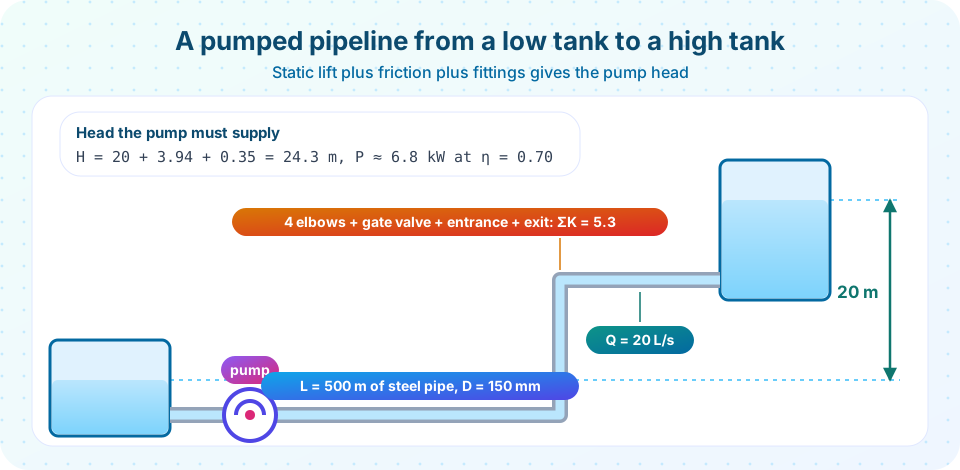
A farm needs to pump Q = 20 L/s of water from a low reservoir to a storage tank. The tank's water surface is 20 m above the reservoir's. The pipeline is L = 500 m of commercial steel pipe with ε = 0.045 mm. The fittings are a sharp-edged entrance (K = 0.5), four standard elbows (4 × 0.9), one gate valve (0.2) and an exit (1.0), so Σ K = 5.3. Water is at 20 °C. Assume an overall pump and motor efficiency of 70 percent.
Find the pump head, the power needed, and the best pipe diameter.
Step 1: pick a trial diameter
Velocities of 1 to 2 m/s are common for water supply: slower wastes pipe, faster wastes energy. Try D = 150 mm, which gives V = Q / A = 0.020 / 0.01767 = 1.13 m/s. Good.
Step 2: Reynolds number and friction factor
Re = ρ V D / μ = 998 × 1.13 × 0.15 / 1.002 × 10⁻³ ≈ 1.7 × 10⁵: turbulent. The relative roughness is ε/D = 0.045/150 = 3 × 10⁻⁴. The Colebrook equation gives f ≈ 0.0181.
Step 3: head losses
- Velocity head:
V²/2g = 1.13² / 19.62 = 0.0653 m. - Friction:
h_f = f (L/D) V²/2g = 0.0181 × 3,333 × 0.0653 ≈ 3.9 m. - Fittings:
h_m = Σ K · V²/2g = 5.3 × 0.0653 ≈ 0.35 m.
Step 4: pump head and power
The energy equation between the two free surfaces, with the pump adding head h_p, reduces to h_p = Δz + h_f + h_m = 20 + 3.94 + 0.35 ≈ 24.3 m.
The hydraulic power is P_h = ρ g Q H = 998 × 9.81 × 0.020 × 24.3 ≈ 4.8 kW, and the electrical input power is P_h / η = 4.8 / 0.70 ≈ 6.8 kW.
Step 5: sanity checks
- The static lift (20 m) is 82 percent of the total, so the losses are a modest addition. That makes sense for a velocity near 1 m/s.
- Per 100 m of pipe, the friction head is about
0.8 m, a typical figure for a water main at this speed. - Rule of thumb: hydraulic power in kW is about
Q (L/s) × H (m) / 102, which gives20 × 24.3 / 102 ≈ 4.8 kW. It agrees with the full calculation, so the answer is the right size.
Step 6: choose the diameter
A smaller pipe is cheaper but needs more pump head and power. A larger pipe costs more but saves energy. The best choice minimizes the annual cost. The code below adds an assumed pipe price (which you should replace with real quotes) and an assumed electricity price.
Common misconceptions
"The pump head equals the static lift." The pump must also overcome friction and fitting losses. For small diameters, those can exceed the lift many times over.
"Choose the pipe that makes the pump smallest." Pumps and pipes are only part of the bill. Energy over 20 years often costs more than the equipment.
"One calculation is enough." Real designs check several flows (peak and average), fouling that increases roughness, and pump wear.
Try it
First, the full solution as code. Change Q, L, D or K and watch the head and power respond.
Press Run (or Ctrl + Enter) to see the result here.
Program input · what you'd type while the program runs
Type the answers before you press Run, one per line. Each time the program reads a line (with input()), it gets the next line from this box.
Second, a cost comparison. The prices are assumptions made up for this exercise: pipe at 120 per meter for a 150 mm size and scaling with D^1.3, written off over 10 years, and electricity at 0.12 per kWh for 8,000 hours a year. Replace them with real figures for a real project. With these made-up prices the minimum falls near 140 mm, close to the 150 mm trial size; different prices would move it.
Press Run (or Ctrl + Enter) to see the result here.
Program input · what you'd type while the program runs
Type the answers before you press Run, one per line. Each time the program reads a line (with input()), it gets the next line from this box.
Check your understanding
Quick check · 5 questions
of 5 answered You scored / 5 · perfect!
-
1. In the design, what makes up the pump head?
Between two free surfaces h_p = delta z + h_f + h_m. -
2. If the diameter is reduced from 150 mm to 100 mm at the same flow, what happens to the velocity?
V is proportional to 1/D^2, so (150/100)^2 = 2.25. -
3. Why does the total annual cost curve have a minimum?
A bigger pipe costs more to buy but lowers friction, so the energy bill falls; the sum has a minimum. -
4. The hydraulic power is 4.8 kW and the overall efficiency is 0.70. The input power is about:
P_in = 4.8 / 0.70 = 6.86 kW. -
5. Which check best shows a head-loss answer is the right size?
At about 1 m/s a water main loses of the order of 1 m per 100 m; a result far from that suggests a mistake.
Summary
- Pipeline design follows a fixed recipe: velocity,
Re,f, losses, pump head, power. - Pump head = static lift + friction + fittings; electrical power =
ρ g Q H / η. - The best diameter balances capital cost against energy cost; sanity checks catch mistakes.
Track your progress
Create a free account to tick off lessons and pick up where you left off on any device.
of Fluid Mechanics lessons completed