


















Lesson 6 of 44 · Fluid Properties and Statics
Fluids at Rest: Chapter Overview
A guided overview of fluid statics: why pressure grows with depth, how dams and gates are loaded, and why ships float. See what each lesson covers.
A fluid at rest is the simplest fluid problem there is, and one of the most useful. No motion means no shear stress, and no shear stress means the only thing a fluid can do to a surface is push on it with pressure. From that single fact you can design dams, size hydraulic jacks, read a barometer, and understand why an iron ship floats. This chapter also introduces the properties (density, viscosity, surface tension, vapor pressure) that every later chapter relies on.
What you will learn
- Why a static fluid carries only normal stress (pressure) and why pressure acts equally in all directions.
- How the chapter's lessons build from properties, to pressure, to forces on surfaces, to buoyancy.
- The big equation that appears in every statics problem.
Key terms
Pressure (p): normal force per unit area acting on a surface in a fluid. Unit: Pa.
Hydrostatic: describing a fluid at rest, where pressure changes only with height.
Gauge pressure: pressure measured relative to the local atmosphere.
Buoyant force: the upward force on a submerged or floating body.
The big picture
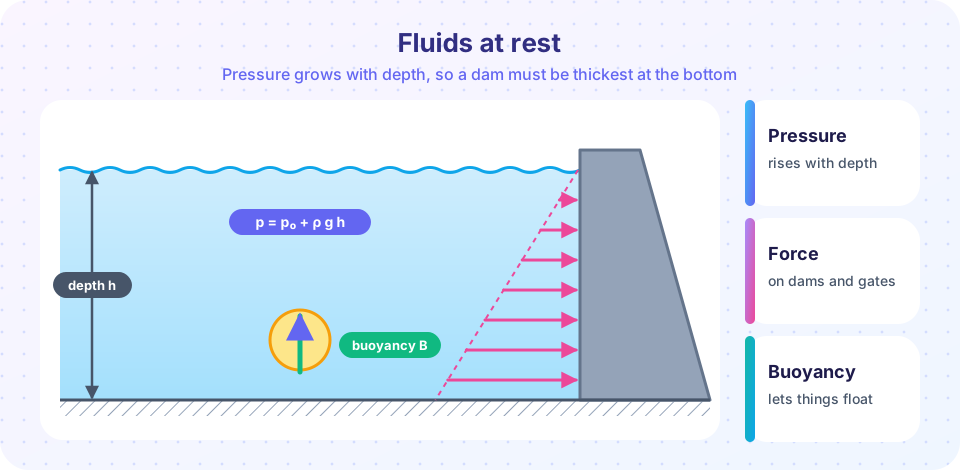
Imagine a tiny cube of water floating motionless in a tank. Nothing is accelerating it, so the forces on it must balance. Because water cannot carry shear when at rest, the forces on each face are purely normal. A short calculation (see Hydrostatic Pressure and Manometers) shows that this makes the pressure at a point the same in every direction, a result known as Pascal's law. Balance the vertical forces too, including the cube's own weight, and you get the hydrostatic equation
dp/dz = −ρ g
Pressure rises as you go down, at a rate set by the fluid's density and gravity. Everything in this chapter is a consequence.
From properties to floating ships
Forces and floating
Why it matters
The lessons in this chapter
| Lesson | What you will do |
|---|---|
| Fluid Properties | Learn density, specific gravity, viscosity, surface tension and vapor pressure, with typical values. |
| Hydrostatic Pressure and Manometers | Derive p = p₀ + ρgh, convert between absolute and gauge, and read manometers. |
| Forces on Submerged Surfaces | Find the resultant force and its line of action on gates and dams. |
| Buoyancy and Stability | Apply Archimedes' principle and test whether a floating body stays upright. |
| Chapter 2 Review | Consolidate with a recap and a mixed quiz. |
A quick feel for the numbers
The calculation below estimates the force of 1 m of water over a door-sized area and the pressure at the Challenger Deep, the deepest known point in the ocean (about 10 900 m). Seawater is slightly denser than fresh water and compresses a little with depth, so treat the second result as an estimate.
Press Run (or Ctrl + Enter) to see the result here.
Program input · what you'd type while the program runs
Type the answers before you press Run, one per line. Each time the program reads a line (with input()), it gets the next line from this box.
Press Run (or Ctrl + Enter) to see the result here.
Program input · what you'd type while the program runs
Type the answers before you press Run, one per line. Each time the program reads a line (with input()), it gets the next line from this box.
The second run foreshadows buoyancy: the net upward force comes from the pressure difference between the bottom and top faces and equals the weight of the displaced fluid.
Common misconceptions
"Pressure depends on the shape or width of the container." It depends only on depth, fluid density and gravity. A narrow tube and a wide lake give the same pressure at the same depth.
"Pressure only pushes down." At a point in a fluid, pressure acts equally in all directions, so it pushes sideways and upward too.
Check your understanding
Quick check · 4 questions
of 4 answered You scored / 4 · perfect!
-
1. Why does a fluid at rest exert only normal forces on a surface?
Shear stress needs velocity gradients; at rest there are none, so only pressure (a normal stress) remains. -
2. What does the hydrostatic equation dp/dz = −ρg tell you?
The negative sign means pressure falls with increasing height z, so it rises with depth. -
3. Two vertical tubes, one narrow and one wide, are open at the top and filled with water to the same depth. Compared with the narrow tube, the pressure at the bottom of the wide tube is
Hydrostatic pressure depends only on depth, density and g, not on the width. -
4. Which lesson of this chapter covers Archimedes' principle?
Buoyancy and Stability applies Archimedes' principle to floating bodies.
Summary
- A fluid at rest carries only pressure, which acts equally in all directions.
- The hydrostatic equation
dp/dz = −ρ ggives pressure that rises linearly with depth in a constant-density fluid. - The chapter covers properties, pressure and manometers, forces on surfaces, and buoyancy.
- The same pressure difference between the bottom and top faces of a body causes buoyancy.
Next: Fluid Properties
Track your progress
Create a free account to tick off lessons and pick up where you left off on any device.
of Fluid Mechanics lessons completed