


















Lesson 15 of 44 · Control Volumes and Conservation
Jets, Plates and Vanes
Use the momentum equation to find the force of a water jet on fixed and moving plates and curved vanes, from fire hoses to Pelton wheels, with calculators.
A fire hose can knock a person over. A Pelton wheel in a mountain hydroelectric plant turns jet momentum into electricity. A garden sprinkler spins itself. These are all applications of the momentum equation to a free jet striking or leaving a surface. Because a jet in air is at atmospheric pressure everywhere, pressure forces drop out and the problem reduces to pure momentum change, which makes jets the cleanest examples in the chapter.
What you will learn
- Compute the force of a jet on a fixed flat plate and on a curved vane.
- Account for a moving plate or vane by using relative velocity.
- Distinguish a single moving plate from a series of vanes on a wheel.
- Estimate the power and efficiency of a simple impulse machine.
Key terms
Free jet: a stream of fluid in air, at atmospheric pressure throughout.
Vane: a curved surface that turns a jet.
Relative velocity: the jet's velocity as seen by a moving vane: V − u.
Impulse turbine: a machine (such as a Pelton wheel) that extracts energy from jet momentum.
A jet on a fixed flat plate
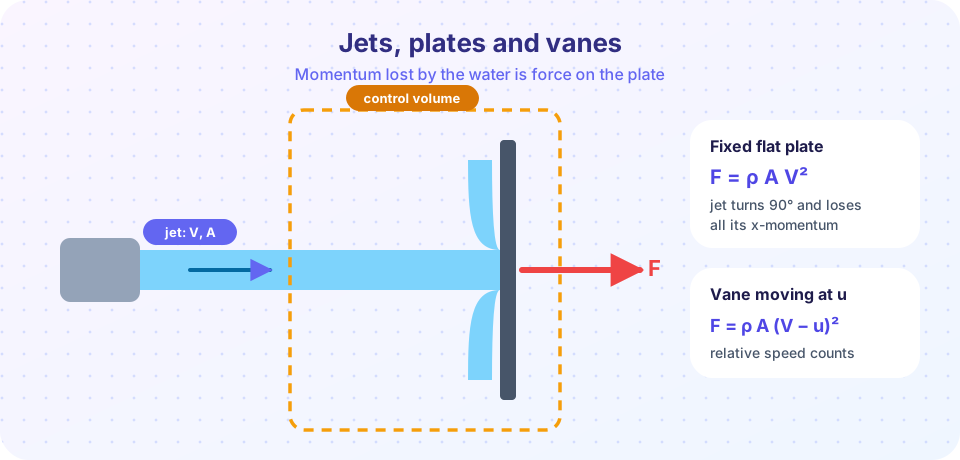
A jet of area A and speed V strikes a flat plate perpendicular to it. Draw a control volume around the impact. The jet enters with x-momentum ṁ V per second; it leaves sideways along the plate with zero x-velocity. Pressure is atmospheric on the whole control surface, so the only horizontal force on the fluid is the plate's reaction R_x:
−F_plate = ṁ (0 − V) ⇒ F = ṁ V = ρ A V²
Here ṁ = ρ A V is the jet's mass flow. The force on the plate is F = ρ A V².
Worked example. A water jet of diameter 25 mm at 20 m/s hits a plate: A = 4.909 × 10⁻⁴ m², F = 998 × 4.909 × 10⁻⁴ × 20² = 196 N. That is the weight of a 20 kg mass.
A jet on a fixed curved vane
If the vane turns the jet through an angle θ (from its original direction) and friction is negligible, the speed leaving relative to the vane is still V (Bernoulli, atmospheric pressure all along). The momentum change along the original direction is ṁ V (1 − cos θ):
F_x = ρ A V² (1 − cos θ)
θ = 90°(flat plate, flow leaves sideways):F = ρ A V².θ = 180°(full reversal):F = 2 ρ A V², the largest possible force with a fixed vane. For the jet above, 392 N.
A cup-shaped Pelton bucket turns the jet nearly 180°, which is why it is so effective.
Moving plates and vanes
If the vane moves away from the nozzle at speed u, the jet reaches it with relative speed V − u.
- A single moving plate: not all the jet's flow reaches it, because the plate runs away from the water. The mass flow hitting the plate is
ρ A (V − u), soF = ρ A (V − u)². - A series of vanes on a wheel: for a Pelton wheel, one bucket after another intercepts the jet, so the whole jet flow
ρ A Vis used:F = ρ A V (V − u)(1 − cos θ).
For a wheel with θ = 180°, the power delivered to the wheel is
P = F u = 2 ρ A V (V − u) u
This peaks when u = V/2, giving P_max = ½ ρ A V³, which is exactly the jet's kinetic energy per second (½ ṁ V² = ½ ρ A V³). So an ideal Pelton wheel extracts all the jet's energy when buckets run at half the jet speed. Real machines reach 85-90 % efficiency because of friction, splash, and imperfect turning (the buckets turn the jet about 165°, not 180°, so the exit stream clears the next bucket).
Press Run (or Ctrl + Enter) to see the result here.
Program input · what you'd type while the program runs
Type the answers before you press Run, one per line. Each time the program reads a line (with input()), it gets the next line from this box.
The next plot shows how the wheel power changes with bucket speed and turning angle.
Press Run (or Ctrl + Enter) to see the result here.
Program input · what you'd type while the program runs
Type the answers before you press Run, one per line. Each time the program reads a line (with input()), it gets the next line from this box.
Sprinklers and rockets
A lawn sprinkler works the same way: the water leaving the nozzles has angular momentum, so the sprinkler spins the other way. A rocket is the reverse picture: the exhaust leaves at speed V_e relative to the rocket, and the thrust is T = ṁ V_e (plus a pressure term if the exit pressure differs from ambient). The thrust equals the momentum rate of the exhaust, which is why a rocket works in a vacuum: it pushes against its own exhaust, not against the air.
Common misconceptions
"A jet hitting a plate bounces back, so the force is 2ρAV²." For a flat plate, the water spreads sideways. Only a vane that reverses the jet doubles the force.
"A moving plate gets the full jet." The plate escapes from the water; only the relative flow ρ A (V − u) hits it. A wheel of vanes is different because the next vane catches the water the previous one missed.
"Jets need absolute pressure in the momentum equation." In a free jet the pressure is atmospheric on the whole control surface, so gauge pressure is zero.
Check your understanding
Quick check · 5 questions
of 5 answered You scored / 5 · perfect!
-
1. A 30 mm water jet at 15 m/s hits a fixed flat plate head-on. The force is about (ρ = 998 kg/m³)
A = π(0.03)²/4 = 7.07 × 10⁻⁴ m²; F = ρ A V² = 998 × 7.07 × 10⁻⁴ × 225 ≈ 159 N. -
2. Replacing the flat plate with a cup that reverses the jet makes the force
A full reversal doubles the momentum change: F = 2ρAV². -
3. A single flat plate moves away at u = 4 m/s from a 20 m/s jet. The force is proportional to
Both the flow rate hitting the plate and its relative speed scale with V − u. -
4. For an ideal 180° Pelton wheel the power is greatest when the bucket speed is
P = 2ρAV(V − u)u is maximized at u = V/2. -
5. A rocket produces thrust because
Thrust is the rate of momentum given to the exhaust, T = ṁ V_e.
Summary
- Fixed flat plate:
F = ρ A V². Fixed vane turning the jet byθ:F = ρ A V² (1 − cos θ). - A single moving plate uses
F = ρ A (V − u)²; a wheel of vanes usesF = ρ A V (V − u)(1 − cos θ). - An ideal Pelton wheel peaks at
u = V/2and extracts all of the jet's kinetic energy. - Jets in air are at atmospheric pressure, so pressure forces vanish.
Next: Chapter 3 Review
Track your progress
Create a free account to tick off lessons and pick up where you left off on any device.
of Fluid Mechanics lessons completed